


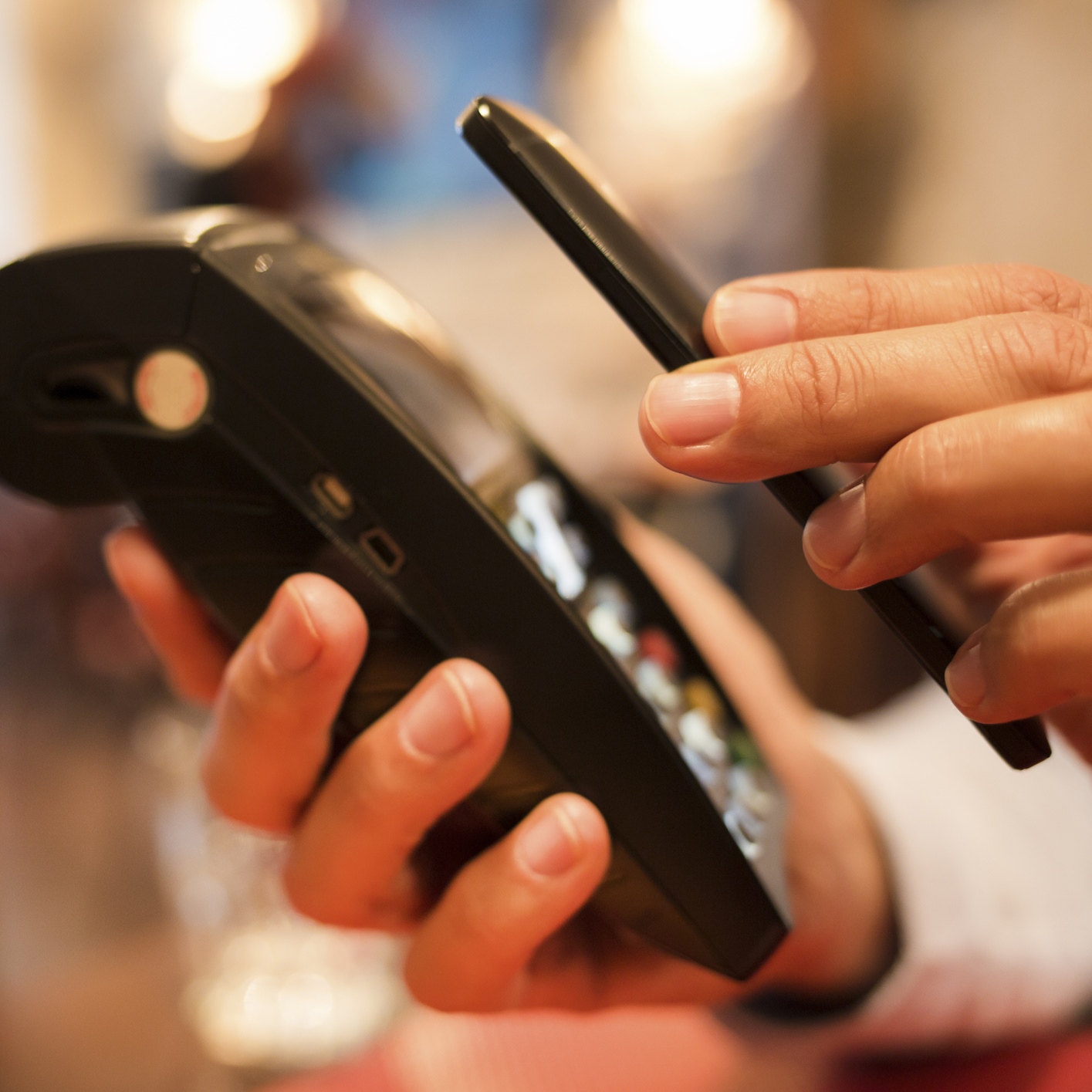
News reports about the 2016 holiday season were dominated by the explosion in online sales. And while that’s absolutely true, the majority of retail sales remains with brick-and-mortar stores. The new (perhaps, last?) frontier for traditional retailers are mobile payment systems that let consumers wave or tap their smartphones to pay at a retail terminal.
Apple Inc. (NASDAQ: AAPL) and Alphabet Inc. (NASDAQ: GOOGL) both recently introduced their mobile payment systems, Apple Pay and Android Pay, in Japan, where the technology has been in use for a dozen years. In 2015, mobile payments accounted for $44 billion in sales in Japan.
Digital transactions accounted for less than 10% of all U.S. retail sales, and that number will only increase to around 10% by 2020. Mobile transaction payments are expected to reach a total of just $27.67 billion in 2016 and grow to $314 billion by 2020, according to research firm eMarketer.
[nativounit]
Worldwide mobile payments are expected to total $780 billion by 2020, according to Taiwan-based research firm TrendForce. According to senior research manager Kelly Hsieh, Apple and Samsung have an advantage:
Among the smartphone makers that are also developing their mobile payment businesses this year, Apple and Samsung are two brands that have an advantage over their competitors. Since Android has over 50% of the mobile OS market share worldwide, Google also has an opportunity to build up an extensive mobile payment ecosystem. Google has recently accelerated the international expansion of its digital wallet platform Android Pay and made a big step forward this December by announcing partnership with major Japanese e-commerce and Internet company Rakuten.
Widespread adoption of mobile payment technology depends the integration of different hardware technologies in encrypted chip design, advances in encryption algorithms and multi-factor authentication methods to increase efficiency in user verification, payment confirmation and secure data transfer, according to TrendForce.
TrendForce also noted that Chinese smartphone makers like Huawei, Xiaomi and Meizu launched near-field communications (NFC) enabled smartphones in 2016 and that in 2017 more than 50% of all smartphone shipments will include NFC modules. The firm believes that NFC chips are “becoming the mainstream solution in mobile payment.” Hshieh says:
On the software end, building NFC modules will need [to] take account of payment app designs. On the hardware end, NFC controller chips will eventually incorporate various types of security-related IC components. For instance, NFC modules can add in sensor chips for fingerprint, iris and fingerprint vein recognition. Having different biometric technologies work together can provide multi-factor authentication for an NFC-based mobile payment system.
[wallst_email_signup]









 Top Gaining Stocks
 Top Losing Stocks