


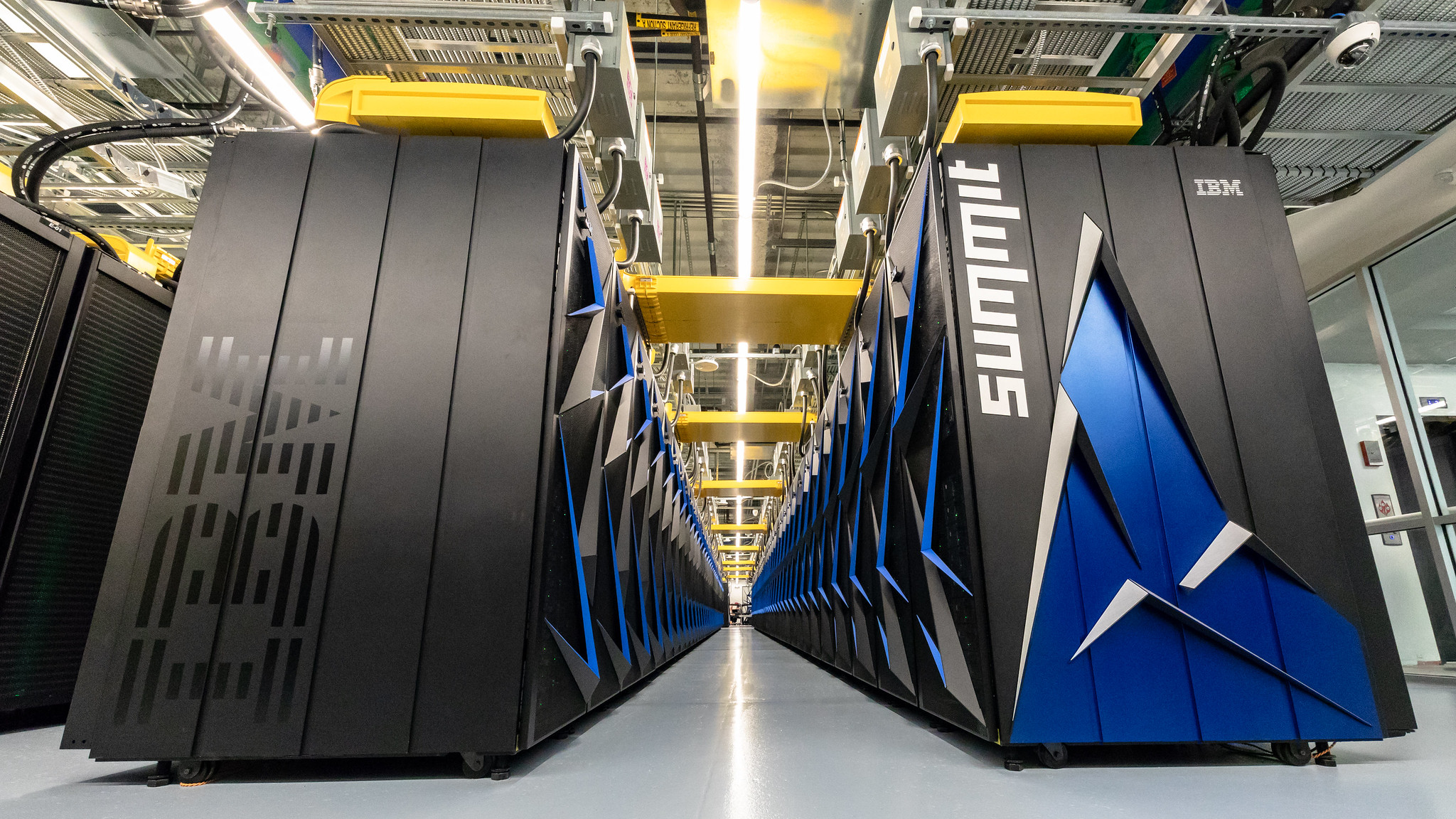
On Monday, the U.S. president announced the formation of a new consortium comprising the White House Office of Science and Technology Policy (OSTP), the Department of Energy and International Business Machines Corp. (NYSE: IBM | IBM Price Prediction) that will provide COVID-19 researchers with access to the world’s most powerful supercomputer. IBM’s Summit supercomputer, which (unofficially) won the title in 2018, could significantly advance the pace of scientific discovery in the fight to stop the coronavirus pandemic.
The consortium includes Amazon.com Inc. (NASDAQ: AMZN), Alphabet Inc. (NASDAQ: GOOGL) and Microsoft Corp. (NASDAQ: MSFT). Other partners include MIT, Rensselaer Polytechnic and U.C.-San Diego, along with five Department of Energy National Laboratories (Argonne, Lawrence Livermore, Los Alamos, Oak Ridge and Sandia), the National Science Foundation’s Pittsburgh Supercomputing Center and NASA.
The COVID-19 High Performance Computing Consortium currently pools 16 systems that together offer over 330 petaflops of supercomputing capacity. One petaflop is equal to one quadrillion floating-point operations per second (flops). The total computing power is equal to that in more than 1.5 million laptops.
The White House announcement emphasized the need for so much computing power:
The sophisticated computing systems available through this Consortium can process massive numbers of calculations related to bioinformatics, epidemiology, molecular modeling, and healthcare system response, helping scientists develop answers to complex scientific questions about COVID-19 in hours or days versus weeks or months.
[nativounit]
IBM’s research director, Dario Gil, commented:
As a powerful example of the potential, IBM’s Summit, the most powerful supercomputer on the planet, has already enabled researchers at the Oak Ridge National Laboratory and the University of Tennessee to screen 8,000 compounds to find those that are most likely to bind to the main “spike” protein of the coronavirus, rendering it unable to infect host cells. They were able to recommend the 77 promising small-molecule drug compounds that could now be experimentally tested. This is the power of accelerating discovery through computation.
Researchers may submit COVID-19 related research proposals to the consortium, where the proposals will be reviewed for matching with computing resources from one of the partner institutions. An expert panel composed of top scientists and computing researchers will work with proposers to assess the public health benefit of the work, with emphasis on projects that can ensure rapid results.
[recirclink id=658306]
[wallst_email_signup]












 Top Gaining Stocks
 Top Losing Stocks