


In 1980, International Business Machines Corp. (NYSE: IBM | IBM Price Prediction) was the eighth largest corporation in the country, according to the Fortune 500. It was bigger than General Electric. No other tech company was in the top 30 companies on the list. In the current list, IBM ranks 49th. It is miles behind Alphabet, Amazon, Apple and a small army of other tech companies. By any measure, IBM is big tech’s largest failure.
[in-text-ad]
IBM is small now. In the recently reported quarter, revenue was flat at $16.7 billion. Apple’s net income was $20.7 billion in its most recent quarter. IBM’s net income was $2.7 billion, up from $2.3 billion in the same period a year ago. James Kavanaugh, IBM senior vice president and chief financial officer, said, “IBM’s revenue growth and operating profit in 2022 demonstrate the strength and multiplier effect of our platform-centric approach to hybrid cloud and AI.” It is tough to support that statement in a review of the financial statements. IBM’s numbers were below consensus estimates. The company laid off 3,900 people. (Click here for the 21 companies making the most profit per second.)
[nativounit]
IBM said it expected only the most modest growth next year. It will need to do better than that to gain on companies it will never catch in either revenue or earnings. Its cloud business is a small fraction of that of leaders Amazon and Microsoft.
[wallst_email_signup]
Did IBM’s failure have to occur? No. It had a massive R&D capacity (perhaps the most impressive in the world) for decades. It could have entered virtually any of today’s largest tech sectors. It not only missed the cloud. It missed the search business, the e-commerce sector and the chance to dominate the global OS systems.
[recirclink id=1183066]
IBM’s years of real success are decades behind it, which will never change.
IBM Is Tech’s Most Beaten-Down Company

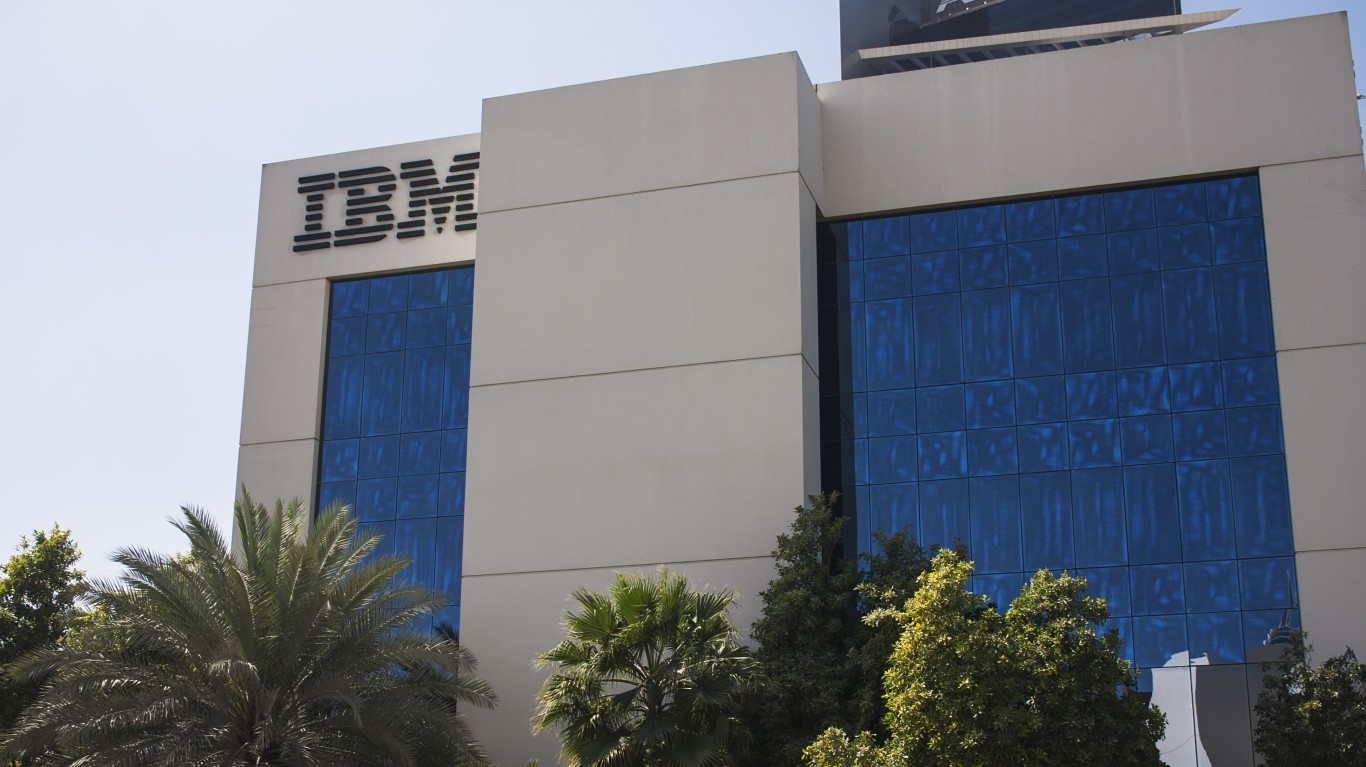
© DKart / Getty Images

Douglas A. McIntyre is the co-founder, chief executive officer and editor in chief of 24/7 Wall St. and 24/7 Tempo. He has held these jobs since 2006.
McIntyre has written thousands of articles for 24/7 Wall St. He is an expert on corporate finance, the automotive industry, media companies and international finance. He has edited articles on national demographics, sports, personal income and travel.
His work has been quoted or mentioned in The New York Times, The Wall Street Journal, Los Angeles Times, The Washington Post, NBC News, Time, The New Yorker, HuffPost USA Today, Business Insider, Yahoo, AOL, MarketWatch, The Atlantic, Bloomberg, New York Post, Chicago Tribune, Forbes, The Guardian and many other major publications. McIntyre has been a guest on CNBC, the BBC and television and radio stations across the country.
A magna cum laude graduate of Harvard College, McIntyre also was president of The Harvard Advocate. Founded in 1866, the Advocate is the oldest college publication in the United States.
TheStreet.com, Comps.com and Edgar Online are some of the public companies for which McIntyre served on the board of directors. He was a Vicinity Corporation board member when the company was sold to Microsoft in 2002. He served on the audit committees of some of these companies.
McIntyre has been the CEO of FutureSource, a provider of trading terminals and news to commodities and futures traders. He was president of Switchboard, the online phone directory company. He served as chairman and CEO of On2 Technologies, the video compression company that provided video compression software for Adobe’s Flash. Google bought On2 in 2009.








 Top Gaining Stocks
 Top Losing Stocks