


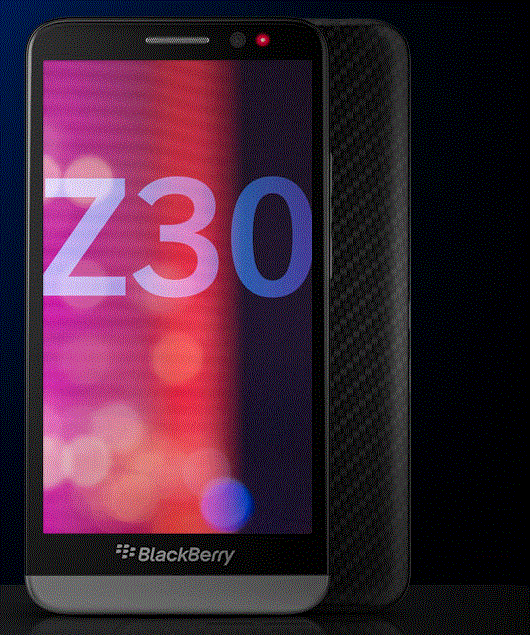
As it launched the Z30, the company argued that it has the best smartphone in the world:
BlackBerry today introduced the new BlackBerry Z30 smartphone, BlackBerry’s biggest, fastest and most advanced smartphone. Featuring BlackBerry® 10 OS version 10.2, the new all-touch BlackBerry Z30 smartphone comes with a beautiful 5″ display and the largest battery yet on a BlackBerry smartphone. It is designed to keep you hyper connected, productive and always in control, and lets you share like you’re there and collaborate with ease.
Even if the Z30 is the best product in its class, the brand momentum in smartphones already has swung too far in favor of Apple Inc. (NASDAQ: AAPL) and Samsung, which have rapidly expanding bases of phones, huge app stores and parent companies with nearly infinite R&D and marketing budgets.
BlackBerry’s board, having looked at the smartphone industry the same way most other people do, has concluded that the firm’s future is dim and that the company may not survive. BlackBerry is for sale. Although its board may hope to dispose of it before the end of the year, no other company or financier has rushed to buy it.
In detail, The Wall Street Journal reported on the BlackBerry layoffs:
Struggling BlackBerry Ltd. is preparing for deep staff cuts — up to 40% of its employees — by the end of the year, people familiar with the matter said.
The layoffs will cut across all departments and occur in waves, likely affecting several thousand workers, the people said. BlackBerry had 12,700 employees as of March, the last time it disclosed a total number.
What has been left out of the analysis is that the cuts just might work. BlackBerry may be a viable company, just at a different size. American public corporation history is filled with companies that decided they could prosper if they shrank at the rate that their sales did.
BlackBerry’s revenue reached almost $20 billion in its fiscal 2011. In the upcoming fiscal year, the number could be half of that. In fiscal 2011, BlackBerry had net income of $3.4 billion. Recently, its annual loss run rate has gotten to more than $200 million.
Even if BlackBerry’s market share continues to drop, that drop may well slow and eventually disappear. Although its new models have not been hits, the company maintains a successful franchise among many large companies and governments. Sales in certain places overseas have also continued to do well. In its most recently quarter, BlackBerry reported:
Revenue for the first quarter of fiscal 2014 was $3.1 billion, up 15% from $2.7 billion in the previous quarter and up 9% from $2.8 billion in the same quarter of fiscal 2013. The revenue breakdown for the quarter was approximately 71% for hardware, 26% for service and 3% for software and other revenue. During the quarter, the Company shipped 6.8 million BlackBerry smartphones and approximately 100,000 BlackBerry PlayBook tablets.
Wall Street must see some hope for BlackBerry, or it is fairly certain the company will be sold at a premium. The company’s stock has risen steadily, but modestly, since early July.
The decision to fire 5,000 or so people may be a brutal. But if BlackBerry can hold a place as a third-tier smartphone vendor, it should be able to hang on. It will not be much, but it is a better alternative to going out of business.






 Top Gaining Stocks
 Top Losing Stocks