


Following the announcement last week that a U.S. drone attack had killed a top Iranian general, defense stocks got a tidy boost of between about 3% and 7%. Northrop Grumman Corp. (NYSE: NOC | NOC Price Prediction) scored one of the biggest boosts with a share price gain of 5.4% on Friday, January 3. Northrop Grumman stock came within a hair’s breadth of posting a new 52-week high.
Lockheed Martin Corp. (NYSE: LMT), Boeing Co. (NYSE: BA), Raytheon Corp. (NYSE: RTN), General Dynamics Corp. (NYSE: GD) and Northrop Grumman are the world’s five largest weapons makers. The Stockholm International Peace Research Institute reported in December that these five firms alone accounted for $148 billion of 2018 global military spending of $420 billion.
Recent Events in Iran
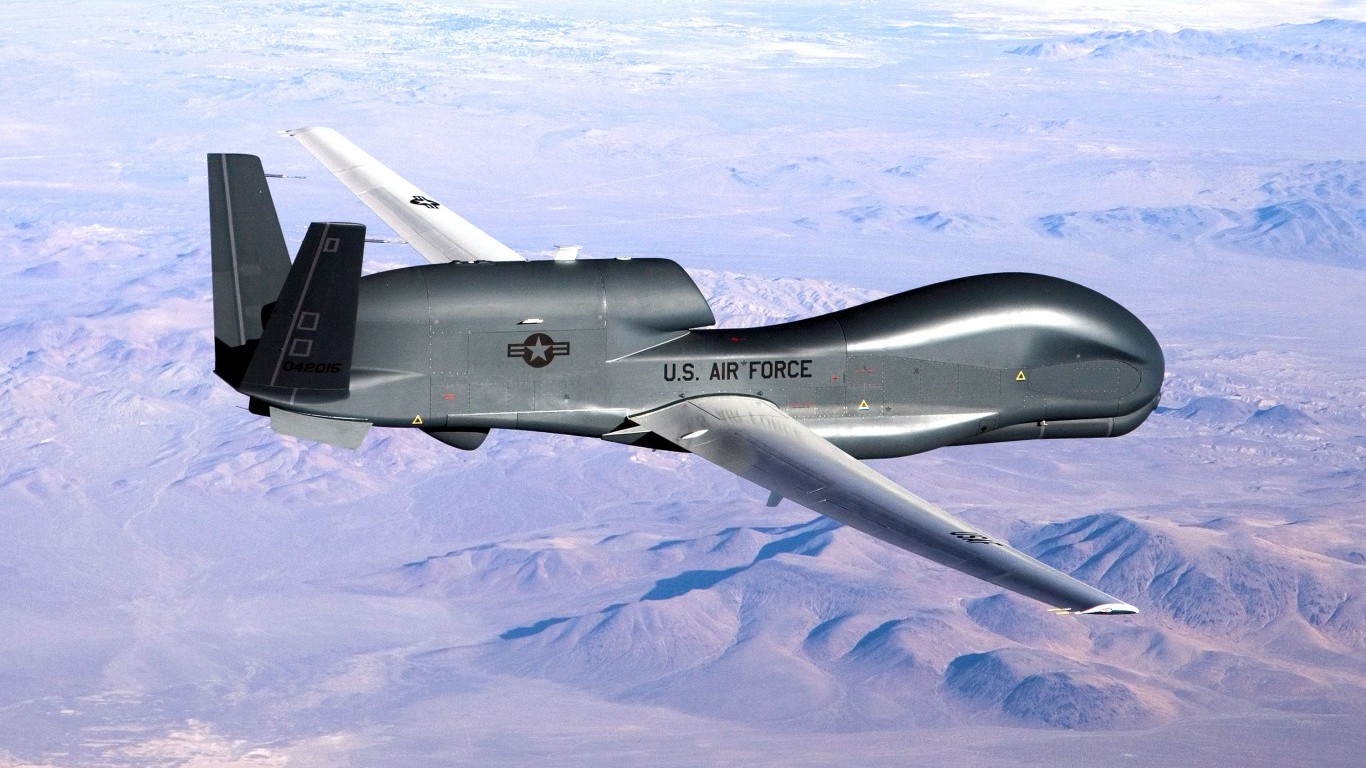
In June, Iran shot down a U.S. RQ-4A Global Hawk drone built by Northrop Grumman. The Iranians claimed the drone was flying over the country’s air space. U.S. officials said the drone was flying over international waters in the Strait of Hormuz, a crucial shipping route in and out of the Persian Gulf.
Last week, a U.S. MQ-9 Reaper drone launched from Iraq killed Iranian Lieutenant General Soleimani near the Baghdad airport. The missile strike was ordered after U.S. officials determined that Soleimani was planning an imminent attack on U.S. forces.
In December, a U.S. civilian contractor in Iraq was killed in a rocket attack on a U.S. base near Kirkuk. The attack was launched from Iraq. U.S. officials blamed the attack on a paramilitary group, the Hezbollah Brigades, known to be backed by Iran. Within days, the U.S. conducted airstrikes against multiple locations, killing some 25 people and wounding dozens of others.
The missile attacks against the Hezbollah Brigades led to the storming of the U.S. embassy in Baghdad on December 31. The embassy siege ended on January 1 with no loss of life on either side. The Iraqi parliament passed a nonbinding resolution on January 6 rescinding the country’s 2014 approval for the United States to help rid Iraq of Islamic State (IS) terrorists.
On January 7, Iran responded to the killing of Soleimani. Iranian armed forces launched more than a dozen ballistic missiles against U.S. bases in Iraq. As of early Wednesday morning, no American or British casualties related to the attacks had been reported. Iran has claimed that at least 80 U.S. troops were killed.
Iran’s Missile Capabilities
The type of ballistic missile used in Wednesday’s attack has not been specified yet. According to the Center for Strategic and International Studies, Iran’s missile arsenal comprises eight short-range and medium-range missiles.
The country’s long-range ballistic missiles are capable of flights of around 1,200 miles. Iran’s lone cruise missile has a range of around 1,500 to 1,900 miles. Iran currently does not have an intercontinental ballistic missile.
How Investors Are Interpreting These Events
In the first four trading days of 2020, Northrop Grumman stock was up 9%. Lockheed Martin was up nearly 6.5%, and Raytheon was up about 3.1% in the same period. Defense technology firm L3Harris Technologies Inc. (NYSE: LHX) traded up 7.5%.
These gains are based on investors’ belief that the United States and Iran will continue flying drones and shooting missiles at each other without causing massive civilian casualties. Not exactly a hot war, but a warm one. Iran’s Islamic Revolutionary Guards Corps issued a statement claiming responsibility for Wednesday’s missile launch. The statement appeared to say that if the United States does not retaliate, the shooting could end.
The U.S. Department of Defense budget for 2020 is set and includes $71.5 billion for Overseas Contingency Operations (OCO). According to the Congressional Research Service, since 2001 Congress has authorized $2 trillion for OCO. There is no statutory limit on how OCO may parcel out its funding. Congress and the president are required by law, however, to designate what the funds are to be used for.
Proponents of OCO spending point to its flexibility in response to events. Critics condemn OCO as a loophole for “replacing combat losses of equipment, resupplying expended munitions, and transporting troops through war zones.” Replacing military equipment and weapons used in the Middle East falls clearly under the rubric of the OCO.
For example, replacements for Northrop Grumman’s Global Hawk drones could be paid for out of the $71.5 billion in 2020 OCO funding. That spending would be over and above Northrop products already included in 2020 spending. The same would be true for other suppliers related to the current fighting between Iran and the United States.
Northrop Grumman’s consensus 12-month price target jumped by $5 a share following the Iranian attacks on the two U.S. bases in Iraq. That implies a share price gain of around 9% in the year ahead, well below the 2019 gain of around 40%. Are analysts just being cautious?
[recirclink id=600892]
[wallst_email_signup]







 Top Gaining Stocks
 Top Losing Stocks