


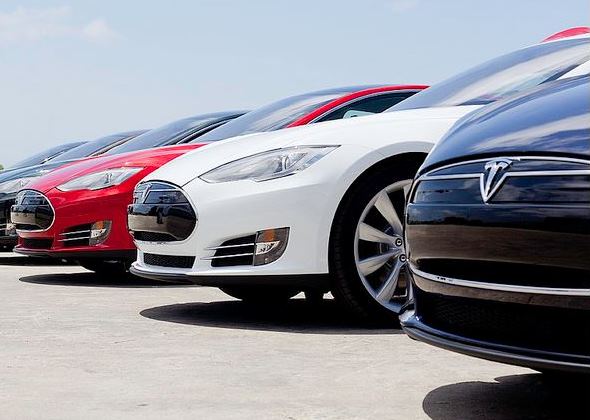
In its note, analysts for the research firm wrote:
Standard & Poor’s Ratings Services said today that it assigned its unsolicited ‘B-‘ corporate credit rating to Tesla Motors Inc. The outlook is stable.
We also assigned our unsolicited ‘B-‘ issue-level and ‘4’ unsolicited recovery ratings to the company’s $920 million 0.25% unsecured convertible notes due 2019, $1.38 billion 1.25% unsecured convertible notes due 2021, and $660 million unsecured convertible due 2018. The ‘4’ recovery rating indicates our expectation for average recovery (30%-50%) for the noteholders in the event of a payment default.
Our “vulnerable” business risk profile assessment incorporates Tesla’s narrow product focus, concentrated production footprint, small scale relative to its larger automotive peers, limited visibility on the long-term demand for its products, and limited track record in handling execution risks that could arise in managing high volume parallel production.
The business risk profile is also constrained by Tesla’s niche and independent market position, compared to its significantly larger and stronger peers, and its very limited product range and operating diversity. We expect global competition for alternative fuel vehicles to intensify over the next few years as competitors penetrate this market through improved products. We believe there is considerable uncertainty in Tesla’s long-term prospects and believe that the company is less likely (compared to larger, more established automakers) to successfully adapt to competitive and technological displacement risks over the medium to long term.
ALSO READ: Companies With the Best (and Worst) Reputations
Tesla does face several powerful “headwinds.” The first among these is that it does not have a mid-priced or low-priced model. A Tesla Model S can cost $70,000 or more. Founder and CEO Elon Musk has promised a car at about half that price, but it is not clear when that will come to market.
Another hurdle for Tesla is that global luxury car manufacturers want to match its success. Therefore, it is likely that Mercedes and BMW, the luxury market leaders, will release their own electric cars. With their brands, dealer networks and almost unlimited marketing budgets, their chances to overtake Tesla in sales (which are only in the tens of thousands a year) are excellent.
Finally, Tesla’s ability to borrow money eventually could be hurt by its remarkably high stock price, which could easily plunge if it reports a bad quarter. At a share price of $212, Tesla’s market cap is more than $26 billion, or more than half of that of the number one U.S. auto manufacturer, General Motors Co. (NYSE: GM).
Tesla’s debt is indeed very risky.






 Top Gaining Stocks
 Top Losing Stocks