


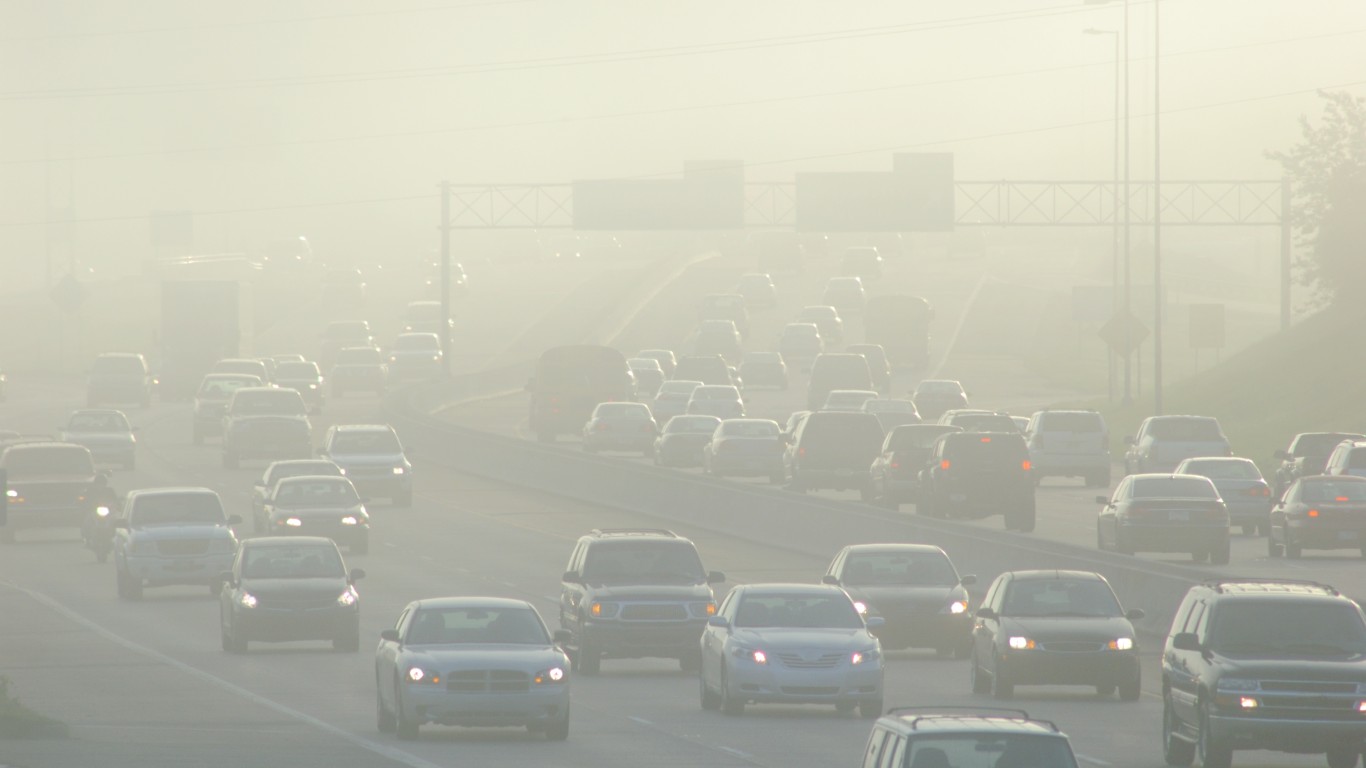
Nearly two years ago, in August 2018, the U.S. Environmental Protection Agency (EPA) and the National Highway Traffic Safety Administration (NHTSA) issued proposed revisions to an Obama-era regulation requiring lower motor vehicle emissions and higher mileage ratings by 2025. The proposal came under immediate fire from several states.
California, along with 22 other states, the District of Columbia, and four cities, filed suit on May 27 challenging the Trump administration’s proposed 2018 rollback of the stronger 2013 standard negotiated between the Obama administration and the auto industry. Interested parties had until June 28 to file motions to intervene in the lawsuit being considered by the federal appeals court for the District of Columbia.
In addition to a filing from the states and cities that brought the suit in May, five automakers filed a motion to intervene. Ford Motor Co. (NYSE: F | F Price Prediction), BMW of North America, American Honda, Rolls-Royce and Volkswagen Group of American seek only to be part of any remedy the court grants in the event that it accepts the case for review.
In their filing, the carmakers say that they intend to “achieve greater greenhouse gas emissions reductions for light duty automobiles” than the requirements of the Trump administration’s proposed rule (called SAFE Rule Part Two). On that basis, they have a “substantial interest” in any remedy imposed by the court.
[nativounit]
Under the new rule, the annual increase in fuel economy is just 1.5% for model years 2021 through 2026. The result would be to reduce the Corporate Average Fuel Efficiency (CAFE) standard to 37 mpg, well below the Obama-era requirement for 46.7 mpg.
The bigger sticking point may be the new rule’s stripping of the exemption granted to California in 2013 to set air quality standards that were more restrictive than federal standards. The exemption also extended to any state the ability to match California’s standards.
Because California and the states that joined it in the lawsuit are responsible for about 30% of all new cars sold in the United States, carmakers have to choose whether to build two versions of the same model or to impose all 50 states the stricter rules. Some automakers, including General Motors Co. (NYSE: GM), Fiat Chrysler Automobiles N.V. (NYSE: FCAU) and Toyota Motor Corp. (NYSE: TM), have backed the Trump administration’s changes.
No automaker wants to build two versions of the same vehicle, however, and that is why Ford and the others filed a motion this week to be included in any discussion of the appeals court’s remedy.
[recirclink id=716349][wallst_email_signup]





 Top Gaining Stocks
 Top Losing Stocks