


Knowing an answer here may require a crystal ball. Still, investors and speculators should start to consider whether gold could or would take on the same sort of sentiment as oil.
Oil already had pulled way back off its historic highs before this most recent drop. It peaked above $140 during the 2008 energy bubble, but more recently it fell from $100 to under $50. Now oil has challenged $43 per barrel again.
Could gold follow, even after dropping from over $1,800 at the 2011 peak down to under $1,200 recently? Gold recently hit new multi-month lows around $1,145 per ounce — before bouncing back up to $1,154 per ounce on Tuesday.
If you just take the fundamentals for oil — lower demand, lower pricing and ever more storage filling up — it does not exactly sound or feel like a major oil recovery is coming. At least not any time soon. What about demand for gold as a comparison?
ALSO READ: 8 Analyst Stocks Under $10 With Massive Upside Calls
Global interest rates do play a role here. Would rising interest rates help or hurt? Obviously, they will not help in commodities — at least not on the surface. Rising rates will drive the dollar strength further, as long as all other things are equal. Otherwise you would have seen gold and oil rise as Japan and Europe have embarked on quantitative easing. This interest rate conundrum, and a U.S. economy stronger than elsewhere, is driving the U.S. dollar higher now.
Another driver is the investor outflows of exchange traded fund (ETF) investing, such as the SPDR Gold Trust (NYSEMKT: GLD). The SPDR website now shows that it has fallen to 750.67 tonnes, with a market value of $27.765 billion in assets. We tracked this on February 12, 2015, as having some 773.3 tonnes of gold in it, worth some $30.37 billion in total value at the time. That is a drop in price and also a drop in tonnes. Now, go back much further to April of 2013, and this ETF had some 1,154.34 tonnes with a value of $51.757 billion at that time.
Comparing gold and oil are two very different animals, at least most of the time. At a minimum, everyone needs to consider that the driving forces behind gold and oil do not always align. Sure, they are both commodities — and both likely will rally in a broad commodities rally like we saw in years past.
Interest rates ahead truly will be an experiment here. Who has seen an environment where Europe has negative interest rates and the Federal Reserve is on the fence about raising interest rates in the United States?
Central banks and industry and investors buy and hold gold, but they do not run their cars on gold. Also, gold does not normally drive the world’s economies.
ALSO READ: 8 Oil and Gas Stocks Analysts Want You to Buy
The question to ask is how highly correlated gold and oil are. It depends on the markets. They are not correlated much at all right now. Just keep in mind that the current situation for gold has not always been the case.
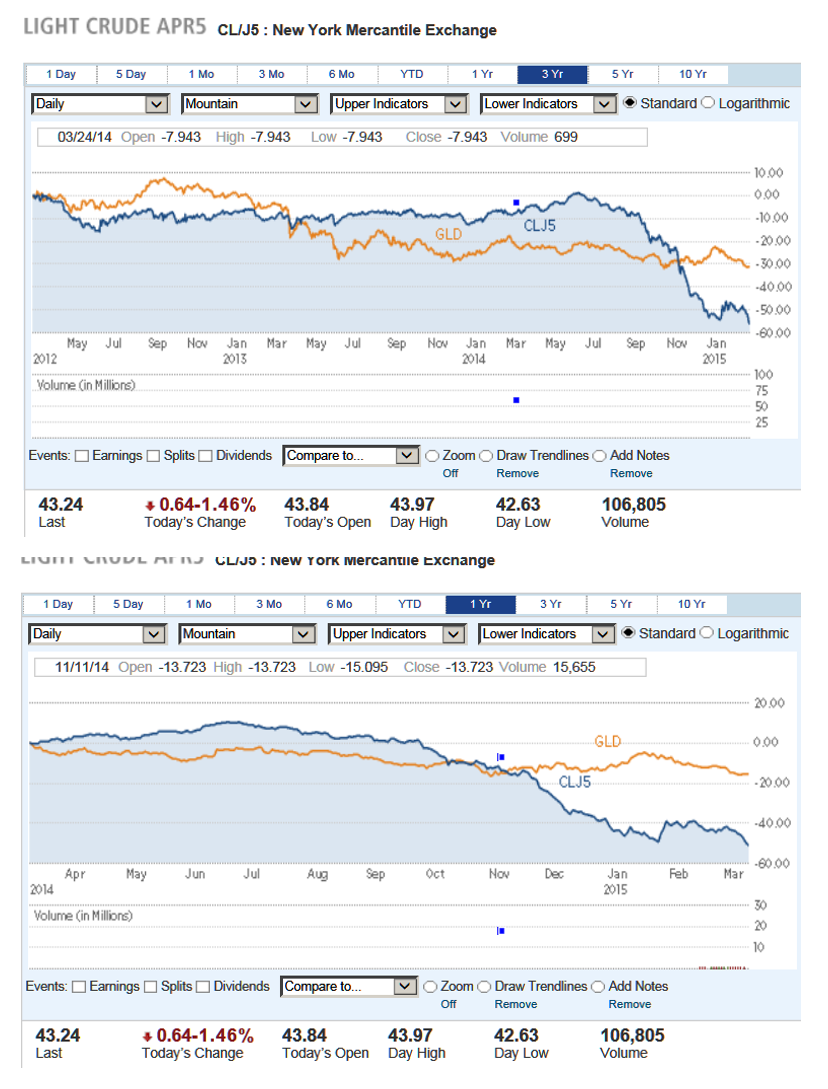
We have included a chart that shows the price of oil for the past three years and compared it to the SPDR Gold Trust. In that time, oil has dropped over 50% and gold has dropped about 30%. After that, we included a one-year chart that shows gold down less than 20% and oil down almost 50%.







 Top Gaining Stocks
 Top Losing Stocks