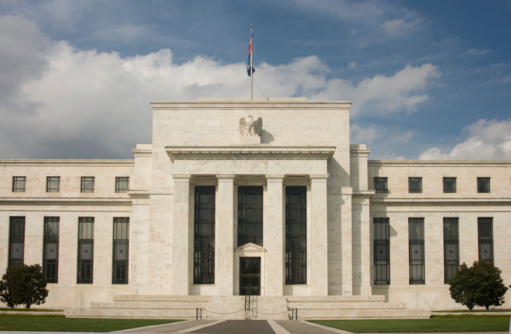
Fed Could Increase Bond Buying to Help Economy

Photo of Douglas A. McIntyre
By Douglas A. McIntyre Published
This post may contain links from our sponsors and affiliates, and Flywheel Publishing may receive compensation for actions taken through them.

As recently as a month ago, the consensus among economists was the Federal Reserve would cut back its $85 billion a month asset purchasing program. The economy appeared to be doing well enough that the Fed could begin to withdraw from the revolutionary program. Now, just a few weeks later, many experts believe that the $85 billion level could be in place well into next year because of the effects of the government shutdown, among other things. What is rarely mentioned is that the Fed could increase the size of the program as a counterweight to a drop in federal spending, which may become permanent.

It is impossible to gauge what the shutdown cost the economy in terms of GDP growth and employment. Certainly the next monthly jobs report, and perhaps the one after that, will reveal some increase in joblessness among government employees and firms that rely on government spending. The range of damage to gross domestic product among forecasts runs from zero to as high as several tens of a percent. And because the overall improvement in the economy may have lost momentum from mid-year, the effects of the shutdown could be magnified.

It is open to debate whether the $85 billion Fed asset program has worked at all. Clearly the members of the Fed’s board believe it has, although there has been a public splintering among them about how long the purchasing program should remain. That debate boils down mostly to the simple issue of whether unemployment will stay fairly high or will come down toward 6% relatively quickly.

The hope of a fast improvement in the jobs situation has begun to evaporate. There will be another battle over the federal budget in Congress, and it already has begun. The debt limit could be reached again as early as March. Another government shutdown may begin in late winter. Once again, hundreds of thousands of federal workers could be temporarily sidelined. The Fed will take into account the chance that the damage done in the past several weeks could be duplicated or even magnified in three or four months.

The $85 billion a month asset purchasing program could be increased in the face of more “headwinds.” A majority of Fed members may think that by mid-2014, GDP growth will slip back toward nil and unemployment could begin to tick higher. At that point, the Fed will be left with only one weapon — an increase in the use of the one it already has.

Photo of Douglas A. McIntyre
About the Author Douglas A. McIntyre →

Douglas A. McIntyre is the co-founder, chief executive officer and editor in chief of 24/7 Wall St. and 24/7 Tempo. He has held these jobs since 2006.

McIntyre has written thousands of articles for 24/7 Wall St. He is an expert on corporate finance, the automotive industry, media companies and international finance. He has edited articles on national demographics, sports, personal income and travel.

His work has been quoted or mentioned in The New York Times, The Wall Street Journal, Los Angeles Times, The Washington Post, NBC News, Time, The New Yorker, HuffPost USA Today, Business Insider, Yahoo, AOL, MarketWatch, The Atlantic, Bloomberg, New York Post, Chicago Tribune, Forbes, The Guardian and many other major publications. McIntyre has been a guest on CNBC, the BBC and television and radio stations across the country.

A magna cum laude graduate of Harvard College, McIntyre also was president of The Harvard Advocate. Founded in 1866, the Advocate is the oldest college publication in the United States.

TheStreet.com, Comps.com and Edgar Online are some of the public companies for which McIntyre served on the board of directors. He was a Vicinity Corporation board member when the company was sold to Microsoft in 2002. He served on the audit committees of some of these companies.

McIntyre has been the CEO of FutureSource, a provider of trading terminals and news to commodities and futures traders. He was president of Switchboard, the online phone directory company. He served as chairman and CEO of On2 Technologies, the video compression company that provided video compression software for Adobe’s Flash. Google bought On2 in 2009.

Featured Reads

Our top personal finance-related articles today. Your wallet will thank you later.

Continue Reading

Top Gaining Stocks

CBOE Vol: 1,568,143
PSKY Vol: 12,285,993
STX Vol: 7,378,346
ORCL Vol: 26,317,675
DDOG Vol: 6,247,779

Top Losing Stocks

LKQ
LKQ Vol: 4,367,433
CLX Vol: 13,260,523
SYK Vol: 4,519,455
MHK Vol: 1,859,865
AMGN Vol: 3,818,618