


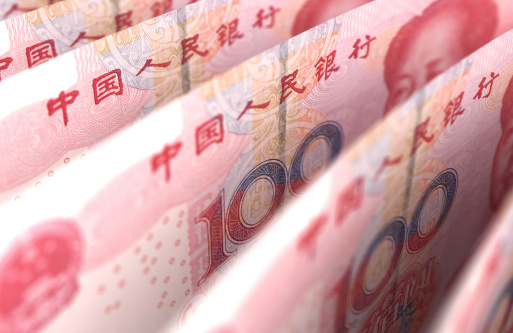
Credit Suisse’s Andrew Garthwaite has taken a look at the renminbi (RmB) devaluation. His view is that China will end up depreciating a little more than the forward curve is currently anticipating. He notes that the curve is expecting 3% or so. His view is based on the following:
- a strong correlation between RmB strength and weakness in Chinese nominal GDP growth;
- acute PPI deflation and China has net foreign assets of 44% of GDP;
- FX intervention has hitherto offset much of the stimulatory impact of RRR/rate cuts;
- a small devaluation could accelerate capital outflows and add pressure on the currency;
- and also because the IMF believes the RMB is no longer undervalued.
ALSO READ: 5 Defensive High-Yield Dividends Should Withstand the Next Stock Market Correction
Gartwaite said:
We think a decline in excess of 10% is unlikely: as the RmB is 5% to 10% overvalued (based on export market share); a large depreciation would threaten a political backlash; the Peoples Bank of China can control the depreciation given FX reserves worth 35% of GDP, as they have done historically (in 2005, for example); and there is gross foreign corporate debt of Chinese enterprises of $665 billion… We think that, near term, there will be more stimulus and there are early signs of some stabilization (Shanghai Rebar, Premier Li indicator, Korean PMIs), with ‘real’ data already very weak. Longer term, we believe investors are too optimistic on Chinese growth and believe housing indicators (which have stabilized in the past two months) are the key.
There are several additional key observations here. It is very negative for commodities and for companies that either export to China or that compete with China. It also could hurt Korean and Taiwanese gross domestic product as they export to China, but is likely to help companies that source from China.
Bonds, according to this note, likely will be driven by the European and U.S. recovery and by core inflation. Also, the Bank of Japan could have to further pursue more quantitative easing and stimulus. Credit Suisse does not see this move as a general risk-off trade — the bull/bear ratio is already depressed while the risk appetite and the “ratio of cyclicals to defensives” are discounting a sharp fall in macro momentum.
Obviously we have to see just what China decides to do and how far to take it before endorsing any one firm’s views on what to expect from China’s central bank and from its government.






 Top Gaining Stocks
 Top Losing Stocks