


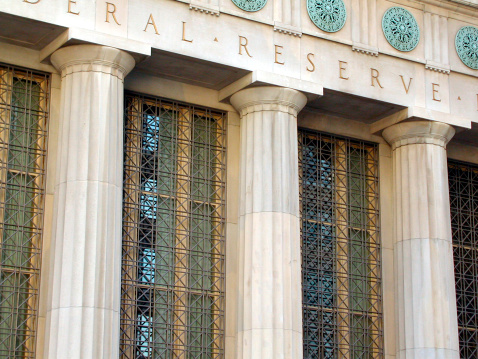
Of that $4.5 trillion, about $4.2 trillion is held directly securities. Those are Treasury debt, mortgage-backed securities, and agency notes. Now consider that a unilateral rise in interest rates will hurt the value of the fixed coupons that it owns.
To put the balance sheet of almost $4.5 trillion into context, we would use the bank JPMorgan Chase’s balance sheet for a reference. The bank’s total loan portfolio was $791 billion – and its total deposit base was $1.28 trillion. Wells Fargo’s total loan portfolio was $888.5 billion versus a total deposit base of $1.18 trillion.
That means that all of the Federal Reserve’s asset buying under quantitative easing is worth more than 5 times the loan balance of each Wells Fargo and JPMorgan. It is also almost 4-times the balance of each bank’s total deposit base.
Now consider the Resolution Trust Corp. as a comparison from the late 1980s and 1990s. The bank assets from the nearly 750 banks and thrifts came with a total assets of almost $400 billion.
The good news here is that the Federal Reserve has a tentative plan. Their website even outlines this under a Monetary Policy Normalization tab, as follows:
In response to the financial crisis, the Federal Reserve promoted economic recovery through sharp reductions in its target for the federal funds rate and through purchases of securities. When economic conditions and the outlook for future economic activity and inflation warrant, the Federal Reserve expects to start the process of normalizing the stance of monetary policy and the size and composition of its balance sheet. The timing and pace of policy normalization will be determined so as to promote the Federal Reserve’s statutory mandate of maximum employment and price stability.
The Fed’s July 29, 2015 FOMC statement also addressed its balance sheet policy. It said:
The Committee is maintaining its existing policy of reinvesting principal payments from its holdings of agency debt and agency mortgage-backed securities in agency mortgage-backed securities and of rolling over maturing Treasury securities at auction. This policy, by keeping the Committee’s holdings of longer-term securities at sizable levels, should help maintain accommodative financial conditions.
Additional normalization tools already seem a bit dated from last year. The Fed report for that is here.
How the Fed will deal with unwinding close to $4 trillion worth of securities still formally remains to be seen. The Fed’s balance sheet was shown to be $ Maybe we should really just ask whether that will take a matter of years or whether it will take decades.









 Top Gaining Stocks
 Top Losing Stocks