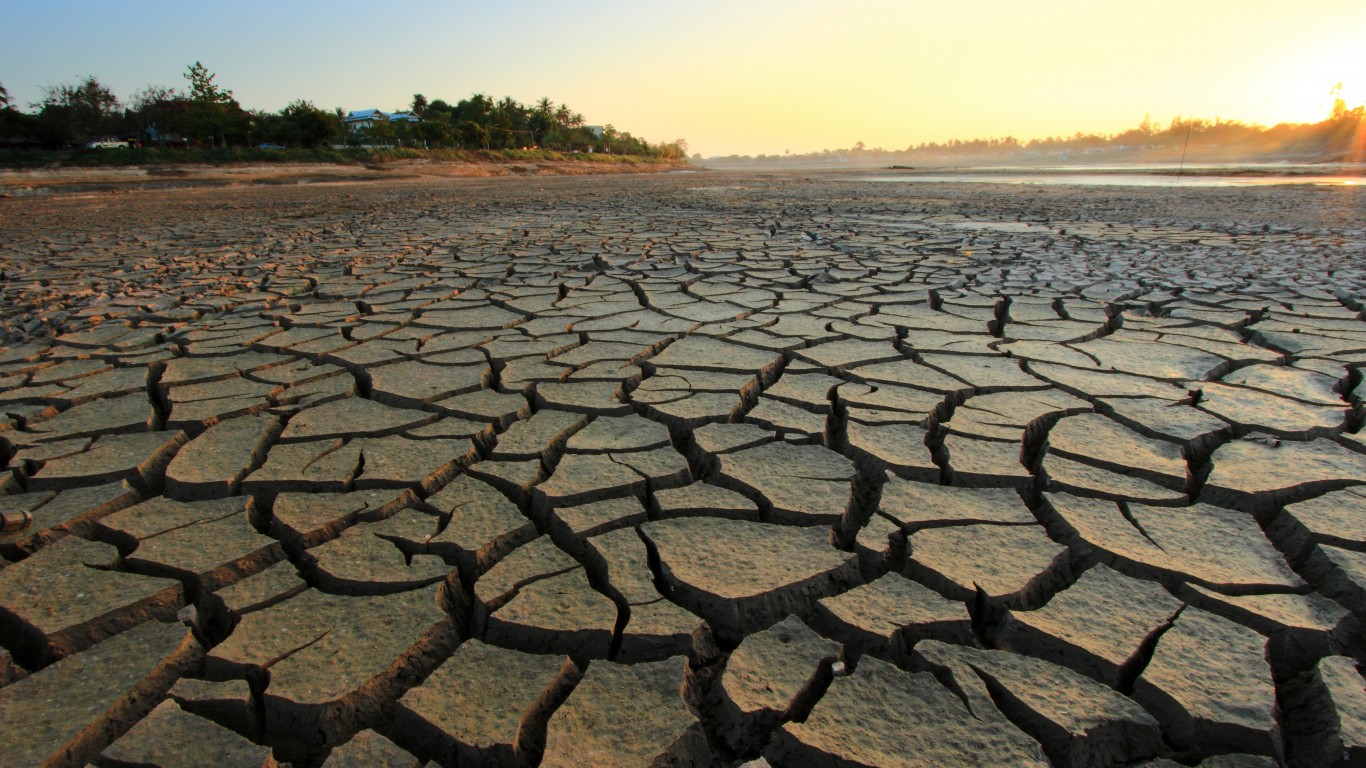
Global Warming’s $65 Billion Price Tag

Photo of Douglas A. McIntyre
By Douglas A. McIntyre Published
This post may contain links from our sponsors and affiliates, and Flywheel Publishing may receive compensation for actions taken through them.
Global Warming’s $65 Billion Price Tag

© Surachet1 / iStock via Getty Images

From time to time, researchers put a price tag on climate change. Insurance rates will rise. Millions of people will need to relocate from places where temperatures are 140 degrees Fahrenheit. Rivers will dry up. Floods and wildfires will cause billions of dollars in replacement costs for homes and businesses, and many people will die in the same process. (These are the worst cities to live in as climate change worsens.)
[in-text-ad]
A new study shows a small microcosm of the overwhelming trouble. The garment industry in several nations may see a big erosion in its output in the next several decades, which could rise to $65 billion.
[nativounit]
A new study from Cornell University’s Global Labor Institute and Schroders shows the effects of heat and floods on 32 garment production areas in four countries, each crucial for fashion production worldwide. These are Bangladesh, Cambodia, Pakistan and Vietnam.

Across these four nations, the research shows the garment industry employs 10.6 million people. The period forecast by the climate experts runs from 2030. On the one hand, better climate change management would protect these jobs. However, what they label as the “high heat and flooding” scenario drives the $65 billion loss figure. Most of the specific triggers are health problems and a drop in productivity.
[wallst_email_signup]
The study’s authors are clever enough to show what kinds of apparel brands will be most affected. These are 1) value fast fashion, 2) value retailer, 3) fast fashion mid-multi retailer, 4) mid-market sportswear, 5) mid-market multi-retailer and 6) online only. This is where the study falls apart completely. The notion that even the best researcher can say what will happen in 2050, particularly at this level, is absurd.
[recirclink id=1265879]
The “Higher ground: how fashion supply chains are being impacted by extreme heat and flooding” study seems valid initially, but a deeper look shows how absurd such specific conclusions are.


Photo of Douglas A. McIntyre
About the Author Douglas A. McIntyre →

Douglas A. McIntyre is the co-founder, chief executive officer and editor in chief of 24/7 Wall St. and 24/7 Tempo. He has held these jobs since 2006.

McIntyre has written thousands of articles for 24/7 Wall St. He is an expert on corporate finance, the automotive industry, media companies and international finance. He has edited articles on national demographics, sports, personal income and travel.

His work has been quoted or mentioned in The New York Times, The Wall Street Journal, Los Angeles Times, The Washington Post, NBC News, Time, The New Yorker, HuffPost USA Today, Business Insider, Yahoo, AOL, MarketWatch, The Atlantic, Bloomberg, New York Post, Chicago Tribune, Forbes, The Guardian and many other major publications. McIntyre has been a guest on CNBC, the BBC and television and radio stations across the country.

A magna cum laude graduate of Harvard College, McIntyre also was president of The Harvard Advocate. Founded in 1866, the Advocate is the oldest college publication in the United States.

TheStreet.com, Comps.com and Edgar Online are some of the public companies for which McIntyre served on the board of directors. He was a Vicinity Corporation board member when the company was sold to Microsoft in 2002. He served on the audit committees of some of these companies.

McIntyre has been the CEO of FutureSource, a provider of trading terminals and news to commodities and futures traders. He was president of Switchboard, the online phone directory company. He served as chairman and CEO of On2 Technologies, the video compression company that provided video compression software for Adobe’s Flash. Google bought On2 in 2009.

Featured Reads

Our top personal finance-related articles today. Your wallet will thank you later.

Continue Reading

Top Gaining Stocks

CBOE Vol: 1,568,143
PSKY Vol: 12,285,993
STX Vol: 7,378,346
ORCL Vol: 26,317,675
DDOG Vol: 6,247,779

Top Losing Stocks

LKQ
LKQ Vol: 4,367,433
CLX Vol: 13,260,523
SYK Vol: 4,519,455
MHK Vol: 1,859,865
AMGN Vol: 3,818,618