


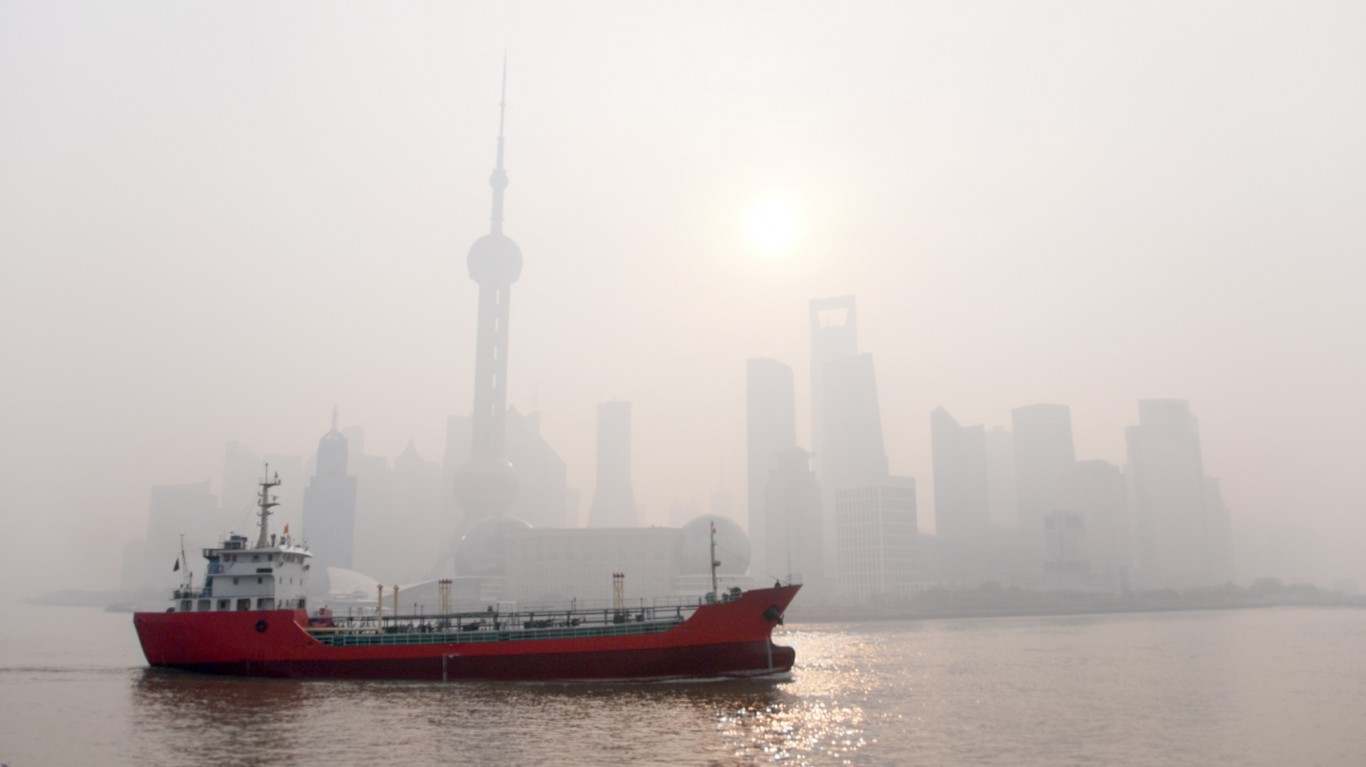
 There have been recent reports that demand for Iranian crude oil is faltering and that the country has begun filling VLCC tankers and having them sail around in circles on the Persian Gulf. Estimates of the amount of crude involved vary, but the high estimate is that 19 VLCCs and 1 Suezmax-class tankers are currently holding about 38 million barrels of Iranian crude.
The Iranians admit that the crude is floating around on the Gulf, but will say only that fewer than 20 vessels are involved. They blame the storage increase on refinery turnarounds that are typical for this time of year as refiners switch from winter production emphasizing distillates to the main summer product, gasoline. Another possibility is that the price rise to more than $87/b has cooled demand from refiners, as they wait to see if prices will stabilize at that level or fall back to around $80/b. No refiner wants to get stuck with $87/b oil just before the price drops.
Another reason put forward for the diminished sales of Iranian crude is the possibility of stricter sanctions on Iran for refusing to halt its development of enriched uranium. Political considerations aside, this explanation is unlikely because China imports around 15%-20% of Iran’s output and so far China has refused to join the US and other countries in supporting sanctions on Iran. China’s imports averaged about 460,000 b/d in 2009, while India imported more than 425,000 b/d and Japan took 421,000 b/d. Iran exports about 2.4 million b/d out of total production capacity of more than 4 million b/d.
Iranian crude oil is heavy and contains a high proportion of sulfur. The number of refineries that can process this stinky brew is falling, and even Iran’s own refineries, which are old and were built to accommodate lighter, less sulfurous crude, have difficulty refining the stuff.
From Iran’s point of view, the troubles the country is having selling its crude is exacerbated by the flattening of the contango curve in the physical oil market. An oil market in contango is one in which future prices are higher than current prices. A month ago the curve on the 12-month contract was flattening and the long-term price was near the bottom of the 2010 range. That curve got a bump when prices jumped to $87/b, but the long-term trend is for the market to tighten and the contango situation to diminish if not disappear altogether.
The SEC’s civil law suit against Goldman Sachs has contributed to a two-day fall in crude price, as has the grounding of aircraft due to the volcanic ash spreading from Iceland across Europe and now affecting even Japan. If the price stays down around $80/b, then Iran’s floating supply will presumably disappear fairly rapidly.
The effects of US efforts to isolate Iran over its continued development of enriched nuclear fuel have so far been pretty well countered by Iran. Certainly China’s commitment to continue importing Iranian crude is a serious blow to the US.
But the US has had better luck attacking Iran’s need to import refined products. Iran’s refineries can meet about two-thirds of the country’s demand. The remaining third is imported, and until last year, most of the 120,000 b/d Iran imported came from India. That has mostly been replaced by imports from China and Malaysia, and Iran has plans to upgrade its refineries by 2013 to become self-sufficient in gasoline production.
Still, the US has been partially effective in discouraging investment in Iran’s oil and natural gas industries, which will make it more difficult for the country to bring new production on-line in a timely manner. While an embargo on gasoline may be more effective than an embargo on exports, neither has any real chance of altering Iran’s determination to build its nuclear capability.
The one thing the US can exploit are the market inefficiencies that Iran has introduced into its oil markets. Because its refineries are old Iran is forced to retain its lighter, easier-to-refine crude in order to make gasoline for domestic consumption. This prevents Iran from getting better pricing for the better grade of crude.
Once the exported crude is refined, it is imported back to Iran as gasoline, a more costly product than crude. To add even more pain to the transaction, the Iranian government subsidizes gasoline heavily within the country. The government must pay this subsidy in order to ensure a certain amount of domestic tranquility. Despite its hydrocarbon riches, Iranian per capita income is under $5,000. Gasoline priced at market rates would be unaffordable for most Iranian citizens.
US sanctions make Iran’s situation worse, but the sanctions by themselves will never be decisive. OPEC, particularly Saudi Arabia, will not allow Iranian crude oil to clog the Gulf indefinitely. The Saudis and the Kuwaitis will withdraw barrels from production if they must in order to support crude shipments from Iran. The US really has no effective response to such a move, given that without Iranian crude there is sure to be a nasty spike in crude prices.
The buildup of circling tankers in the Persian Gulf does not indicate that the US policy of isolating Iran is working. It is far more likely that the growing number of tankers is the result of seasonal fluctuations and poor government in Iran.
Paul Ausick






 Top Gaining Stocks
 Top Losing Stocks