


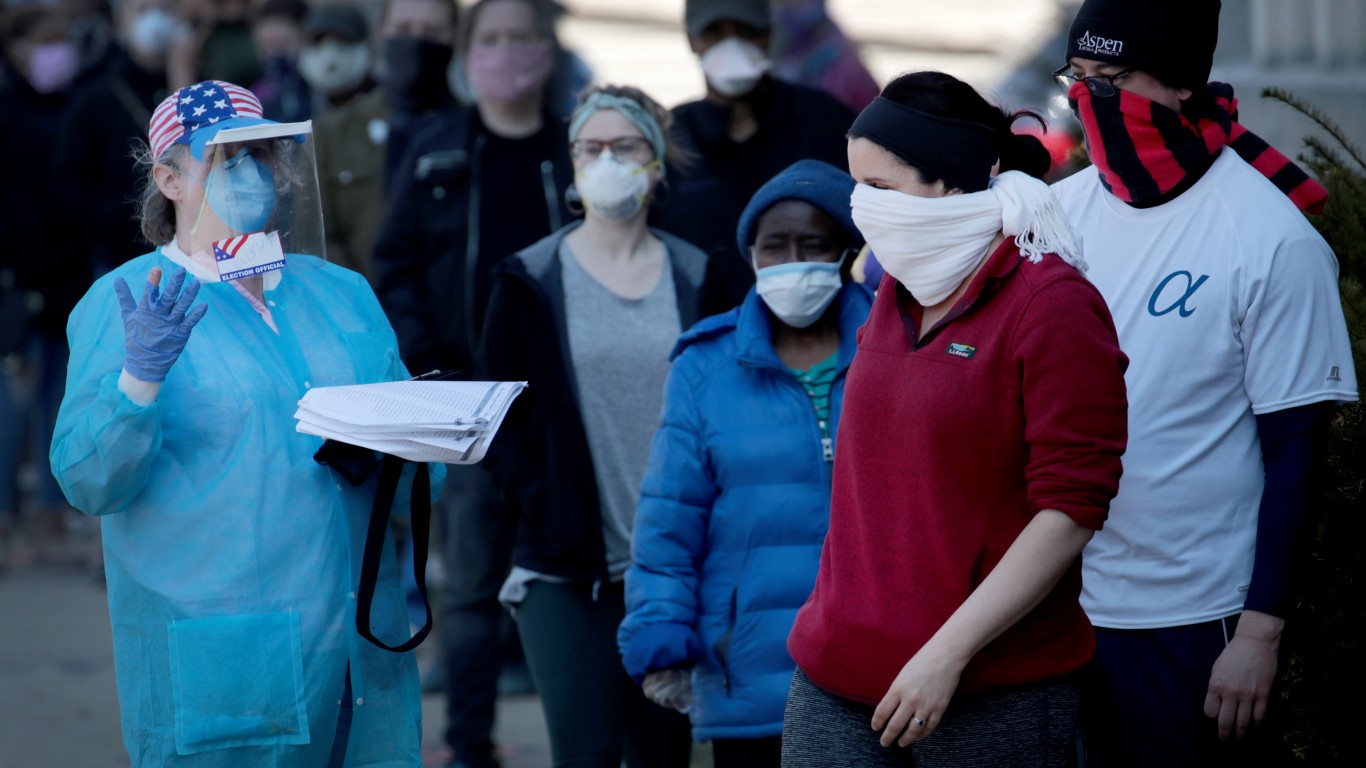
Much of the conversation about the COVID-19 as it spreads through the United States is when the confirmed cases will peak by state, county and city. Following a peak, conventional wisdom is that the number of new cases drop, and at a similar rate, days or weeks later, deaths. After a peak, in most cases, the rates of new confirmed cases decline slowly for a few weeks and then slide very sharply downward. Centers for Disease Control and Prevention Director Robert Redfield said that cases already may have peaked in the United States, but not all locations are even close to their dates. Some states will not hit peak cases for weeks.
The state that is forecast to peak at the latest date is Wyoming, on April 29. It is the only state that has reported just one death so far.
According to the Bing COVID-19 Tracker, there were 587,752 confirmed cases in the United States as of early April 14, and 23,765 people have died. New York State is the hardest hit, with 195,459 confirmed cases and 10,107 deaths. New York hit its peak, a report from the University of Washington’s Institute for Health Metrics and Evaluation in Seattle shows, on April 8. Another hard-hit state, Michigan, peaked on April 7. As of today, Michigan has 25,635 confirmed cases and 1,602 deaths.
The other states that have peaked already according to the evaluation are April 1 for Vermont, April 2 for Washington (where the outbreak began in the United States), April 4 for Louisiana and April 8 for Colorado and Ohio.
Other states that have already peaked include April 9 for Delaware and the District of Columbia, April 11 for Illinois and New Jersey and April 12 for Hawaii.
[nativounit]
April 13 should have been the peak date for California, Pennsylvania and Wisconsin. From today onward, it is April 14 for Idaho and Indiana. April 15 is expected to be the date for North Carolina and West Virginia. April 16 is forecast to be the peak in Mississippi and New Hampshire. The following day, April 17, the cases in Alaska, Maine, Maryland, Nevada and Tennessee are expected to peak.
April 20 is the anticipated peak date in Alabama, Georgia, Kansas, Massachusetts, Montana and Virginia. Following on April 21 are Connecticut, Florida, Kentucky, Missouri, New Mexico and North Dakota.
April 22 is the projected peak date for Arizona, Oregon and Texas, followed on April 23 by Minnesota and Oklahoma. April 24 is forecast for South Carolina. Then April 25 is expected to be the peak date for Arkansas, Rhode Island and Utah.
April 26 is the forecast peak date for Nebraska. April 27 is the forecast peak date for Iowa and South Dakota.
If there is any pattern to the figures, it is that many states along the east and west coast will peak early. Some of these states took the brunt of confirmed cases as the virus entered the United States. This is certainly true of Washington and New York.
Many later peaks are closer to the middle of the country. It may be that the virus has not worked its way inward geographically. Some of these states are not densely populated. That may make the virus spread more slowly. States with late peaks forecast include Wyoming, South Dakota, Iowa, Nebraska, Minnesota, North Dakota and Missouri.
Regardless of the order in which states reach their peaks, the disease will not spare any area for more than two weeks.
[recirclink id=681297]
[wallst_email_signup]









 Top Gaining Stocks
 Top Losing Stocks