


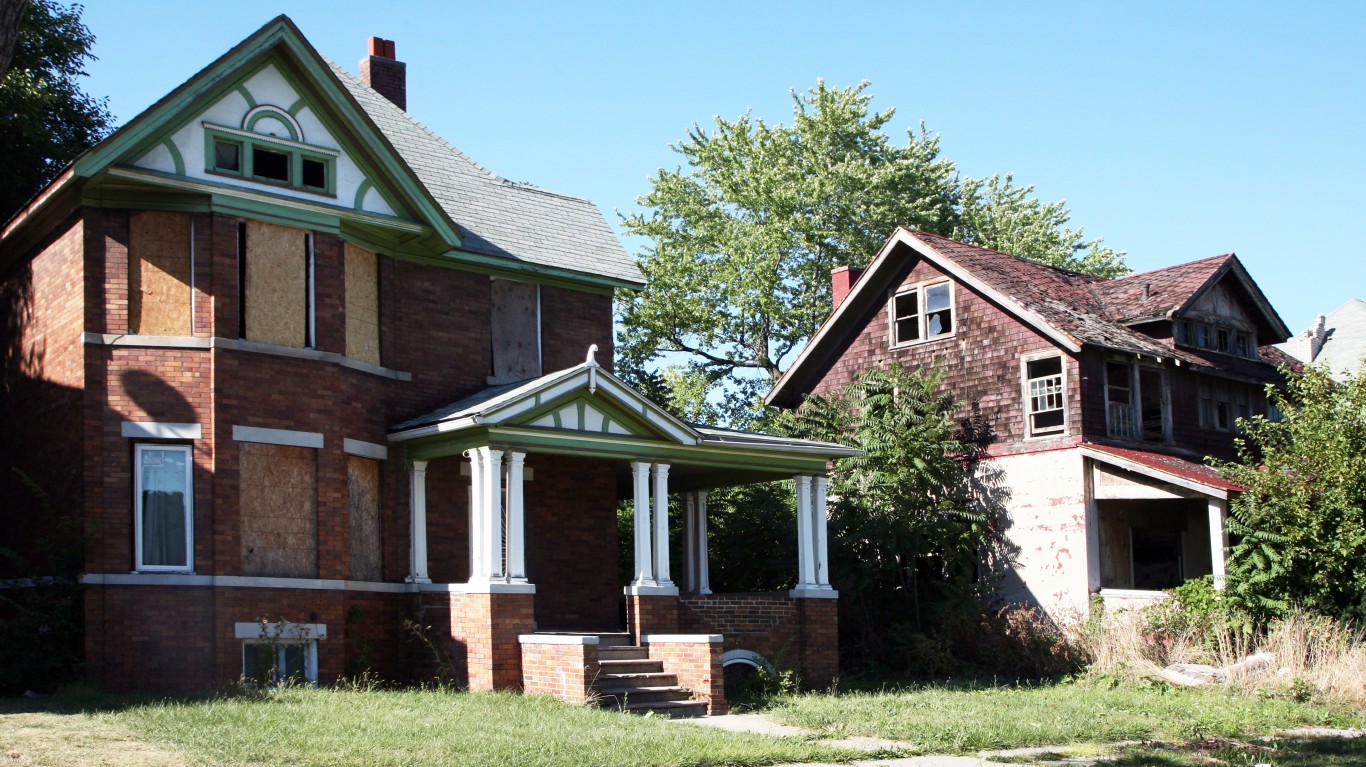
The Detroit Land Bank Authority (DLBA) has a website anyone can visit to view the city’s inventory of homes for sale. The opening bid for almost all of them is $1,000, and 504 homes currently are available. The city owns these homes and is anxious to get rid of them.
Detroit’s core problem, both in terms of home occupation and services that support the city’s population, is that it has been largely abandoned by the wealthy, the middle class and hundreds of businesses that represented a healthy tax base. At the peak of its reign as the “Automobile Capital of the World,” the city that Henry Ford and other industrialists built had 1.85 million residents. That was when the 1950 census was taken. The number has dropped to 760,000, as of the 2019 estimate.
The DLBA’s job is to sell off what it calls its blighted and vacant properties. It holds nearly 100,000 of these properties, which makes it the largest landowner in the city. At least 20,000 of these are abandoned homes. Detroit came to own this inventory primarily through tax foreclosures.
Detroit’s property blight problem is by far the greatest in America. The Detroit Demolition Program was put into place in 2014. Its core mission was to bulldoze homes on as many as 40,000 parcels of land. The federal government and the state were to provide the funding. The program is scheduled to run until the end of this decade. Most experts believe that the magnitude of the task is so large and expensive that it will never be completed, or even come close to its goals. Additionally, the Detroit Land Bank is such a small part of the solution that even at the current rate of sales, it will barely make a dent in the number of unoccupied properties.
[nativounit]
Potential buyers can preview the homes by viewing photos and getting information from the auction section of the DLBA site. Buyers also can review an Inspection/Condition Report to make an evaluation of the property and how much work will be required to make it habitable.
The rules to buy one of these homes are fairly simple. Bidders cannot have unresolved blight or code violations in the City of Detroit. They cannot have delinquent property taxes on any property in Wayne County, which is the county in which Detroit is located. A bidder cannot have lost property due to tax foreclosure in Wayne County in the past three years, with the exception of property that was their primary residence. Anyone who previously has been the winning bidder in a DLBA auction and failed to close is not eligible to make an offer.
Winning bidders must supply photos and other proof that the property is being improved. This may include documents from a contractor and utility bills. The rehabilitation of the property, meaning it can pass city inspections and be legally occupied, has to be completed within 180 days of the purchase.
There are several hurdles to the $1,000 home program. First, even if a home is made habitable, it is still almost certainly part of a blighted neighborhood. A drive through Detroit shows that deserted houses tend to be grouped together, sometimes block after block. Next, these homes also tend to be in parts of Detroit with high crime rates. That makes them unattractive to potential owners or tenants. And any home purchased eventually could be in a section of Detroit set aside to be razed to the ground, most likely by bulldozers.
Even though dozens of $1,000 homes are for sale in Detroit, that does not make the prices a good deal.
[recirclink id=803447]
[wallst_email_signup]






 Top Gaining Stocks
 Top Losing Stocks