


From The Fiscal Times
One of the few things that Donald Trump and Hillary Clinton could agree on during the presidential campaign was the crying need for new highways, bridges, transit systems and dams.
Trump said he favored spending $1 trillion or more on new infrastructure projects over a decade, doubling what his Democratic rival had proposed. And the day after Trump won the election, House Democratic Leader Nancy Pelosi of California declared that she and other Democrats would be willing to work with the new president and GOP leaders on a major package of infrastructure and transportation project.
Trump and the Democrats, for the most part, remain in sync on the need for massive new spending to spruce up the nation’s infrastructure and create tens of thousands of new jobs. But profound differences between the Democrats and Republican congressional leaders on the size and makeup of the package – and precisely how to pay for it — threaten to sidetrack the proposal this year.
The nation’s massive shortfall in critically needed infrastructure spending has been long documented by the Congressional Budget Office (CBO), government watchdog groups and the American Society of Civil Engineers, which repeatedly has graded the U.S. a D-plus in keeping maintaining the nation’s infrastructure compared with the country’s overseas trading rivals.
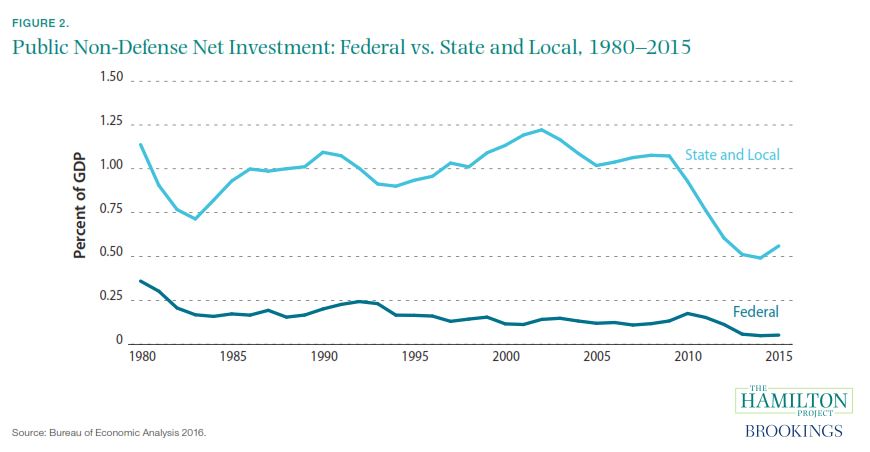
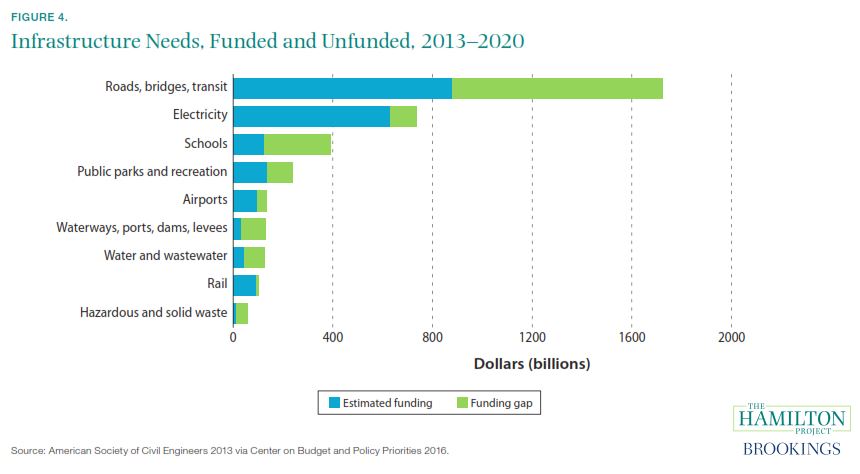
By one important measure of the inadequacy of federal, state and local policies, annual public investment in infrastructure has declined from 1.5 percent of Gross Domestic Product in 1980 to just 0.6 percent of the overall economy in 2015, as the Brookings Institution’s Hamilton Project notes in a new report. Indeed, the American Society of Civil Engineers in 2013 estimated that $3.6 trillion would be required just to bring U.S. infrastructure into a state of good repair, not counting any expansion to the existing infrastructure.
The Democrats recently sought to match Trump when Senate Minority Leader Chuck Schumer of New York and a half-dozen other senators unveiled their $1 trillion “Blueprint to Rebuild America’s Infrastructure” – a document aimed at generating more than 15 million jobs by fixing crumbling infrastructure and creating a “21st century network” of transportation systems, water projects, schools, electric grids and other projects.
During the campaign, Trump and his economic advisers outlined a proposal to offer $137 billion in tax breaks and incentives to private investors with deep pockets willing to invest in toll roads and bridges and other projects that would leverage revenue streams to help retire $1 trillion in debt on these projects. Trump’s transition team also explored whether to establish a national infrastructure bank for other development – an approach long favored by Democrats but opposed by GOP leaders.
Some Democratic critics denounced Trump’s approach as another tax giveaway for the rich that would have a relatively little positive impact on the economy. Ron Klain, a former Obama administration official, warned that the plan would subsidize investors, not infrastructure projects. By contrast, Schumer and the other Democrats proposed to finance their projects through direct government spending – either by raising revenues such as higher corporate taxes or simply adding to the deficit to help stimulate the economy.
Schumer has challenged Trump “to negotiate with us” to come up with a way of dealing with the funding “that we can all agree on,” Schumer said.
“We’re insisting it has to be direct spending,” a Senate Democratic aide explained on Monday. “Real spending and not tax credits that go to the private industry. It has to be real direct spending that’s going into these projects.”
But this approach to stimulus spending immediately became a stumbling block for the GOP – not as much for Trump as for Senate Majority Leader Mitch McConnell (R-KY) and House Speaker Paul Ryan (R-WI) who are insisting that new infrastructure spending must be paid for.
McConnell, in particular, is opposed to any fiscal or budgetary program that even hints of the Obama administration’s highly controversial 2009 stimulus package that cost the government an estimated $862 billion. Obama promised that the large package of construction projects would boost the economy and create thousands of permanent jobs, but the initiative fell well short of its goals.
McConnell said late last year, “It will be interesting to see how this is put together,” and he added, “I hope we avoid a trillion-dollar stimulus.”
Another difference between the Democrats’ and Trump’s approach is that the Democrats favor spending the lion’s share of funds on upgrading or repairing existing roads, bridges and other infrastructure, with lesser amounts paying for shiny new projects that Trump is most interested in.
To that end, the Senate Democratic plan would spend $210 billion of the total “to repair crumbling roads and bridges,” $180 billion to replace and expand existing rail and bus lines, $110 billion to modernize water and sewer systems and $65 billion to modernize American ports and airports.
The Hamilton Project’s new “Guide to the Economics of Infrastructure Investment,” released today, “What is less clear is whether … the return from an additional dollar of spending on new infrastructure is still larger than the cost. …Repair and maintenance often have higher returns than new construction. About one-third of the nation’s major urban roads were rated in substandard or poor condition in 2016, generating large costs for motorists.”
The report endorses a “Fix it First” approach in which more money is allocated for upgrading and repairing existing infrastructure rather than undertaking brand new ventures. “Conducting early and regular maintenance yields large cost savings relative to fixing or replacing roads only after they have become badly damaged,” the report states.
Whether Trump and the Democrats can finally reach an accommodation – and then bring the GOP leaders on board – remains to be seen. But some Democrats are highly skeptical.
“If the president wants to do a trillion-dollar infrastructure package like ours, I’m sure we can find common ground,” Sen. Brian Schatz (D-HAWAII) told Politico. “Count me as doubtful.”
Related: Trump Proposes $1 Trillion for Infrastructure Without Raising Taxes
Related: Trump’s $1 Trillion Infrastructure Plan Raises a Red Flag for Dems
Related: Trump May Be the First Test Case for His Own Supreme Court Nominee
[wallst_email_signup]






 Top Gaining Stocks
 Top Losing Stocks