



For years, 24/7 Wall St. has covered stocks under $10. While not all were home runs, many savvy investors with foresight and patience made millions on stocks that traded in the single digits.
One company that traded under $10 for years has become the darling of the stock market and has led a massive rally over the last year, especially since October. For low-price stock skeptics, many of the biggest companies in the world, including Apple Inc. (NASDAQ: AAPL | AAPL Price Prediction), Amazon.com Inc. (NASDAQ: AMZN), and NetFlix, Inc. (NASDAQ: NFLX) all traded in single digits at once.
We decided to stroll back in time to see how wealthy an investor would be if, ten years ago, in 2014, they invested $20,000 in Artificial Intelligence giant Nvidia Inc. (NASDAQ: NVDA). One thing is for sure: most investors will wish they had put this monstrous trade on.
Nvidia emerged as an AI chip giant
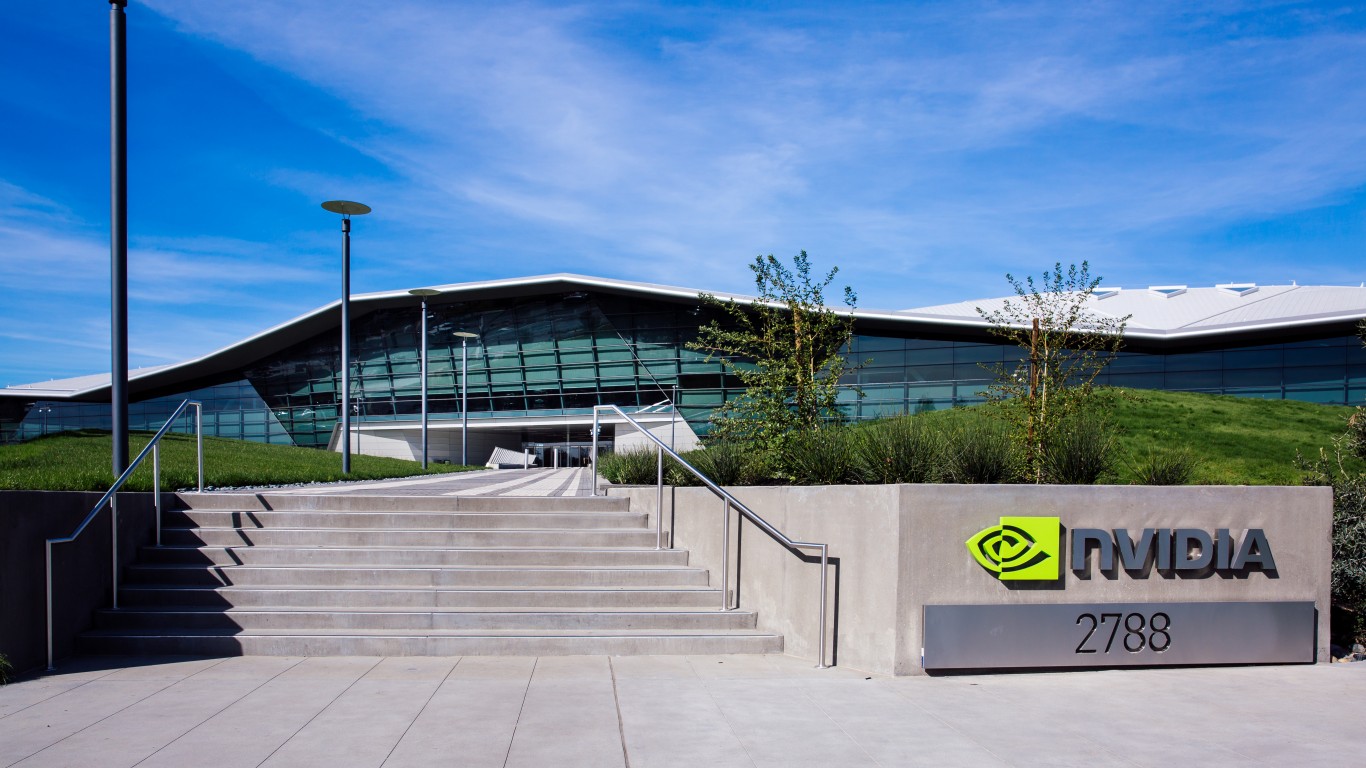
Nvidia Corporation is an American multinational corporation and technology company headquartered in Santa Clara, California,
The company traded under $10 per share from 2000 to 2015, pioneered many technologies on which AI applications depend.
Nvidia graphic cards got the party started

NVIDIA holds approximately 80% of the global market share in GPU semiconductor chips as of 2023.
The Nvidia graphics processing units (GPUs) helped the gaming industry explode and were the go-to chips for processing multiple tasks simultaneously. While Nvidia is still a massive player in the gaming world, the AI explosion changed everything.
Ten years ago, Nvidia traded between $3.93 and $4.78 on a closing basis

Nvidia expects revenue of $24 billion in the first quarter of fiscal 2025.
If we average those January and December 2014 closing prints and assume that not all the stock was bought at once, a buyer likely would have an average print of about $4.36 per share. That would translate to approximately 4,587 shares.
Don’t forget about the stock split

NVIDIA has split five times in its history.
In the summer of 2021, the company conducted a four-for-one split. Now, our very savvy 2014 buyer is holding 18,348 company shares.
Nvidia explodes higher starting in October of 2023

Vanguard is the biggest shareholder with 204.5 million shares.
The low close in October of last year was a stunning $407.80, and since then, the stock has skyrocketed up an incredible 127% and traded at an all-time high of $926.69 on March 6, 2024.
Nvidia sold off 7.4% in the last week and closed recently at $856.16
With a huge share count that is on the books at an average cost of $1.09 per share due to the stock split, there are two ways to figure the massive gain:
If all of the stock was sold at the March 5th closing all-time high the sale would yield a incredible $17,002,908-$20,000 cost = $16,982,908
If the sale were conducted now, the shares would fetch a massive $15,708,823-$20,000 cost= $15,688,823











 Top Gaining Stocks
 Top Losing Stocks