


Michael Muir discusses the relative strengths and roles of global navies, emphasizing the dominance of the U.S. and China. He highlights Russia’s submarine capabilities and Indonesia’s extensive coastal fleet. The conversation also covers historical examples of asymmetric naval strategies and the differences between power projection and localized naval strength.
Transcript:
Michael, we just had a really great conversation about aircraft carriers.
Now, I’d love to look at navies in general.
In many ways, aircraft carriers are sort of the flagship, the kingpin of global navies, but they are still relatively rare on the global stage.
When we look at the totality of navies in different countries and the different power that they can project on Earth, what are some of the strongest navies that people need to be aware of?
Well, I mean, there’s the obvious answer, which is going to be the United States and China.
And they’re just so far in front of the rest of the naval powers. They’re basically in a whole category of their own.
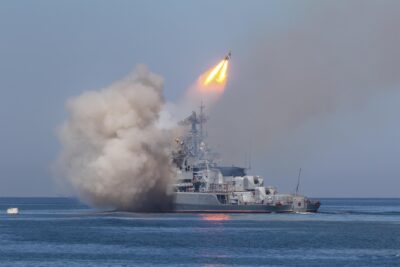
Just sort of the best of the rest would still be Russia. I know there’s a lot of things we said about the performance of the Black Sea fleet in the Ukraine war.
But they still have a very powerful Navy in other regions.
And I would say that the Russian Navy’s main strength isn’t so much in surface ships, but submarines, just like the USSR was. So they still have a very large number of submarines.
I’ll get to the United States and China in just a moment.
But one nation you wouldn’t really associate with naval strength would be Indonesia.
Now, the main reason is that Indonesia, as you may be aware, has a lot of islands.
In fact, there are so many islands in Indonesia, they don’t even know how many they have. I believe they launched an effort to actually count them.
The main areas of naval strength in the Indonesian Navy are in OPVs, which is offshore patrol vessels.
If you have 17,000, roughly, islands, you need a lot of ships to safely patrol and secure your maritime borders.
So in terms of raw numbers, Indonesia is actually one of the largest navies in the world. But in terms of power projection, it’s all very local. So they have a lot of coastal strength.
I love this point. I just love to pause on it real quick and give people some examples here and figures.
So you assembled some and you said, you know, Indonesia has four submarines, seven frigates, 25 corvettes, nine mine warfare, which these are consequential vehicles, but maybe not at a high volume. And then they have 170 OPVs.
So this is a very coastally competent naval operation. And when we think about maybe the changing dynamics of asymmetric warfare, a large number of smaller vehicles in the right theater can be extremely meaningful, right? Am I correct?
Yeah, no, that’s an interesting point you bring up because we actually have a pretty strong historical example there. Actually, a couple of them.
But when we have an established power that is way out in front of the rest, the next group or the ones behind usually have to think of different ways to bridge the gap. And that’s either by embracing new technology or new methods of warfare.
We can go back to the American Civil War. We can look at the Confederacy and the Union. The Union’s surface fleet was on an entirely different level. So the Confederacy didn’t try to catch them one to one. They tried to develop different weapon systems.
So what we got there was a submarine, which was a complete disaster. It killed more Confederate sailors than it did Union sailors, but that’s beside the point. And torpedoes, which we would today think of as mines.
So they’re trying to use, and ironclads as well. So they’re trying to use different methods to bridge the gap.
We also have the example of the British and the French. Okay, the British had the greatest battle fleet ever assembled at that time, the French couldn’t possibly hope to catch up in terms of battleships.
So they developed a whole other system called Jeune Ecole, which means young school to emphasize speed mobility commerce rating to bridge the gap. So that’s really tying into what we’re seeing today really has a lot of historic examples.
So, Michael, is it fair to say, you know, naval power, U.S. and China in a class of their own, Russia very much the third, but still much more potent than people realize.
And we look at the Black Sea performance in Ukraine has been somewhat embarrassing, but also a fear that is almost perfectly set up to disadvantage that Navy, right, given their bias towards some of these, given the lack of mobility in the Black Sea.
I mean, almost, I mean, correct me if I’m wrong, I believe almost all of the gains that Ukraine has had in the Black Sea conflict have been with stationary naval vehicles. And when you get into the open sea, perhaps Russia’s navy becomes a lot more potent.
Well, absolutely. You know, with the Black Sea, you have, I mean, Turkey or prior to that, the Ottomans have been the gatekeepers to the Black Sea since the fall of Constantinople in the 15th century.
So the Black Sea fleet, it’s kind of misleading almost to call it that because it just has such limited operational range, which greatly diminishes what it can and can’t do.
And as we’re seeing the rise in kamikaze drones and anti-ship munitions are just getting that much better. So in a confined space, they’re not much good, but in the wide open seas, which is still the vast majority of our planet, they’re a lot more useful.
Interesting. And I love your point on Indonesia sort of being a dark horse, fourth Navy here. But again, like we talked about, theater matters and it’s not raw ship volume or even raw types of ships, but maybe I’m sorry, size of ships, but maybe the types of ships in the specific theater that could play there.
Maybe, you know, the Indonesian Navy might have performed a lot better in a Black Sea theater, just given how relatively constrained it is, just for illustration about how different these dynamics are.
Yeah, but I mean, again, it’s maybe not the fairest comparison. And again, the Indonesian naval strength is local. It’s entirely within its own borders. It has next to no power projection.
But when we were assembling that, we were just talking about the totality of the naval strength. So if you just sort of add them together, and it’s not really an easy scale to do it, but for what they need to achieve and what they what they can are capable of, then Indonesia is actually right up there.
But if we’re talking about power projection, then we have to go a little further down the list and we start looking at, you know, sort of our traditional naval powers like Britain. The Royal Navy is much smaller than it used to be, but they are still have significant power projection capabilities.
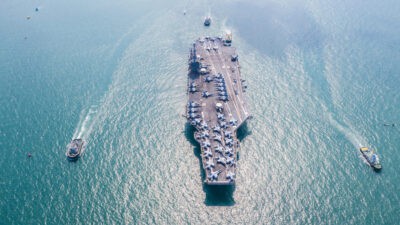
They have two aircraft carriers. Only China and the United States have more. France, again, they’re probably just ahead of the Royal Navy now at long last. And again, in terms of power projection.
But most navies in the world are what we call green water navies. That is, they patrol their own coastal waters and maintain their own territorial sovereignty. And very few of the world’s naval powers are actually capable of operating far from their own borders.








 Top Gaining Stocks
 Top Losing Stocks