


24/7 Wall St. Key Points:
Watch the Video
Transcript:
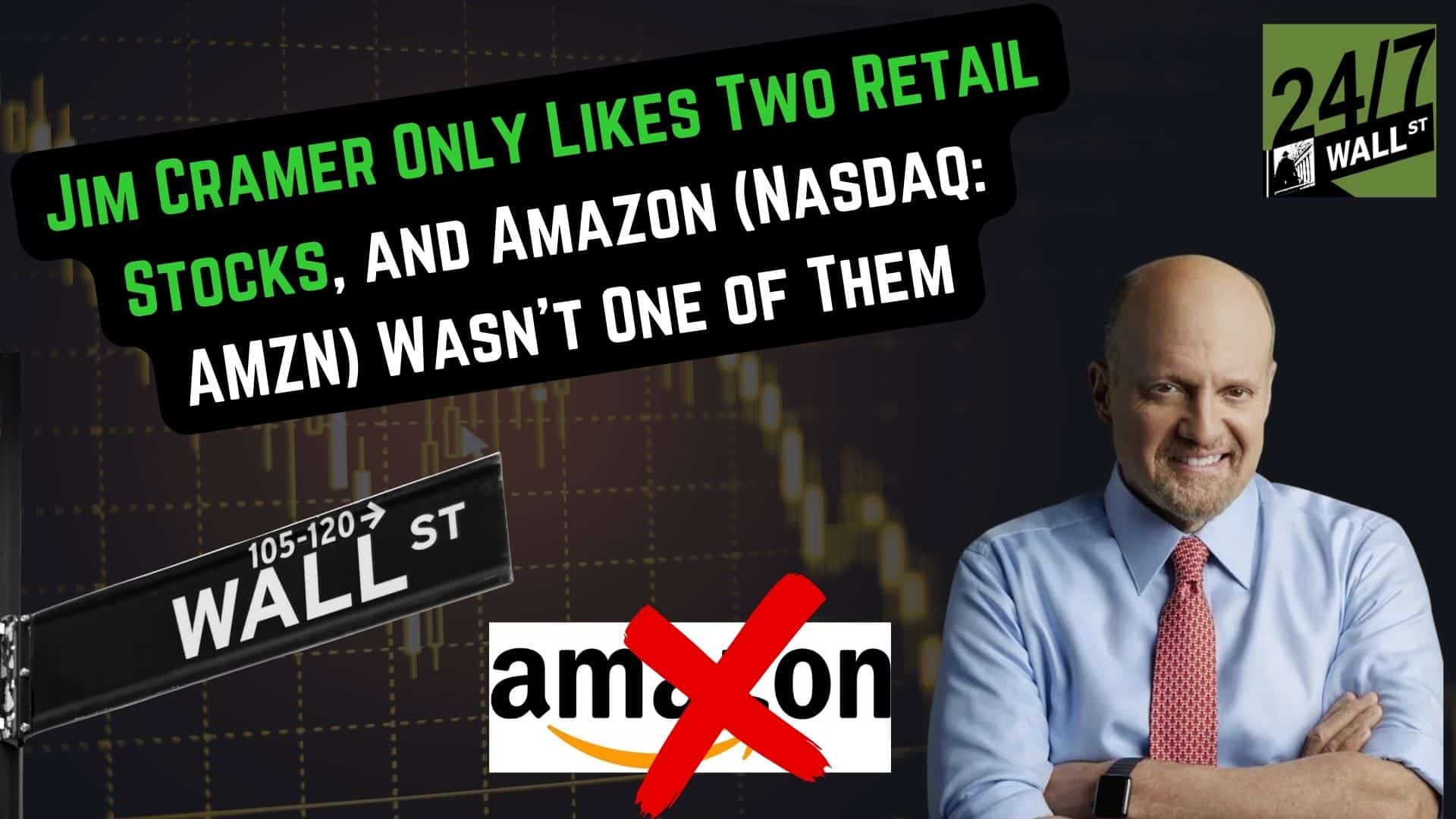
[00:00:04] Doug McIntyre: Jim Cramer said yesterday. You mean your pal? Jim Cramer. My pal Jim Cramer, who I went to college with, said yesterday that he only likes two retailers. oh, Walmart. And he likes Costco. Those are the two biggest retailers. He likes Walmart because of the footprint. Costco because everything there is so cheap.
[00:00:26] Doug McIntyre: He also didn’t say this, but one of the reasons that anybody who’s smart should, like Costco is the membership fee. The membership fee is about 2% of revenue and 72% of gross profit because there’s no cost against it. it’s,
[00:00:50] Lee Jackson: Well, ostensibly probably a little bit, but it’s pocket change compared to what it brings in.
[00:00:57] Doug McIntyre: Yeah. So if you look at Cramer’s comments there, Walmart and Costco are both up. I mean, they’re, way outperforming the market and as a whole bunch of retailers aren’t. But when people look for stocks that could do well, and I go back to the idea of moat. Trying to compete with Walmart is impossible.
[00:01:21] Doug McIntyre: And now that they have a powerful e-commerce operation, even Amazon, Walmart is now a real competitor to them. it wasn’t 20 years ago, it is now. And the Costco people, the idea of setting a a, fee people have to pay is brilliant. It’s absolutely brilliant. Of course, if you talk about recurring.
[00:01:43] Doug McIntyre: Gross profit. Nothing in retail drives it like that.
[00:01:47] Lee Jackson: Well, and plain and simple, if you don’t have your card, they don’t let you in. No. So I mean, I guess you can fool ’em for a little while, but I mean, that’s your entry pass. and there’s a lot of people, but Costco is especially. For middle income families is a necessary item when you have kids, things of that nature.
[00:02:07] Lee Jackson: Okay. Everything’s packaged in big boxes with a lot of it. Well, if you got a growing family, you need that. And you’re exactly right. Cramer’s right about this. And focusing now on Walmart and Costco makes a ton of sense.
[00:02:23] Doug McIntyre: Yeah. I would get out of virtually every other retailer and if I like the retail sector.
[00:02:30] Doug McIntyre: I would be in Walmart and Costco. I would, I disagree sometimes with what Jim Cramer says. I do not disagree with this.
[00:02:37] Lee Jackson: I think, well, I don’t either. And the thing is, especially if overall sales start to temper a little bit and everybody starts to slow down because credit card balances are up again, they’re way up.
[00:02:51] Lee Jackson: And that means that and, then a lot of stuff is being financed with the buy now, pay later. A company like Affirm (NASDAQ: AFRM | AFRM Price Prediction) people like that, and the one they’re trying to bring you public outta Europe, the Klarna. But the bottom line is things are gonna get tapped out and specialty retailers and high-end retailers are gonna get hammered if that happens.
[00:03:14] Lee Jackson: But Walmart and Costco hang in there.
[00:03:17] Doug McIntyre: Look, if the economy gets bad, you know whose car you’re gonna see over at the Walmart? Yours, mine
[00:03:24] Lee Jackson: And mine as well. And we don’t actually have a Costco near us. We have a Sam’s near us, but in fact the Sam’s and the Walmart are almost adjacent to each other, which doesn’t make sense, but yeah.
[00:03:38] Lee Jackson: You’ll see mine there as well. and a lot of middle income and upper middle income people. And the Walmart guy talked about that. They’ve shifted their grocery buying. From like, like an Albertsons (NYSE: ACI) or a Ralph’s or whatever, your local big, or even a Kroger (NYSE: KR), which is the biggest in the land, they’ve shifted their grocery buying because as, as much as Kroger can buy on a volume basis, they can’t touch what Walmart can buy.
[00:04:04] Doug McIntyre: No, and that’s another thing to like about Walmart is, that it’s a grocery store now. Yeah. I mean they, a lot of other stuff, but in a recession, you still have to have groceries. And you’re gonna go to the place where the groceries are fresh and they’re relatively inexpensive. So another reason to like Walmart and a downturn is there are things you buy in Walmart, sort of, you walk through and you see a t-shirt you want, but one of the people, reason the people will be at Walmart’s if there’s a recession is just because the food will be good and it’ll be inexpensive.
[00:04:42] Lee Jackson: We, could be ready to hit that point because we likely have a recession this year. Whether they’ll actually acknowledge it like they didn’t in 2022. But you can bet that the Walmart customer will stand firm and the Costco customer.
[00:04:59] Doug McIntyre: Yep. And new people who wanna save money will come over.
[00:05:03] Doug McIntyre: Start to shop there.
[00:05:04] Lee Jackson: Sure. the cheapest Walmart membership or Costco membership is, well, I don’t know what it is these days because we haven’t had one nearest, for a while. But it’s not unaffordable even for a middle class and even lower middle class family, they’ll gladly pay 50, 60, 70 bucks a year to have access to the cheaper prices.
[00:05:24] Lee Jackson: Exactly.






 Top Gaining Stocks
 Top Losing Stocks