


From an investor’s standpoint, there’s a lot to like about NVIDIA (NASDAQ:NVDA | NVDA Price Prediction). A strong revenue generator, NVIDIA produces graphics processing units (GPUs) that can handle today’s power-intensive artificial intelligence (AI) applications.
However, NVIDIA is definitely not a dividend king or even a dividend contender. NVDA stock only provides a forward annual dividend yield of 0.03%, and passive income hunters will probably want much more than that.
To that end, there’s an exchange traded fund (ETF) called the YieldMax NVDA Option Income Strategy ETF (NYSEARCA:NVDY) which offers a substantially higher annual yield than NVDA stock. You’ll undoubtedly want to capture the income opportunity that NVDY presents, but proceed with caution as the fund’s risks are considerable.
NVDY: Massive Yield, Paid Monthly
If you directly own NVIDIA stock shares, you’re not aiming for the maximum dividend yield. Instead, you’re probably hoping for NVDA share-price appreciation.
It’s the opposite scenario with the YieldMax NVDA Option Income Strategy ETF, which hasn’t provided spectacular share-price gains. Investors in NVDY are typically willing to accept subpar share-price performance because the fund pays large distributions each and every month.
Here’s how the YieldMax NVDA Option Income Strategy ETF works. Instead of directly holding NVIDIA stock shares, NVDY uses synthetic option strategies and then sells covered calls to generate income.
Additionally, the YieldMax NVDA Option Income Strategy ETF holds U.S. Treasury bonds, which can serve as collateral and may provide more income. It’s fine if you don’t fully understand complex strategies of NVDY, since the fund’s managers know how to work with options and Treasury bonds.
Granted, the YieldMax NVDA Option Income Strategy ETF deducts annual operating expenses of 1.27% from the fund’s share price. That’s a high rate of expenses for an ETF, but NVDY’s jaw-dropping yield more than makes up for the management fees.
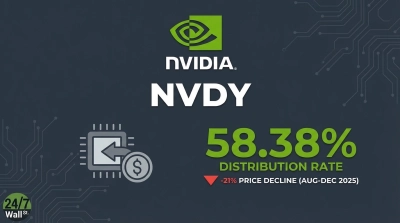
Astoundingly, the YieldMax NVDA Option Income Strategy ETF features an annual distribution rate (i.e., a dividend-like annualized yield) of 55.19%. This dwarfs the fund’s operating expenses, and it certainly outpaces the meager 0.03% annual dividend yield of NVIDIA stock.
And again, the NVDY ETF pays out its distributions on a monthly basis. Thus, ambitious investors could create a compounding effect by reinvesting the distributions every month back into shares of the YieldMax NVDA Option Income Strategy ETF.
There’s No Free Lunch With NVDY
An old saying warns that there’s no free lunch in the financial markets. With the YieldMax NVDA Option Income Strategy ETF, sensible investors should wonder whether the fund’s risks outweigh the gigantic 55.19% distribution rate.
Using a covered call strategy means that even if NVIDIA stock shoots to the moon, the share-price upside potential will be limited with the YieldMax NVDA Option Income Strategy ETF. Hence, while you might be ultra-bullish about NVDA stock, don’t expect the NVDY share price to follow the same upward trajectory.
Investors should observe that the YieldMax NVDA Option Income Strategy ETF doesn’t have a great share-price performance track record. Going forward, it shouldn’t be too surprising if NVDY experiences some share-price erosion.
Plus, regardless of how the YieldMax NVDA Option Income Strategy ETF, you’ll still have to pay the annual operating fees. Furthermore, there’s no guarantee that the NVDY ETF will continue to provide a 55.19% distribution yield in the future.
To help mitigate these risks, I’m deploying cautionary strategies. In particular, I’m maintaining a very small position size with the YieldMax NVDA Option Income Strategy ETF.
Along with that, I’m monitoring the NVDY share price and if it falls too fast, I’m prepared to sell my shares at a moment’s notice. Sure, the annual yield of the YieldMax NVDA Option Income Strategy ETF is breathtaking, but it’s not wise to stay on a ship if it’s sinking.
Not Too Risky If You’re Careful
In the final analysis, I won’t declare outright that the 55.19% distribution rate of the YieldMax NVDA Option Income Strategy ETF is too risky. At the same time, I’ll acknowledge that the risks are considerable and will be extremely careful with NVDY.
If you’re buying the YieldMax NVDA Option Income Strategy ETF, consider maintaining a tiny position size. If NVDY is only a small part of your overall portfolio, a share-price wipeout won’t put you in the poorhouse.
Moreover, investors should be watchful and willing to sell the YieldMax NVDA Option Income Strategy ETF if the losses become unmanageable. That way, you can use NVDY responsibly and, if all goes well, take advantage of the fund’s monthly distribution reinvestment opportunities.










 Top Gaining Stocks
 Top Losing Stocks