


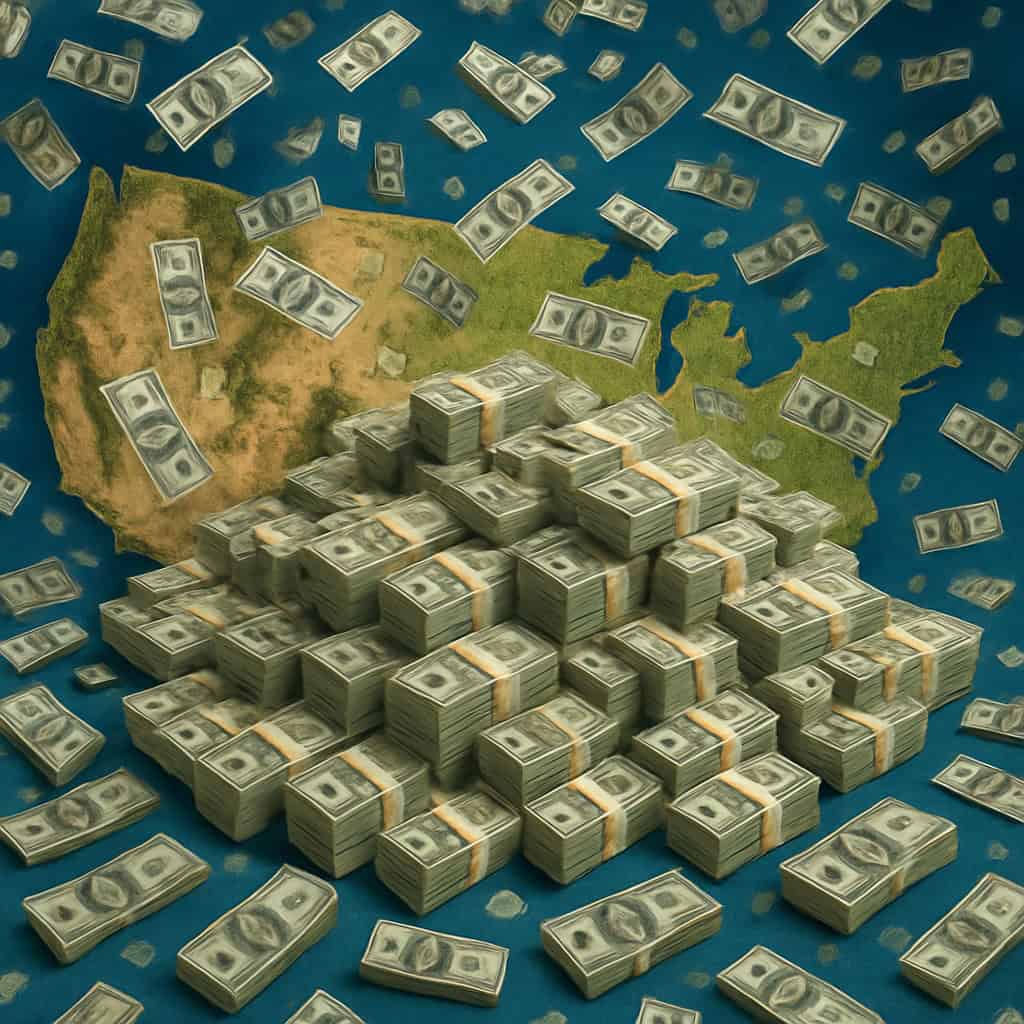
The most important aspect of the passage of the Big Beautiful Bill (BBB), was preventing the 2017 tax cuts from expiring. Had the BBB failed, middle class families would have had to pay an additional $2100 per year in taxes, while small business would have dealt with a top tax rate of 43.4%. Of great significance, large capital expenses and research could not have been fully deducted immediately, which would have caused economic contraction.
With $37 trillion of debt, and annualized interest payments of $1.2 trillion, prior to the BBB, our country was on the precipice of financial disaster. Thankfully, with unprecedented investment spurring GDP growth, the US should realize great prosperity, and begin to pay down the debt in the years to come.
Yet, why is there be a gap of up to $14.4 trillion of tax revenue from what the Congressional Budget Office (CBO) projected, to the estimate from the Council of Economic Advisers? The answer; the CBO is almost always wrong!
Income tax revenue from Trump’s 2017 tax cuts, produced an additional $2.6 trillion in 5 years. This, despite the CBO told us the tax cuts would cost $1.5 trillion over 10 years.
Thus, how could the CBO be off by trillions of dollars? Well, their flawed modeling does not allow for increased employment, GDP growth, and income tax revenues from tax cuts, nor decreased payments of governmental assistance for those who now have new or better jobs. Also, we anticipate productivity gains from AI, as Goldman Sachs projects 0.4% of added GDP, or $1.2 trillion.
For the BBB, the CBO projected GDP growth to be 1.8%. However, Director of the National Economic Council, Kevin Hassett, stated GDP growth would likely be in the vicinity of 4%, noting of $10 trillion of investment commitments, along with zero tariffs on businesses that manufacture products in the US. Additionally, when interest rates are finally lowered, this will generate significant income with real estate and capital investment.
Some major components of the BBB provide funding for the “Golden Dome”, to protect from nuclear attack, the border wall, and for the prioritized deportation of criminal illegal aliens. Medicaid cuts apply to those who are able bodied, and choose not to even look for a job or volunteer. This workfare was highly successful under the Clinton administration.
Although there are $1.6 trillion of spending cuts over 10 years from the BBB, we should have cut $1.6 trillion per year. In 2019, the budget was $4.45 trillion, yet in 2021 we spent $6.8 trillion, 50% more than prior to the Pandemic. Biden delivered $7.8 trillion of budget deficits, while national debt is currently at $37.1 trillion, with annualized interest payments of $1.2 trillion. This is not sustainable for funding government programs, and risks default.
However, the future is exceedingly bright given the stability of the passage of tax cuts in the BBB. $3 trillion of investment commitments have been procured for AI, while auto manufacturers and others are building plants in the US instead of Mexico. Domestic production avoids tariffs, while having a low tax rate, effectively in the vicinity of 15%, which spurs global investment in America.
What should be some solid growth stocks to hold for the long term? I’ll keep you in suspense, as in my next article, I will cite specific companies that would hopefully provide great returns over the exciting years to come. There could be some volatility with tariffs and the process of procuring better trade deals, so consider that with respect to investments in the coming weeks.








 Top Gaining Stocks
 Top Losing Stocks