



Finding dividend stocks that are reliable and have the balance sheet stability and cash flow profile to continue to grow their distributions over the long-term is what many investors are after.
However, putting in the time and effort to identify which specific single stocks meet the quality and growth criteria most investors have is easier said than done. That’s why I’m here, to dive into a wide array of stocks and pick the ones I think are worth considering. Selfishly, this research really is done for my portfolio, but I’m happy to share some of my findings here.
These top dividend kings are companies I’ve had on my radar screen for a long time as potential portfolio additions. Here’s why I’m considering adding these companies to my portfolio right now.
Lowe’s (LOW)
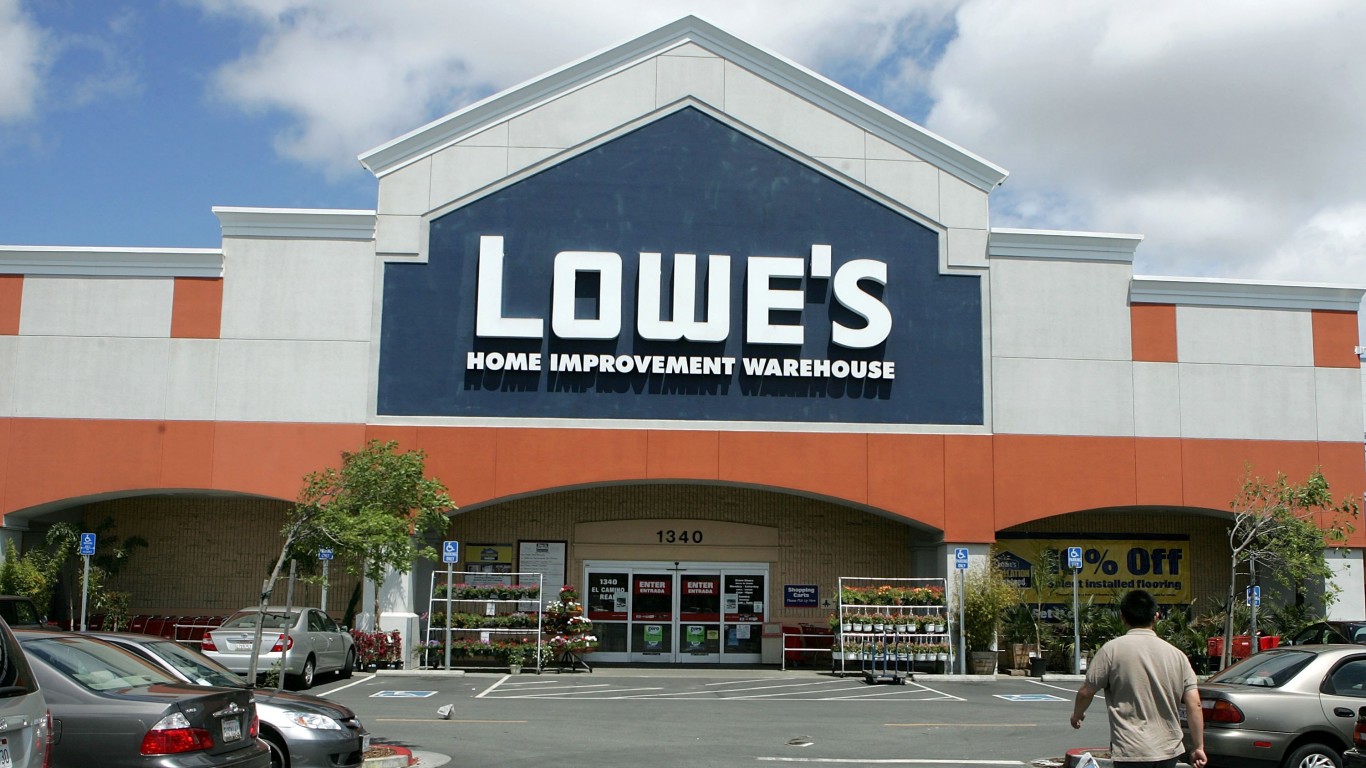
A Lowe’s location
Lowe’s (NYSE:LOW) | LOW Price Prediction may not be as prominent a player in the construction and home renovation space as Home Depot (NYSE:HD). However, this home improvement retailer has seen solid growth over the past five years (with its stock up more than 50%), though its more recent one-year return is negative.
Thus, the question for many investors is whether now is a good time to load up on this company, or by extension this sector. Indeed, interest rates remain high, applying pressure to homebuilders and homeowners, many of whom finance their projects. During the pandemic, when interest rates were near rock-bottom and everyone was sheltering in place, Lowe’s, Home Depot and any company that was tied to the home improvement/construction sector really outperformed.
Indeed, I view Lowe’s as a quasi-meta play on this overall sector. And while I don’t necessarily see light at the end of the tunnel for the industry yet, I do think that the U.S. will ultimately need to push the housing market out of its slump to resume growing again. If that’s the case, and investor demand for dividend kings like Lowe’s (which has raised its dividend for more than 60 years in a row) increases, this is a stock that could perform very well in the years to come.
PepsiCo (PEP)
Cases of Pepsi in a store
For investors who don’t think salty snacks and carbonated beverages will go out of style tomorrow, PepsiCo (NASDAQ:PEP) stands as a top options to consider in this market. The company’s portfolio of some of the most well-known global brands in this space has created a business which spits off a tremendous amount of free cash flow. Over the coming decades, I’d expect this trend to continue.
Organic revenue growth has remained in the high single digits for Pepsi, with its earnings and cash flow growth also coming in at very robust levels. This is the kind of backdrop that makes the company’s dividend growth track record of more than 50 years sustainable, and why I think this top consumer staples stock could be undervalued here.
One of the key factors with Pepsi I continue to come back to is the company’s dividend yield, currently at 3.9%. With Pepsi’s long-term dividend yield typically lower than where it’s at right now, I think there’s plenty of capital appreciation upside possible for this company, particularly if Pepsi and its management team continue to hit earnings out of the park moving forward.
Johnson & Johnson (JNJ)
Johnson & Johnson office sign
With a 62 year track record of raising its dividend distributions, healthcare giant Johnson & Johnson (NYSE:JNJ) is one of the most well-known and recognizable names on the “dividend kings” list most investors have on their desk.
I kid, but the reality is that Johnson & Johnson is a core holding of most funds for good reason. This healthcare company has built a well-diversified and stable business model which continues to grow at a very consistent rate over time. This revenue and earnings growth over time has largely been passed onto investors, with many viewing the stock as a mature cash cow of sorts to buy for stability.
Given the company’s positioning in the healthcare sector and its current dividend yield of 3.1%, such a view certainly makes sense. I’m of the opinion that as capital becomes more defensive, companies like JNJ could significantly outperform their peers. And with more than $20 billion in cash flow generated over the past year, there’s solid reason to believe that this dividend streak won’t be broken anytime soon, hence the very modest yield for this large-cap name.













 Top Gaining Stocks
 Top Losing Stocks