



Dealing From a Position of Strength
Palantir Technologies (NASDAQ:PLTR | PLTR Price Prediction) has solidified its position as a leader in the artificial intelligence (AI) and data analytics space with its latest quarterly results.
The company delivered a staggering $1 billion in revenue, a 48% year-over-year increase, marking its first-ever quarter surpassing the billion-dollar mark. U.S. revenue soared 68% to $733 million, driven by a 93% surge in the U.S. commercial segment and fueled by demand for its Artificial Intelligence Platform (AIP).
Adjusted earnings reached $0.16 per share, up 78% and handily beat Wall Street’s expectations of $939 million in revenue and $0.14 per share in earnings. The U.S. commercial customer count grew 64%, with total contract value in this segment skyrocketing 222% to $843 million.
These figures underscore Palantir’s ability to capitalize on the AI revolution, making it a compelling case for investors.
One Metric to Rule Them All
The Rule of 40 is a widely used benchmark in the software and technology sector to evaluate the balance between growth and profitability. It states that the sum of a company’s revenue growth rate (as a percentage) and its profit margin (typically adjusted operating margin or free cash flow margin) should equal or exceed 40.
This metric is particularly relevant for high-growth companies like Palantir, where investors seek a blend of rapid expansion and improving financial health. The Rule of 40 is often applied to assess Software-as-a-Service (SaaS) companies during periods of significant scaling, as it indicates whether a company can grow sustainably without sacrificing profitability.
For Palantir, this metric is a critical lens through which to view its performance, given its focus on AI-driven data analytics and its transition from government-centric contracts to a broader commercial market.
Why PLTR’s Rule of 40 Score Shines
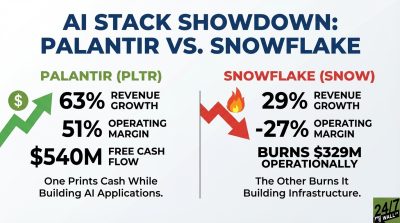
Palantir’s Rule of 40 score for its most recent quarter is an extraordinary 94%, a figure CEO Alex Karp described as “obliterating” the metric. This score is derived from the company’s 48% revenue growth rate and a 46% adjusted operating margin, reflecting its ability to scale rapidly while maintaining robust profitability.
This near-unprecedented number highlights Palantir’s operational efficiency and its success in leveraging AI to deliver value to clients. The strength of this score is driven by the company’s U.S. commercial segment, particularly its AIP, which has seen accelerating adoption across enterprises.
For context, a Rule of 40 score above 40 is considered strong, and Palantir’s 94% places it in an elite category, signaling that it is not only growing quickly but also generating significant cash flow to reinvest in innovation and expansion. This makes Palantir a standout in the AI and SaaS landscape.
Caveats to Palantir’s Rule of 40 Number
While Palantir’s Rule of 40 score is impressive, investors should approach it with caution due to its reliance on adjusted metrics. The company’s adjusted operating margin excludes stock-based compensation, a significant expense given Palantir’s generous equity grants to employees and executives.
In 2024, Karp’s compensation, largely in stock, was valued at $6.8 billion, which can inflate adjusted profitability figures. Additionally, Palantir’s revenue growth, while strong, is partly driven by large government contracts, which may not scale as predictably as commercial deals. The company’s high valuation — trading at 219 times forward earnings — also raises concerns about sustainability, as any slowdown in growth could lead to volatility.
Furthermore, insider sales, including Karp’s previously announced plan to sell up to $1 billion in shares, which was terminated in May 2025 after selling only a small portion, may signal caution. However, these 10b5-1 plans are often for diversification rather than a lack of confidence.
Key Takeaways
Palantir’s Rule of 40 score of 94% is a powerful indicator of its potential as a long-term investment. This metric demonstrates the company’s ability to balance explosive growth with profitability, a rare feat in the AI sector.
The surge in U.S. commercial revenue and customer growth, driven by AIP, suggests Palantir is capturing a significant share of the enterprise AI market, projected to be worth $2.6 trillion to $4.4 trillion over the next decade, according to McKinsey research.
Despite its lofty valuation and reliance on adjusted metrics, Palantir’s sticky customer base, with average trailing-12-month revenue from its top 20 customers at $75 million, and its expanding government contracts — including a recent $10 billion Army deal — provide a strong foundation for sustained growth.
For investors with at least a three-to-five-year horizon, but preferably a decade or more, Palantir’s ability to execute on its AI-driven mission makes it a compelling buy-and-hold opportunity, even amidst any potential short-term volatility.













 Top Gaining Stocks
 Top Losing Stocks