



A Stellar Year with a Sudden Jolt
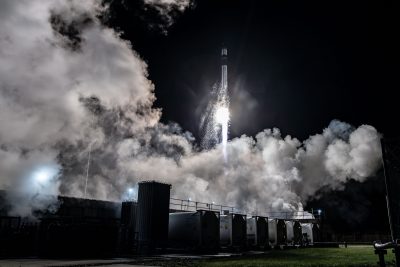
Rocket Lab (NASDAQ: RKLB | RKLB Price Prediction) has been a breakout star in the space economy, with its stock skyrocketing 600% in the past 12 months. The aerospace innovator, the second-largest space company and the closest rival to SpaceX, has carved a niche with its Electron rocket, delivering small satellites to orbit with unmatched frequency.
On Tuesday, RKLB shares jumped after the company celebrated the completion of its Neutron rocket launchpad, Launch Complex 3 (LC-3), at Wallops Island, Virginia, signaling it was making progress toward its medium-lift ambitions. Yet, just a day later, the stock plummeted 11.72%, closing at $43.53, as investors reassessed its lofty valuation.
With a robust $1 billion backlog, strong revenue growth, and new contracts on the horizon, is this dip a buying opportunity, or a sign of turbulence ahead?
Ready to Rocket to New Heights
The Neutron rocket is Rocket Lab’s ticket to competing in the medium-lift market, a significant leap from the Electron’s 300 kilogram (kg) payload capacity. Designed to carry up to 15,000 kg, Neutron aims to capture high-value contracts for satellite constellations, national security missions, and even interplanetary payloads.
Its inclusion in the Pentagon’s $5.6 billion National Security Space Launch program underscores its strategic importance, positioning Rocket Lab to challenge SpaceX’s Falcon 9 dominance. Rocket Lab’s second-quarter revenue hit $144.5 million, up 36% year-over-year, driven by Electron’s 70 launches and a growing Space Systems segment, which accounted for 68% of second-quarter revenue. A $515 million Space Development Agency contract for 18 satellites further bolsters its backlog, with 58% of the total expected to convert to revenue within 12 months.
Neutron’s reusable design and cost-effective launches could push gross margins toward 40%, significantly boosting profitability if successful.
Valuation Remains a High-Flying Concern
Despite its promise, Rocket Lab’s valuation raises red flags. At a market cap of $21 billion after yesterday’s tumble, RKLB trades at over 40 times its trailing revenue, a premium that reflects investor enthusiasm but leaves little room for error.
The company also remains unprofitable, reporting a $118.8 million operating loss year-to-date, with an EBITDA margin of around -36. While analysts project breakeven by 2027, the current cash burn and $300 million to $600 million needed for Neutron’s steady-state operations highlight the execution risks Rocket Lab faces.
Competitive pressures from SpaceX’s rideshare services and potential delays in Neutron’s late-2025 debut — skeptics like Bleecker Street Research suggest a 2026-2027 timeline — could further weigh on sentiment if they’re right.
Yesterday’s 12% drop likely reflects profit-taking as investors grapple with these losses against a stretched valuation.
Profit-Taking or a Warning Signal?
The sharp pullback follows a pattern familiar to high-growth stocks: a surge driven by milestones like the LC-3 opening, followed by a reality check. With RKLB’s stock up 600% in a year, early investors may be locking in gains, especially as the company’s $190 million annual EBITDA losses contrast with its $21 billion market cap.
The Nasdaq’s 1% gain yesterday suggests broader market stability, pointing to RKLB-specific reassessment rather than any sector-wide pressure. This dip may be a healthy correction, but the stock’s premium pricing demands caution, as any Neutron delays or launch failures could trigger further declines.
Key Takeaway
Rocket Lab’s long-term outlook is undeniably bright, with Neutron’s potential to unlock billion-dollar revenue streams and a growing footprint in defense and commercial markets. However, its high valuation and persistent losses make buying at current levels risky.
Yesterday’s stock tumble may prompt further reassessments (however, RKLB stock is up almost 2% in premarket trading today), especially if Neutron’s timeline slips or competition intensifies.
Waiting for a better entry point could offer a smarter path for investors eyeing this space contender, particularly as Wall Street has just a $46 one-year price target on the stock. Rocket Lab is likely a long-term winner, but that doesn’t mean buying it at any price.










 Top Gaining Stocks
 Top Losing Stocks