


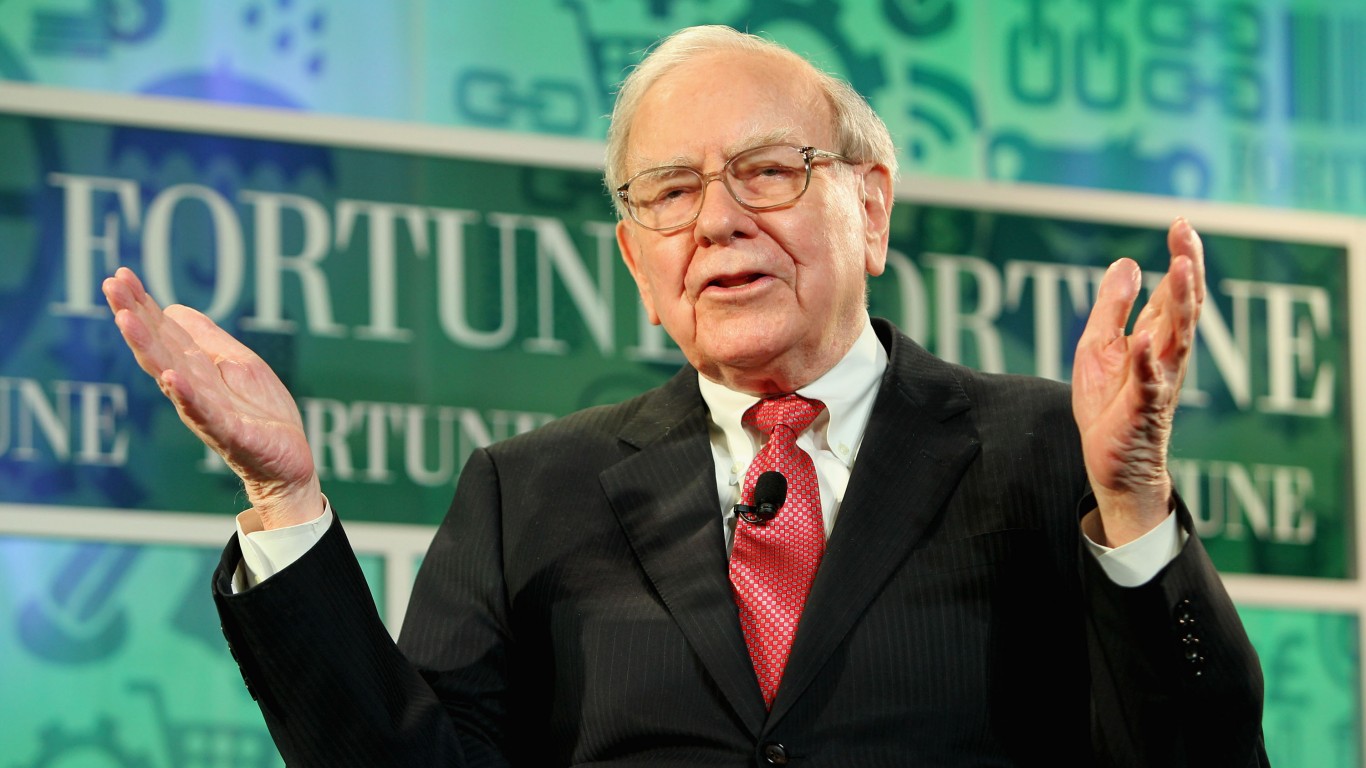
Warren Buffett remains one of the world’s most prominent investors, renowned for his long-term buy-and-hold strategies and extensive portfolio of public and private holdings. With interest rates poised to decline, it makes sense to consider adding Buffett’s dividend-paying stocks, which are expected to rally as bond yields fall. However, the dividend stocks we were particularly interested in are those that Buffett owns through his “secret portfolio.” These are the holdings of New England Asset Management (NEAM), which Berkshire Hathaway indirectly owns.
We have been aware of Buffett’s “secret portfolio” for some time, but it took some digging to discover NEAM’s connection to Berkshire Hathaway Inc. (NYSE: BRK-B | BRK-B Price Prediction). Buffett owns NEAM, but indirectly. NEAM is a wholly owned subsidiary of General Re, which in turn is a subsidiary of Berkshire Hathaway. Since Buffett is the CEO and largest shareholder, he effectively owns NEAM through this corporate structure. The securities NEAM holds in its investment portfolio are ultimately owned by Berkshire Hathaway. This arrangement has created what some financial media refer to as “Buffett’s hidden $5.9 billion portfolio” or his “secret portfolio,” since NEAM operates as an investment management subsidiary with its own holdings that are separate from Berkshire’s leading stock portfolio but still ultimately owned by the investment goliath.
Try This: Suze Orman Says This Is the One Expense You Must Cut in Retirement
Greg Abel officially takes over as CEO of Berkshire Hathaway on January 1, 2026, and plans to uphold Berkshire’s decentralized, trust-based culture. It is likely that he will bring his own operational expertise to the conglomerate, having successfully overseen principal Berkshire subsidiaries and demonstrated his business acumen through deals like Cal Energy’s expansion.
Wall Street appears unanimous in its view that Abel is well-positioned to maintain the company’s long-term value investing philosophy while potentially introducing more hands-on operational management. Buffett will remain as board chair after Abel takes over as CEO, providing continuity during the leadership transition at one of America’s most closely watched companies.
What we are very curious about here at 24/7 Wall St. is whether, under new leadership, Berkshire Hathaway will add more high-yield value stocks like the ones in the “secret portfolio.” We screened the entire holdings at the firm and found five stocks that appear to be perfect fits in Berkshire Hathaway. All are Buy-rated across Wall Street and pay outstanding, reliable dividends.
Why do we cover high-yield value dividend stocks?

High-yield dividend stocks offer investors a reliable source of passive income. Passive income is characterized by its ability to generate revenue without requiring the earner’s continuous active effort, making it a desirable financial strategy for those seeking to diversify their income streams or achieve financial independence.
Consider This: Dave Ramsey: “You Make $140K. Stay Out of Restaurants, Don’t Go on Vacation, And Get Rid of the Ferrari Bike”
American Electric Power
American Electric Power Co. Inc. (NYSE: AEP) is one of the largest electric utility companies in the United States, serving more than 5 million customers across 11 states. This industry-leading utility pays investors a reliable dividend yield of 3.43%. American Electric is an electric public utility holding company that generates, transmits, and distributes electricity for sale to retail and wholesale customers in the United States.
It operates through:
- Vertically Integrated Utilities
- Transmission and Distribution Utilities
- AEP Transmission Holdco
- Generation & Marketing
The company generates electricity using:
- Coal
- Lignite
- Natural gas
- Renewable energy
- Nuclear energy
- Hydro
- Solar energy
- Wind and other energy sources
It also supplies and markets electric power wholesale to other electric utility companies, rural electric cooperatives, municipalities, and other market participants.
Morgan Stanley has an Overweight rating with a target price of $117.
Kinder Morgan
Kinder Morgan Inc. (NYSE: KMI) is one of North America’s largest energy infrastructure companies, offering shareholders a dividend yield of 4.34%. This is one of the top energy stocks and remains a Wall Street favorite, paying a solid and dependable dividend. Kinder Morgan is an energy infrastructure company in North America.
The company operates through four segments:
- Natural Gas
- Products
- Terminals
- CO2
The Natural Gas Pipelines segment owns and operates:
- Interstate and intrastate natural gas pipeline and underground storage systems
- Natural gas gathering systems and natural gas processing and treating facilities
- Natural gas liquids fractionation facilities and transportation systems
- Liquefied natural gas liquefaction and storage facilities
The Products Pipelines segment owns and operates refined petroleum products, crude oil, and condensate pipelines, as well as associated product terminals and petroleum OKE pipeline transmission facilities.
The Terminals segment owns and operates liquids and bulk terminals that store and handle various commodities, including:
- Gasoline
- Diesel fuel
- Chemicals
- Ethanol
- Metals
- Petroleum coke
Lastly, the CO2 segment produces, transports, and markets CO2 to recover and produce crude oil from mature oil fields. It owns interests in or operates oil fields, gasoline processing plants, and a natural oil pipeline system in West Texas. It holds and runs approximately 83,000 miles of pipelines and 144 terminals.
Wells Fargo has an Overweight rating with a $34 target price.
Pfizer
Pfizer Inc. (NYSE: PFE) was established in 1849 in New York by two German entrepreneurs. This top pharmaceutical stock, which pays a huge 6.83% dividend, was a massive winner in the COVID-19 vaccine sweepstakes, but has been crushed over the past two years as many people have not received boosters. Pfizer discovers, develops, manufactures, markets, distributes, and sells biopharmaceutical products worldwide. It pays a dependable dividend, which has risen yearly for the past 14 years.
The company offers medicines and vaccines in various therapeutic areas, including:
- Cardiovascular, metabolic, and women’s health under the Premarin family and Eliquis brands
- Biologics, small molecules, immunotherapies, and biosimilars under the Ibrance, Xtandi, Sutent, Inlyta, Retacrit, Lorbrena, and Braftovi brands
- Sterile injectable and anti-infective medicines and oral COVID-19 treatment under the Sulperazon, Medrol, Zavicefta, Zithromax, Vfend, Panzyga, and Paxlovid brands
Pfizer also provides medicines and vaccines in various therapeutic areas, such as:
- Pneumococcal disease, meningococcal disease, and tick-borne encephalitis
- COVID-19 under the Comirnaty/BNT162b2, Nimenrix, FSME/IMMUN-TicoVac, Trumenba, and the Prevnar family brands
- Biosimilars for chronic immune and inflammatory diseases under the Xeljanz, Enbrel, Inflectra, Eucrisa/Staquis, and Cibinqo brands
- Amyloidosis, hemophilia, and endocrine diseases under the Vyndaqel/Vyndamax, BeneFIX, and Genotropin brands
Pfizer anticipates full-year 2025 revenues in the range of $61.0 billion to $64.0 billion. This includes the expectation that revenues from COVID-19 products in 2025 will be broadly consistent with those in 2024, after excluding approximately $1.2 billion of non-recurring revenue for Paxlovid in 2024.
Jefferies has a Buy rating, accompanied by a $33 target price.
U.S. Bancorp
Based in Minneapolis, this super-regional financial giant is an outstanding choice for growth and income investors now, offering a hefty 4.11% dividend to shareholders. U.S. Bancorp (NYSE: USB) is a financial services holding company.
The bank’s segments are:
- Wealth
- Corporate
- Commercial and Institutional Banking
- Consumer and Business Banking
- Payment Services
- Treasury and Corporate Support
It offers a comprehensive range of financial services, including lending and deposit services, cash management, capital markets, and trust and investment management services. It also engages in credit card services, merchant and ATM processing, mortgage banking, insurance, brokerage, and leasing.
The company’s banking subsidiary, U.S. Bank National Association (USBNA), is engaged in the banking business, principally in domestic markets. USBNA provides a range of products and services to individuals, businesses, institutional organizations, governmental entities, and other financial institutions.
The non-banking subsidiaries offer investment and insurance products to customers primarily within their domestic markets, as well as fund administration services to a range of mutual and other funds.
Oppenheimer has an Outperform rating with a target price of $67.
Verizon
Verizon Communications Inc. (NYSE: VZ), commonly known as Verizon, is an American multinational telecommunications company that continues to offer tremendous value and a large 6.13% dividend. It trades at 9.13 times its estimated 2026 earnings and is up almost 10% in 2025. Verizon provides a range of communications, technology, information, and entertainment products and services to consumers, businesses, and government entities worldwide.
It operates in two segments:
- Verizon Consumer Group
- Verizon Business Group
The Consumer segment provides wireless services across the United States through Verizon and TracFone networks, as well as through wholesale and other arrangements. It also provides fixed wireless access (FWA) broadband through its wireless networks and related equipment and devices, such as smartphones, tablets, smartwatches, and other wireless-enabled connected devices.
The segment also offers wireline services in the Mid-Atlantic and northeastern United States through its fiber-optic network, Verizon Fios product portfolio, and copper-based network.
The Business segment provides wireless and wireline communications services and products, including:
- FWA broadband
- Data
- Video and conferencing
- Corporate networking
- Security and managed network
- Local and long-distance voice
Network access services to deliver various IoT services and products to businesses, government customers, and wireless and wireline carriers in the United States and internationally.
Goldman Sachs has a Buy rating and a price target of $49.
Five Safe High-Yield Dividend Kings That Every Retiree Should Own






 Top Gaining Stocks
 Top Losing Stocks