



ProShares UltraPro QQQ (NASDAQ:TQQQ | TQQQ Price Prediction) is proof positive that you don’t need sophisticated trading know-how to get leverage in the financial markets. Instead of delving into NASDAQ 100 futures contracts or individual stock picking, you can simply use ProShares UltraPro QQQ to get magnified exposure to the biggest names in American technology.
While there are other triple-leveraged funds available on the market today, ProShares claims that its ProShares UltraPro QQQ is the “only ETF that targets 3x the daily returns of the Nasdaq-100 Index.” This makes TQQQ a unique financial product that could grow your account rapidly if U.S. large-cap technology stocks rally.
On the other hand, you’ll want to be prepared in case tech stocks fall, which would cause the ProShares UltraPro QQQ to lose value very quickly. Moreover, the TQQQ ETF could disappoint investors even if the NASDAQ 100 index goes higher, so be ready for unexpected outcomes.
Efficient Exposure to Tech Titans
Right off the bat, ProShares touts its UltraPro QQQ ETF as being efficient since it “offers 3x exposure” to the NASDAQ 100 “with less cash.” Thus, in theory at least, someone with a small account could use TQQQ to achieve similar results to an investor with a larger account.
In addition to efficiency, the ProShares UltraPro QQQ ETF offers convenience when compared to individual stock picking and futures-contract trading. With the TQQQ ETF, you can “[b]uy and sell leveraged exposure via a single ticker in a brokerage account.”
Be aware, however, that you’ll indirectly end up paying a price for the efficiency and convenience of the ProShares UltraPro QQQ. As it turns out, the TQQQ ETF imposes an expense ratio (i.e., an annual operating-expenses fee) of 0.82% of the share price.
Still, you may be glad to pay that price for triple-leveraged access to some of the most famous names in American technology. You’ll find familiar NASDAQ 100 names in the holdings list of the ProShares UltraPro QQQ ETF; some examples include NVIDIA (NASDAQ:NVDA), Microsoft (NASDAQ:MSFT), Apple (NASDAQ:AAPL), Amazon (NASDAQ:AMZN), and Broadcom (NASDAQ:AVGO).
At first glance, it might seem like you can’t possibly lose with the ProShares UltraPro QQQ ETF since it’s packed with U.S. tech-sector leaders. However, as we’ll discuss in a moment, the TQQQ ETF can yield unanticipated results for long-term shareholders.
Volatility Issues to Consider With TQQQ
ProShares doesn’t hide the fact that its ProShares UltraPro QQQ only has a “daily investment objective” of tripling the price move of the NASDAQ 100. Indeed, for “any holding period other than a day,” ProShares acknowledges that “your return may be higher or lower than the Daily Target” and that these “differences may be significant.”
So, let’s say the ProShares UltraPro QQQ declines 3% and then recovers 3%. Or, the opposite happens in which TQQQ rises 3% and then falls 3%.
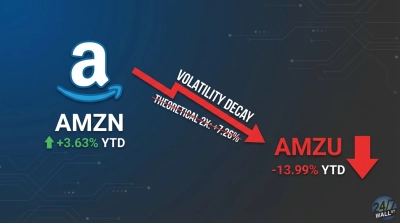
Either way, the final price of the PProShares UltraPro QQQ will end up slightly lower than where it started. This is a mathematical phenomenon that some traders call “volatility decay.”
The underlying index, which is the NASDAQ 100, is bound to fluctuate. As a result, volatility decay can drag on the price of the ProShares UltraPro QQQ ETF even when tech stocks are generally on an uptrend.
Now, we can better understand why the ProShares UltraPro QQQ is up 35% year to date, which is less than 3x the 17.4% gains of the NASDAQ 100 index. So far this year, TQQQ has basically doubled the results of the NASDAQ 100 instead of providing triple the results.
The point is that you can confidently hold the ProShares UltraPro QQQ for a day and achieve 3x the price move of the NASDAQ 100. Beyond that, you may end up with disappointing outcomes due to the aforementioned 0.82% expense ratio and because of volatility decay.
Go Big, but Stay Small
With a small or large account size, you can “go big” with the efficient triple leveraged offered by theProShares UltraPro QQQ. It’s a convenient way to get portfolio exposure to established U.S. technology names with potentially magnified results.
Nevertheless, it’s wise to keep your position size small with the TQQQ ETF. This fund moves fast, and a dip in the NASDAQ 100 could result in a deep downturn in the ProShares UltraPro QQQ.
Besides, investors should consider the negative impacts of the fund’s expense ratio as well as volatility decay. Therefore, even if you’re bullish about tech stocks, it makes sense to keep your position size small with the ProShares UltraPro QQQ and to only hold it for short periods of time.













 Top Gaining Stocks
 Top Losing Stocks