


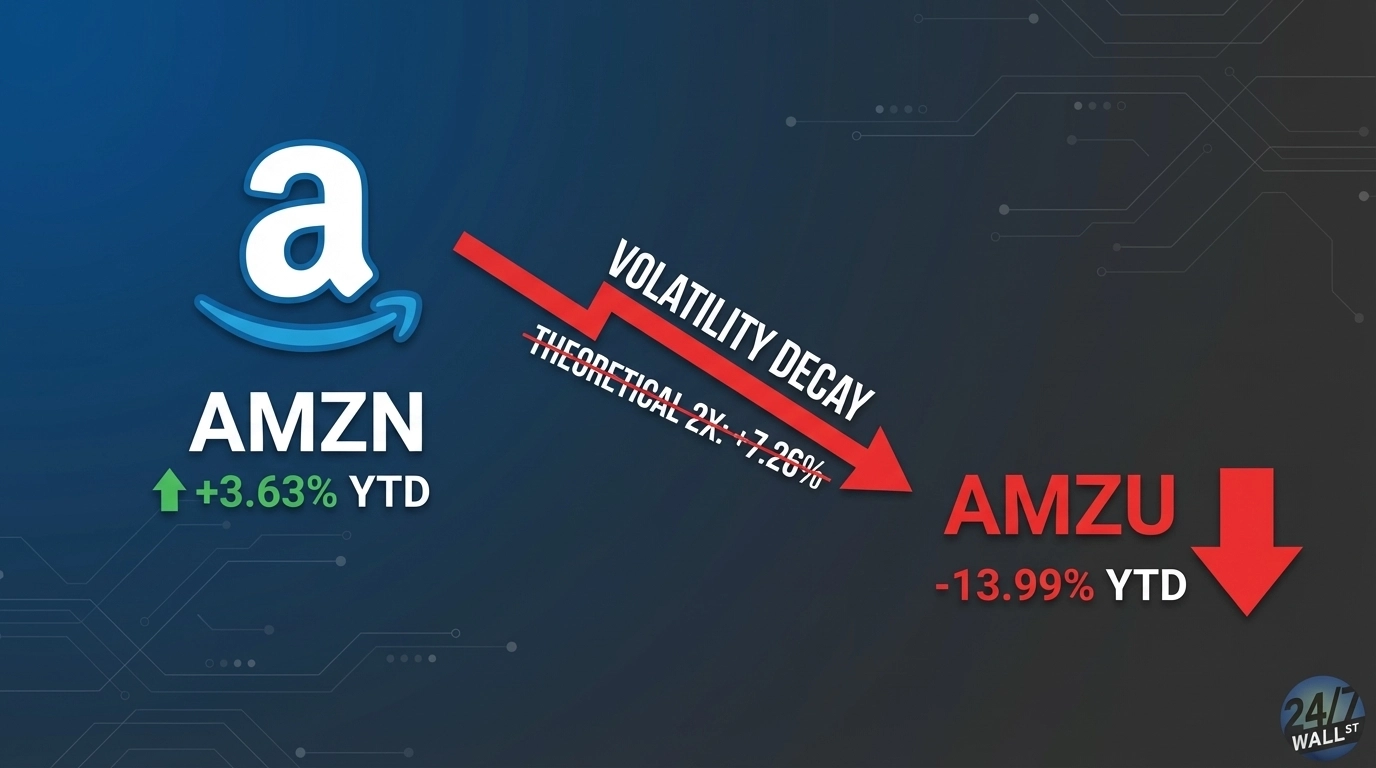
Direxion Daily AMZN Bull 2X Shares (NYSEARCA:AMZU) offers 200% daily exposure to Amazon (NASDAQ:AMZN | AMZN Price Prediction), but its mechanics reveal why it’s designed for short-term traders, not income investors. Understanding how AMZU generates distributions and its structural risks is critical before investing.
How AMZU Generates Income
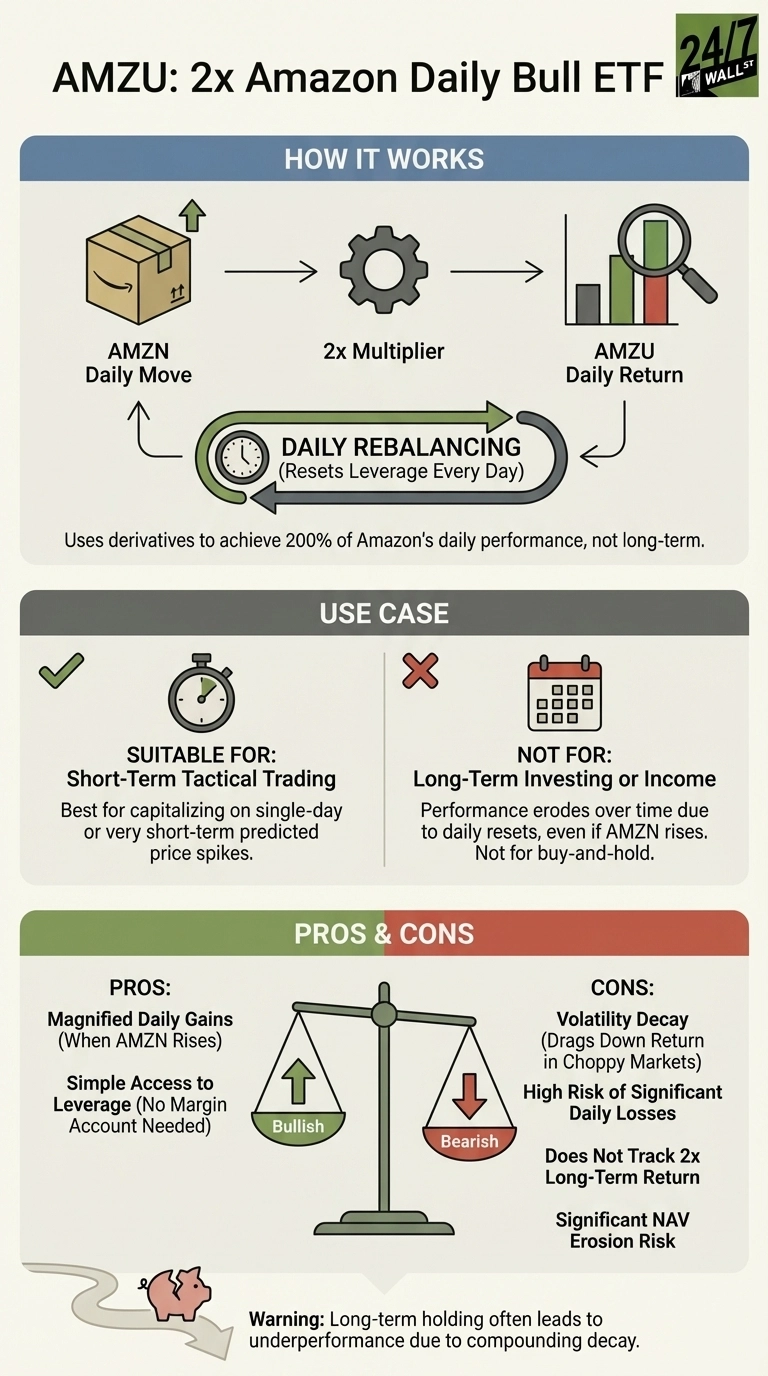
AMZU doesn’t generate income through traditional dividends. It uses derivatives, swaps, and daily rebalancing to achieve 200% exposure to Amazon’s daily price movements. When Amazon pays a dividend, AMZU receives the distribution amplified through leverage, but at significant cost. The ETF paid a $1.20 special dividend in December 2025, but this must be evaluated against substantial NAV erosion from volatility decay.
The fund holds only 13.57% in direct Amazon equity, with the remainder in derivatives for daily 2x leverage. This structure resets leverage daily, creating compounding drag that destroys long-term returns even when the underlying stock performs well.
The Devastating Math of Leverage Decay
While Amazon declined 1.64% over the past year, AMZU lost 23.15% – nearly 20 percentage points beyond what 2x leverage predicts. The S&P 500 gained 12.63% and the Nasdaq-100 surged 20.70% over the same period.
Year-to-date through December 2025, Amazon gained 3.63%, which should theoretically produce a 7.26% return for AMZU. Instead, the fund lost 13.99% – a 21-percentage-point shortfall from volatility decay. This occurs because daily resets lock in losses during choppy markets. When Amazon drops 2% one day and rises 2% the next, AMZU doesn’t return to breakeven due to compounding effects.
Recent volatility illustrates the problem. In December 2025, Amazon experienced multiple 3-4% daily swings, with intraday ranges exceeding $7. On December 17, the stock dropped 4.4%. These moves amplify decay as AMZU rebalances derivatives at the worst times.
Distribution Sustainability and Total Return Reality
While AMZU’s $1.20 special dividend might seem attractive, total return matters more. High yield means nothing if the ETF price collapses. Since inception in September 2022, AMZU has consistently underperformed its theoretical 2x target during volatile periods.
Amazon’s fundamentals remain strong—Q3 2025 revenue of $180.2 billion and net income of $21.2 billion both beat estimates. AWS sales grew 20%, and the company maintains 24.3% return on equity with a healthy balance sheet. However, these positives don’t translate to AMZU performance due to daily resets.
The ETF’s $321.5 million in assets and limited three-year track record provide insufficient data for long-term distribution patterns. The structure guarantees volatility will erode returns over extended periods, making dividend sustainability irrelevant when capital losses exceed income received.
A Better Alternative for Leveraged Exposure
For leveraged technology exposure without single-stock concentration risk, ProShares UltraPro QQQ (NASDAQ:TQQQ) offers better diversification. TQQQ provides 3x daily exposure to the Nasdaq-100 Index, including Amazon alongside 99 other leading technology companies.
TQQQ generates income from dividends across the entire Nasdaq-100. The fund’s $24 billion asset base and track record since 2010 provide more reliable performance data. While TQQQ still suffers from volatility decay inherent to leveraged ETFs, diversification across 100 stocks creates smoother daily movements than AMZU’s single-stock concentration. For tactical traders seeking short-term leveraged exposure, TQQQ’s broader base and deeper liquidity make it more practical than betting 200% on Amazon alone.












 Top Gaining Stocks
 Top Losing Stocks