



Leveraged exchange-traded funds deliver a daily multiple of an underlying index’s return, using swaps and futures to reset exposure every session. The daily reset means multi-day performance depends on the path the index travels between the start and end points. Traders use these instruments to express short-horizon directional views over brief holding periods.
Context shapes how these funds behave: the VIX is close to 19, in the normal range after touching about 31 in late March and staying above 20 from March 2 through April 8. Choppy periods like that one are where compounding decay can chew through returns even when the underlying index recovers. The funds below each target a different slice of the U.S. equity market: the Nasdaq-100, the S&P 500, and the aerospace and defense sector.
TQQQ: A Three-Times Bet on Mega-Cap Tech
ProShares UltraPro QQQ (NASDAQ:TQQQ | TQQQ Price Prediction) seeks three times the daily performance of the Nasdaq-100 Index, according to the fund’s summary prospectus. That index is concentrated in large-cap technology and consumer platform names such as Apple, Microsoft, NVIDIA, Amazon, Meta, Alphabet, and Tesla, so the fund behaves as an amplified expression of mega-cap growth sentiment.
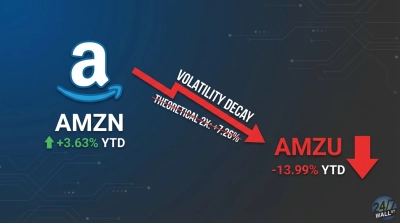
The amplification works in both directions, and recent data illustrate the mechanism. Over the past month, the Nasdaq-100 proxy returned roughly 10% while TQQQ returned about 37%. On a one-year basis, the same pairing shows 43% against 165%. In trending markets, the daily reset can deliver more than the stated 3x multiple over a window. In choppy markets, it can deliver less, and in drawdowns, the geometry is harsh.
TQQQ uses total return swaps and Nasdaq-100 futures to achieve its exposure. The fund is among the most heavily traded leveraged ETFs in the U.S. market, which provides active traders with tight spreads and a deep order book. The carrying cost of that leverage, embedded in swap financing rates, rises with short-term interest rates and is one reason ProShares markets the fund as a trading tool.
The trade-off is concentration layered on top of leverage. A sharp rotation out of mega-cap tech hits the Nasdaq-100 harder than the broader market, and TQQQ multiplies that hit by three each day. The ten-year split-adjusted return of 2,840% reflects a long bull run in the underlying; the funds are engineered for trending conditions.
UPRO: Amplified Exposure to the Broader U.S. Market
ProShares UltraPro S&P 500 (NYSEARCA: UPRO) targets three times the daily performance of the S&P 500 Index, according to the fund’s documentation. The reference index spreads exposure across roughly 500 large-cap U.S. companies, with sector weights tilted toward technology, financials, healthcare, communication services, and consumer discretionary. That diversification gives UPRO a different risk profile from TQQQ, even though both funds use the same 3x daily reset structure.
The volatility drag is typically smaller for a broad-market amplifier because the S&P 500 carries lower realized volatility than the Nasdaq-100. Recent data shows the pattern. The S&P 500 proxy returned about 8% over the past month while UPRO returned roughly 28%. Over one year, the underlying gained about 32%, and UPRO gained roughly 115%. The shortfall relative to a pure 3x multiple reflects daily rebalancing through the March VIX spike.
UPRO suits traders who want macro equity exposure without layering sector concentration on top of leverage. Earnings season rotations, single-stock shocks, and group-specific selloffs are absorbed across a larger set of constituents. The fund is liquid, uses the same swap and futures toolkit as other ProShares leveraged products, and carries the same disclosure that it is built for daily use.
Broad exposure still carries substantial drawdown risk. A 20% decline in the S&P 500 spread over weeks of elevated volatility can produce a UPRO drawdown well beyond 60%, and the recovery path has to overcome the compounding math before it can catch up.
DFEN: Leveraged Access to Aerospace and Defense Primes
Direxion Daily Aerospace & Defense Bull 3X Shares (NYSEARCA:DFEN) tracks three times the daily performance of the Dow Jones U.S. Select Aerospace & Defense Index, as described in the Direxion fund document. The underlying basket is dominated by U.S. defense primes and large commercial aerospace names, including RTX, Boeing, Lockheed Martin, Northrop Grumman, and General Dynamics. The fund is a way to express a leveraged view on defense budgets, procurement cycles, and geopolitical risk premia.
The sector has run hard. The aerospace and defense benchmark gained about 47% over the past year, and DFEN gained roughly 175%. The shorter windows show how the leverage cuts both ways. Over the past week, the underlying fell about 4%, while DFEN dropped roughly 13%; over one month, the fund is down 8% against a roughly 2% decline in the benchmark. Sector concentration amplifies single-name headline risk: a failed weapons test, a Boeing production issue, or a budget continuing resolution can move the entire index.
DFEN trades with lower volume than TQQQ or UPRO, which widens spreads on the fast tape. The fund rebalances daily using swaps on the reference index, and the narrow constituent list means counterparty pricing of those swaps can feel the pressure of concentrated flows.
Matching the Fund to the Trade
The choice among the three reduces to the thesis behind the trade. UPRO fits a leveraged macro view of U.S. large caps, where sector diversification is the point. TQQQ fits a leveraged call on mega-cap technology and growth, with the understanding that concentration is the engine and the risk. DFEN fits a narrower trade tied to defense spending, geopolitical tailwinds, or commercial aerospace cycles, where the trader accepts sector and single-name risk stacked on daily-reset leverage.









 Top Gaining Stocks
 Top Losing Stocks