


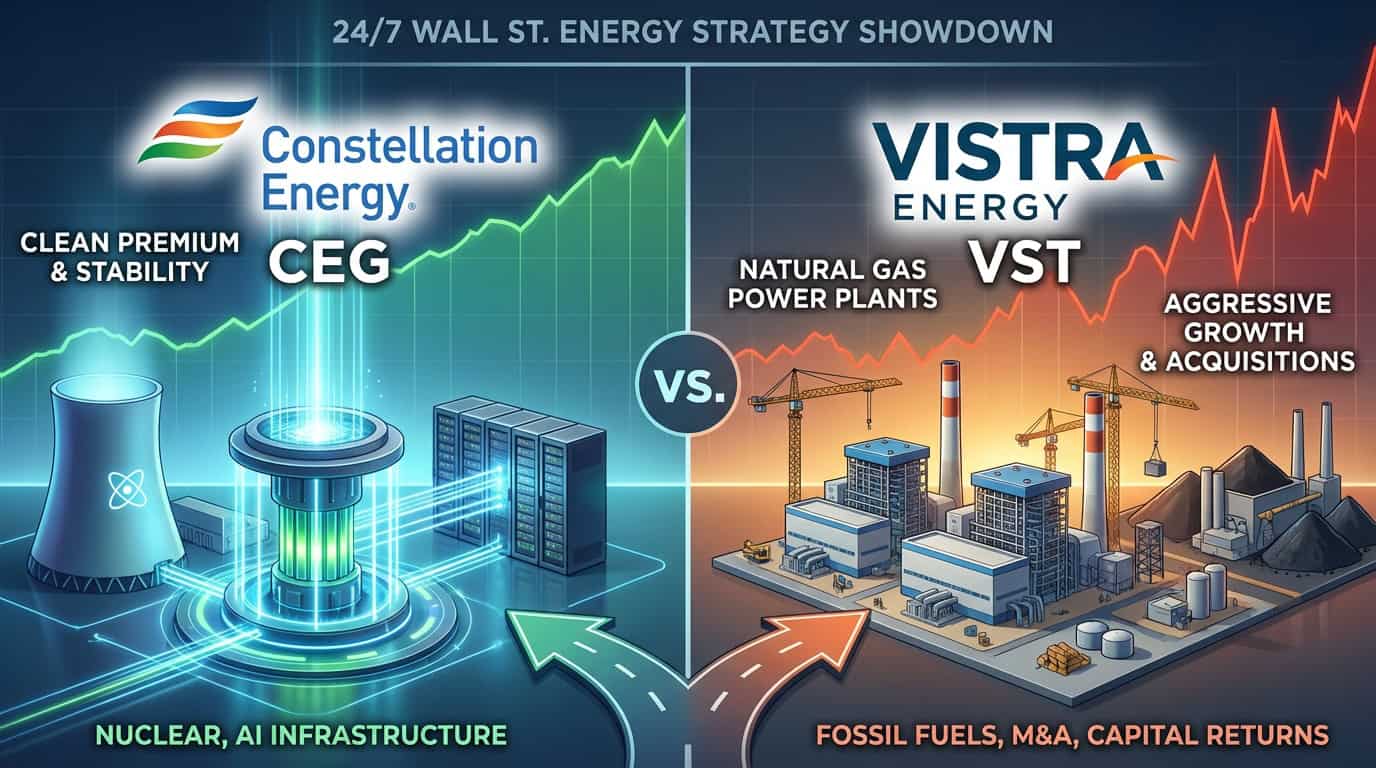
Constellation Energy (NASDAQ: CEG | CEG Price Prediction) and Vistra Energy (NYSE: VST) reported Q3 earnings this month, exposing two fundamentally different approaches to power generation. Constellation doubled down on premium nuclear assets and clean energy positioning. Vistra leaned into growth through fossil fuel acquisitions and aggressive capital returns.
Clean Premium vs. Diversified Growth Machine
Constellation missed Q3 revenue estimates at $6.57B versus $6.63B expected, but fundamentals tell a steadier story. Nuclear production climbed to 46,477 gigawatt-hours from 45,510 in the prior year quarter, and renewable capture rate improved to 96.8%. The company operates nearly 90% carbon-free generation, positioning itself as infrastructure backbone for data centers and AI workloads demanding reliable, emissions-free power. CEO Joe Dominguez emphasized that “momentum continues to build around reliable, clean nuclear energy as a cornerstone of America’s energy strategy.”
Vistra missed revenue more dramatically at $4.97B against a $6.16B estimate. Net income dropped 66.7% year-over-year to $652M, hurt by lower unrealized mark-to-market gains on derivatives and the Martin Lake Unit 1 outage. But Vistra is playing a different game. The company completed acquisition of seven natural gas plants during the quarter, started building two new gas units in West Texas, and secured a 20-year power purchase agreement for its Comanche Peak nuclear facility. CEO Jim Burke described the quarter as “marked by disciplined growth and a focus on meeting customer needs across key markets.”
| Business Driver | Constellation | Vistra |
| Core Asset Focus | Nuclear and renewables (90% carbon-free) | Diversified gas, nuclear, coal, solar, storage |
| Q3 Strategy | Operational excellence, premium positioning | M&A expansion, new builds |
| Profit Margin | 11% | 6.7% |
| Market Cap | $112.41B | $56.64B |
Capital Allocation Shows the Real Divide
Constellation carries a 0.41% dividend yield and trades at 41.17 times trailing earnings, reflecting its status as a quality asset with predictable cash flows. The company narrowed full-year 2025 adjusted operating earnings guidance to $9.05 to $9.45 per share.
Vistra authorized an additional $1B in share repurchases through 2027 and trades at a 60.13 trailing P/E but just 17.92 times forward earnings. That compression suggests the market expects significant earnings acceleration. The company initiated 2026 adjusted EBITDA guidance of $6.8B to $7.6B, well above 2025’s $5.7B to $5.9B range. Institutional ownership sits at 92.7%, higher than Constellation’s 85%, indicating professional money managers favor the growth trajectory over the premium stability play.
Which Model Holds Up When Power Demand Surges
Both companies benefit from rising electricity demand driven by data centers and AI infrastructure buildout. Constellation captures that demand through existing nuclear capacity that can’t be easily replicated. Vistra captures it by building new gas plants and acquiring distressed assets at attractive multiples.
Valuation and Growth Trajectory Comparison
The two companies trade at significantly different valuation multiples. Constellation trades at 32.15 times forward earnings, reflecting its premium positioning and stable nuclear asset base. Vistra trades at 17.92 times forward earnings despite management guidance for significant EBITDA growth from $5.7B-$5.9B in 2025 to $6.8B-$7.6B in 2026. The valuation gap reflects different risk profiles: Constellation offers operational stability with 90% carbon-free generation, while Vistra pursues growth through acquisitions and new capacity additions. Institutional ownership stands at 92.7% for Vistra versus 85% for Constellation, indicating professional investors have positioned for both strategies.











 Top Gaining Stocks
 Top Losing Stocks