


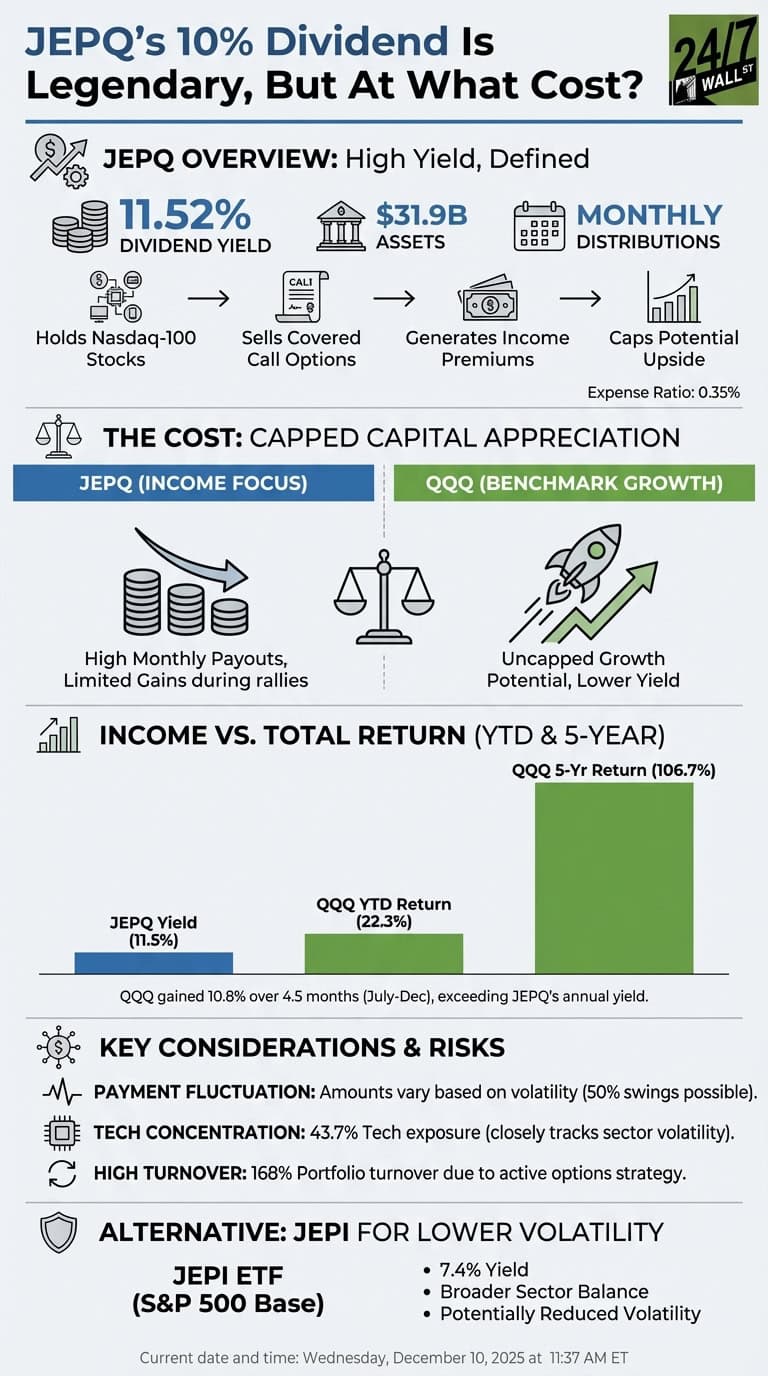
The JPMorgan Nasdaq Equity Premium Income ETF (quite the mouthful!) (NASDAQ:JEPQ) has attracted nearly $32 billion in assets with a simple and appealing feature: a remarkably high 11.52% dividend yield. The fund holds Nasdaq-100 stocks and sells covered call options against those positions, generating consistent monthly premiums that fund distributions while capping upside when stocks rally. The core question: does sacrificing capital appreciation for double-digit income make financial sense?
How JEPQ Generates Its High Yield
JEPQ holds a portfolio mirroring the Nasdaq-100, concentrated in mega-cap technology stocks. The fund sells call options on these positions, collecting premiums that produce monthly distributions. When markets are volatile, option premiums rise, potentially increasing payouts. When stocks surge, those call options limit gains. The fund’s 0.35% expense ratio is competitive, and it has paid monthly distributions without interruption since its May 2022 inception. Payment amounts fluctuate significantly—ranging from $0.34 to $0.68 per share—because they depend on market volatility rather than underlying dividend fundamentals.
The Cost of 10% Income
JEPQ’s top holdings reveal the opportunity cost. Nvidia (NASDAQ:NVDA | NVDA Price Prediction), the fund’s largest position at 8.02%, gained 33.27% year-to-date and 1,316.40% over five years. Apple (NASDAQ:AAPL) at 7.58% returned 13.53% this year and 126.16% over five years. Microsoft (NASDAQ:MSFT) at 6.48% delivered strong Azure growth, while Alphabet (NASDAQ:GOOG) at 5.88% posted its first $100 billion revenue quarter. Broadcom (NASDAQ:AVGO) rounds out the top five at 4.95%.
The benchmark Invesco QQQ Trust (NASDAQ:QQQ), which holds similar stocks without covered calls, returned 22.27% year-to-date and 106.68% over five years. During November’s tech selloff, QQQ dropped 4.6% in a single day but recovered 6.7% in the subsequent rally. JEPQ holders received their dividend during the decline but captured minimal upside during the rebound due to capped call options. Over 4.5 months from July through early December, QQQ gained 10.8%—exceeding JEPQ’s annual dividend yield through capital appreciation alone.
Is the Dividend Sustainable?
JEPQ’s distributions are sustainable—the fund will continue paying monthly and has never missed since inception. However, amounts vary dramatically based on market conditions. Investors seeking predictable income may find the 50% payment swings challenging for budgeting. The fund’s 168% portfolio turnover reflects the active options strategy, and its 43.7% technology concentration means performance closely tracks tech sector volatility.
For investors prioritizing current income over growth, JEPQ delivers. But the math shows a clear trade-off: roughly 10-12 percentage points of annual return surrendered for that 10% yield. Over five years, this compounds to potentially giving up half of total return potential.
Alternative: JEPI for Lower Volatility
Investors seeking similar income with broader diversification should consider JPMorgan Equity Premium Income ETF (NASDAQ:JEPI). JEPI applies the same covered call strategy to S&P 500 stocks rather than Nasdaq-100, offering a 7.4% yield with less technology concentration. The fund holds $36 billion in assets and provides more sector balance, potentially reducing volatility while generating substantial monthly income.









 Top Gaining Stocks
 Top Losing Stocks