


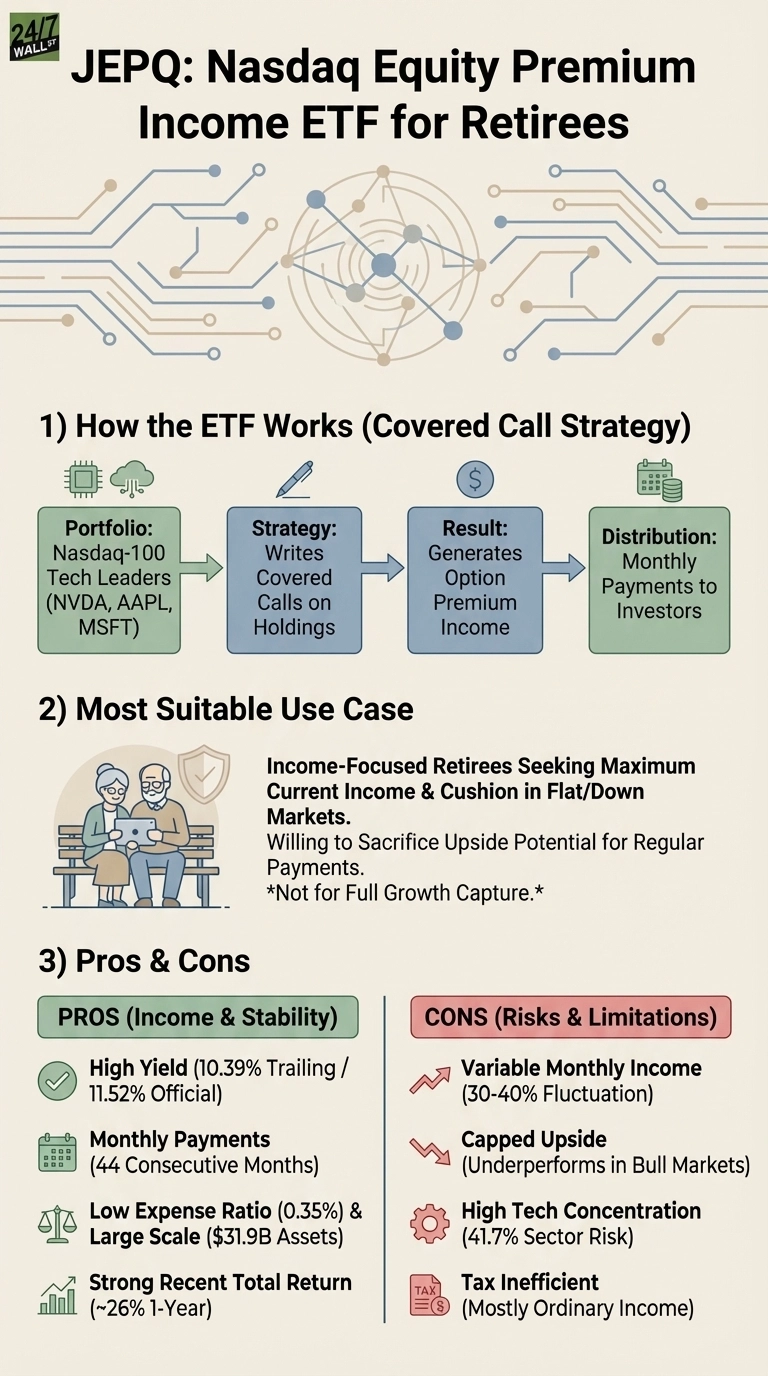
JPMorgan Nasdaq Equity Premium Income ETF (NYSEARCA:JEPQ) offers retirees an 11.5% dividend yield with monthly distributions through a covered call strategy on Nasdaq-100 holdings rather than traditional dividend payouts.
The ETF holds mega-cap tech stocks like NVIDIA (NASDAQ:NVDA | NVDA Price Prediction) (7.78%), Apple (NASDAQ:AAPL) (6.76%), and Microsoft (NASDAQ:MSFT) (6.25%), then systematically sells call options on these positions. When investors buy these calls, they pay premiums that become JEPQ’s income. This strategy works well in volatile markets where option premiums are elevated, but caps upside potential when stocks rally sharply.
Monthly Payment Volatility
JEPQ has delivered 44 consecutive monthly payments since its May 2022 inception. However, monthly amounts fluctuate significantly based on market volatility and option premium levels. December 2025’s distribution of $0.5761 per share represented a 40% increase over September’s $0.4420 payment.
Over the trailing twelve months through December 2025, JEPQ distributed $6.13 per share against its current $59.04 price, confirming the advertised 10.4% yield. While the fund has never missed a payment, retirees cannot predict exact monthly income amounts, requiring flexible budgeting or cash reserves to smooth irregular distributions.
The Trade-Off: Income vs. Growth
The critical question for retirees is whether JEPQ’s high yield compensates for sacrificed capital appreciation. The ETF’s 1-year price return of 15.6% plus approximately 10.4% in distributions delivered total returns around 26%, outpacing the Nasdaq-100’s 20.7% price return. However, covered call strategies typically underperform in sustained bull markets because sold calls cap upside participation.
JEPQ’s 41.7% technology sector concentration creates both opportunity and risk. While tech giants generate substantial option premiums due to volatility, a sector downturn would impact both the ETF’s net asset value and its ability to generate attractive premiums. The fund’s $31.9 billion in assets and 0.35% expense ratio provide operational stability, but underlying holdings pay minimal dividends—Apple yields just 0.38% and NVIDIA pays 0.02%.
SCHD: A Dividend Growth Alternative
Retirees seeking more predictable income might consider Schwab U.S. Dividend Equity ETF (NYSEARCA:SCHD) as a complement or alternative. SCHD tracks dividend-growing companies with strong fundamentals, currently yielding 3.8% with quarterly payments. While the yield is substantially lower than JEPQ’s 11.5%, SCHD has delivered 199% total returns over the past decade with consistent dividend growth averaging 5% annually.
SCHD holds quality dividend payers like Bristol-Myers Squibb (NYSE:BMY), Merck (NYSE:MRK), and Lockheed Martin (NYSE:LMT). These companies generate actual cash flow to support distributions rather than relying on option premiums. The ETF’s 14-year track record and diversified sector exposure (energy, consumer staples, healthcare) provide stability that complements JEPQ’s tech-heavy, income-focused approach. For retirees, a blended strategy might balance JEPQ’s high current income with SCHD’s dividend growth and capital appreciation potential.








 Top Gaining Stocks
 Top Losing Stocks