


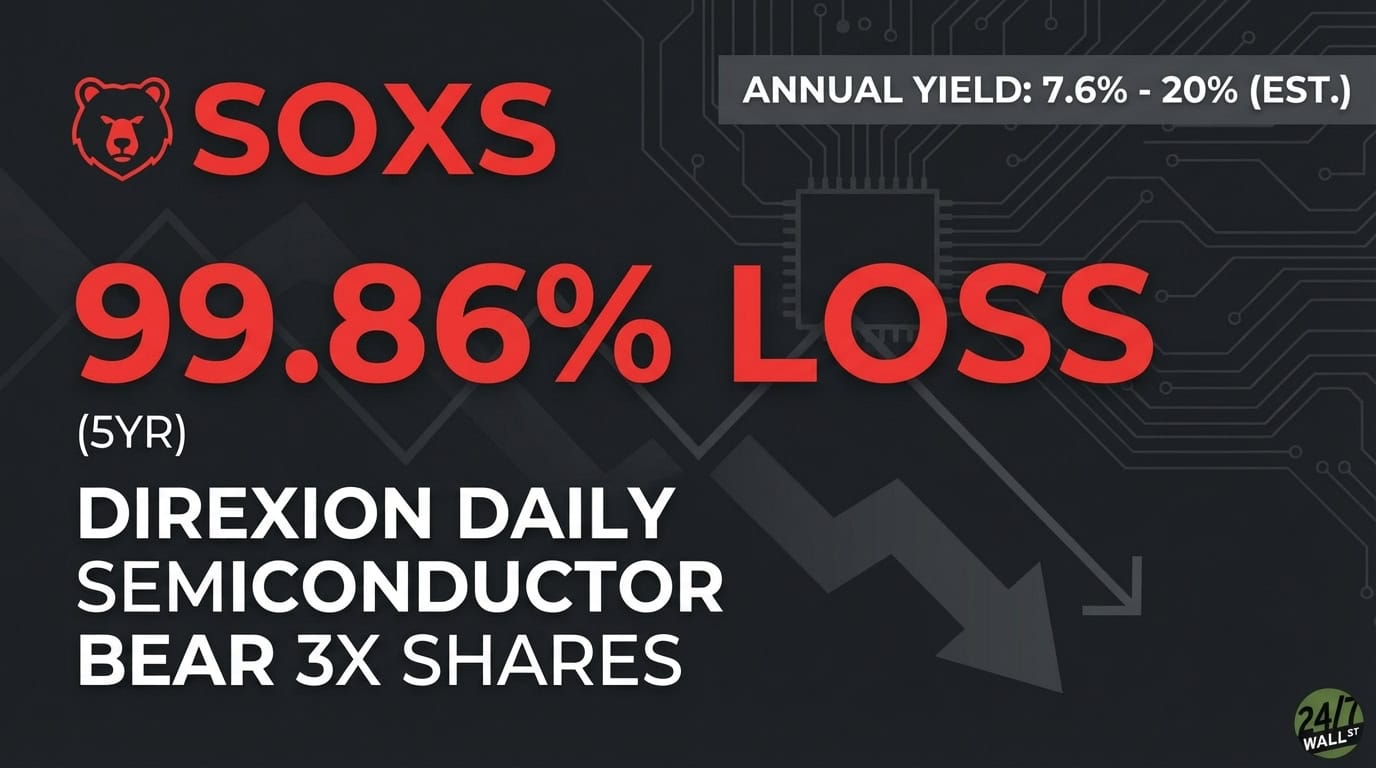
Direxion Daily Semiconductor Bear 3x Shares (NYSEARCA:SOXS) offers a contrarian bet against the AI boom, delivering three times the inverse daily performance of semiconductor stocks. While the ETF has attracted attention for its dividend distributions, understanding how this fund generates income reveals why it’s fundamentally different from traditional dividend investments.
How SOXS Generates Such High Distributions
SOXS doesn’t hold semiconductor stocks or collect dividends from companies like NVIDIA (NASDAQ:NVDA | NVDA Price Prediction) or Advanced Micro Devices (NASDAQ:AMD). Instead, the fund uses derivatives including swaps and futures to achieve -3x daily exposure to the ICE Semiconductor Index. Approximately 66% of the fund’s $1.1 billion in assets sits in cash collateral, primarily Goldman Sachs (NYSE:GS) Treasury Instruments, generating interest income. Additional distributions come from gains when semiconductor stocks decline and the fund profits from short positions.
The fund paid $0.056 per share in its September 2025 distribution. Based on the current price of $2.95, this translates to an annualized yield of approximately 7.6%. Some sources cite yields approaching 20% by projecting forward based on historical volatility in distributions, which ranged from $0.056 to $0.185 quarterly throughout 2025.
Distribution Sustainability and Total Return Reality
SOXS distributions are highly unstable because they depend on two volatile factors: interest rates on cash collateral and gains from semiconductor stock declines. When semiconductors rally, as they have throughout 2025, the fund generates minimal profits from short positions while experiencing severe price decay from daily rebalancing costs.
The fund’s 0.97% expense ratio and daily reset mechanism create structural headwinds. SOXS has declined 87% year-to-date in 2025, falling from $22.12 to $2.95. Over five years, the fund has lost 99.86% of its value. A 10% yield provides little consolation when the underlying ETF loses 87% of its value.














 Top Gaining Stocks
 Top Losing Stocks