


When financial stocks rally, a 3x leveraged ETF can deliver outsized gains. When they stumble, losses compound just as fast. Direxion Daily Financial Bull 3X Shares (NYSEARCA:FAS) promises amplified exposure to the financial sector. That 8% yield? It happened in 2025, almost entirely from a single December special distribution. Regular quarterly yield sits closer to 1.5%.
What FAS Actually Does
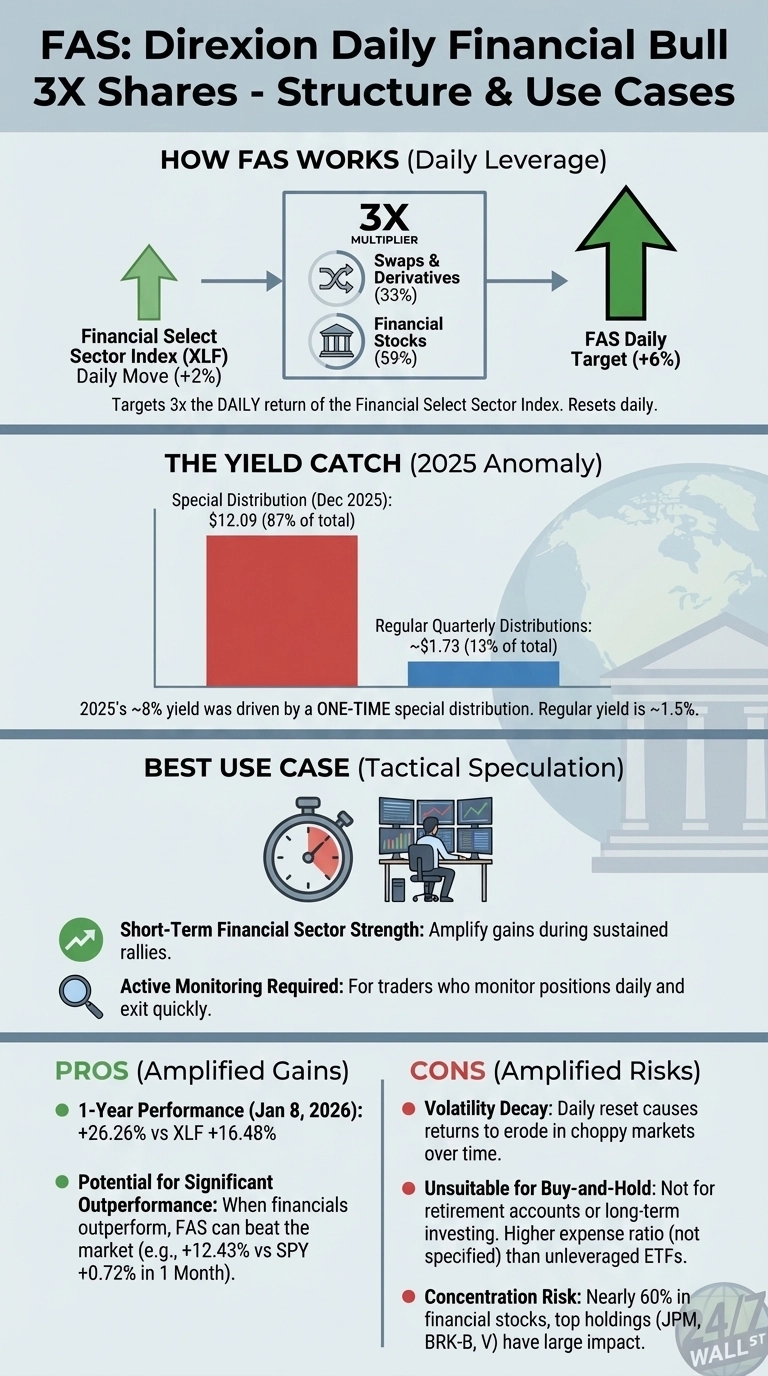
FAS uses swaps and derivatives to deliver three times the daily return of the Financial Select Sector Index. When JPMorgan Chase & Co. (NYSE:JPM | JPM Price Prediction), Bank of America Corporation (NYSE:BAC), and Visa Inc. (NYSE:V) (the fund’s largest holdings) climb 2% in a day, FAS targets a 6% gain. The fund holds $2.5 billion in assets, with 59% in financial stocks and roughly 33% in cash instruments and swaps that create the leverage.
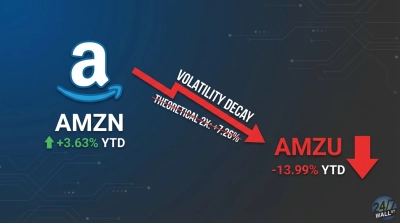
This structure works through daily rebalancing. Each morning, the fund resets exposure to hit that 3x target for that trading day only. Over longer periods, the math gets complicated. Path dependency means returns diverge from a simple 3x multiplier. FAS has demonstrated performance that varies from the theoretical 3x multiplier due to volatility decay and daily rebalancing effects.
The Catch Everyone Misses
That 8% yield came from a $12.09 special distribution in December 2025, representing 87% of the year’s total payouts. Regular quarterly distributions typically range from $0.30 to $0.50, translating to an annual yield around 1.5%. The special distribution was a one-time event, likely from realized gains as the fund rebalanced positions.
The expense ratio of 0.89% is more than 11 times higher than Financial Select Sector SPDR Fund (NYSEARCA:XLF)’s 0.08%, and that cost compounds over time alongside the volatility decay inherent to daily leveraged products.
When This ETF Makes Sense
FAS fits portfolios during sustained financial sector rallies. If you believe banks will benefit from stable interest rates, improved lending conditions, or regulatory tailwinds over the next few weeks or months, FAS can amplify those gains.
This is a tactical tool, not a core holding. Traders who monitor positions daily and can exit quickly when momentum shifts will find FAS useful. It’s also appropriate for investors with high risk tolerance who want concentrated financial sector exposure without using margin.
The Tradeoffs You Accept
Volatility decay erodes returns in choppy markets. When the underlying index swings up and down without clear direction, the daily reset mechanism causes FAS to lose value even if the index ends flat over time. A 10% drop followed by an 11.1% gain leaves the index unchanged, but FAS experiences larger swings that don’t fully recover.
Concentration risk is severe. Nearly 60% of the fund sits in financial stocks, with the top 10 holdings representing about 38% of equity exposure. If JPMorgan Chase or Berkshire Hathaway Inc. (NYSE:BRK.B) stumble, FAS feels it three times over.
Who Should Avoid FAS
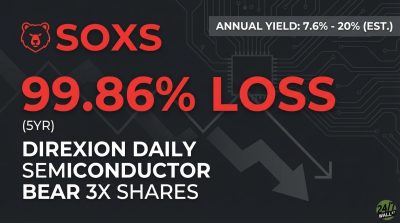
Buy-and-hold investors should stay away. The daily reset mechanism and volatility decay make FAS unsuitable for retirement accounts or long-term wealth building. The fund’s leveraged structure creates significant volatility that requires active monitoring.
Income-focused investors expecting consistent 8% yields will be disappointed. The fund’s distribution history shows extreme variability, with 2025’s $13.82 total driven almost entirely by that December special distribution.
Consider XLF Instead
XLF offers similar financial sector exposure without leverage. It charges just 0.08% annually and delivers a more consistent 1.3% dividend yield. XLF has delivered solid performance with significantly lower volatility. For investors who want financial sector exposure but can’t actively monitor positions daily, XLF provides the same holdings without the amplified downside risk or volatility decay.
FAS works for short-term tactical bets on financial sector strength, but the 8% yield was a one-time event and the 3x leverage cuts both ways.









 Top Gaining Stocks
 Top Losing Stocks