



Direxion Daily Semiconductor Bear 3X Shares (NYSEARCA:SOXS) has shed nearly 38% since the start of 2026, even as the semiconductor sector has climbed. That gap tells you almost everything about why holding SOXS for more than a few days is one of the most structurally punishing trades available to retail investors.

What SOXS Is Designed to Do
SOXS is a daily-reset, 3x inverse leveraged ETF targeting a return equal to three times the inverse of the ICE Semiconductor Index. If the index falls 2% on Monday, SOXS is designed to gain roughly 6%. If the index rises 2%, SOXS loses roughly 6%. The appeal is clear: a leveraged short position on semiconductors without a margin account or options knowledge.
Investors reach for SOXS when they believe semiconductors are overvalued or facing a near-term catalyst that will push the sector lower. With $1.1 billion in net assets, the fund is not a fringe product.
Risk 1: The Fund Destroys Value Even When You Are Right About Direction
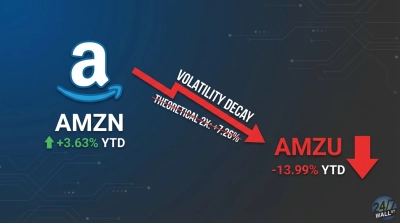
The most dangerous structural feature of SOXS is volatility decay, also called beta slippage. Because the fund resets its leverage daily, it does not deliver three times the inverse of the index over any period longer than one trading day. In choppy or upward-trending markets, the daily rebalancing math works against the holder relentlessly.
Here is the mechanics: if the index falls 10% one day and rises 10% the next, the index is down roughly 1% over two days. SOXS would have gained roughly 30% on day one and lost roughly 30% on day two, leaving it down roughly 9% over the same stretch. The fund lost far more than the index moved, simply because of how compounding works with daily leverage resets.
The current volatility environment makes this worse. The VIX sits at 27.19, up 54% from mid-February, putting it in the elevated uncertainty zone. Higher volatility directly accelerates beta slippage. The more the index whipsaws, the faster SOXS bleeds value regardless of where the index ultimately ends up.
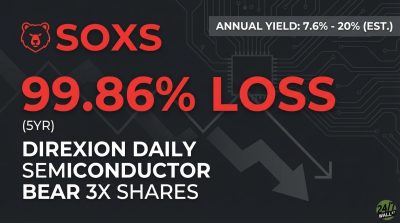
The long-term performance data makes this concrete. Over the past year, SOXS has lost 92% of its value. Over five years, it is down 99.8%. These are not just the result of a rising semiconductor sector. They reflect the structural erosion built into daily-reset leverage compounded over time.
Risk 2: The Underlying Index Has Powerful Secular Tailwinds
Even setting aside structural decay, the directional bet faces a difficult backdrop. The ICE Semiconductor Index is concentrated in companies central to the AI infrastructure buildout. Micron, Nvidia, Applied Materials, AMD, and Broadcom collectively represent the five largest positions in the index, with the top five holdings representing the five largest positions in the portfolio.
These are not speculative names riding a passing trend. AI data center spending is driving sustained demand for memory, GPUs, and advanced packaging at a scale that has kept earnings estimates moving higher for the sector’s largest players. The long index, iShares Semiconductor ETF (NYSEARCA:SOXX | SOXX Price Prediction), is up 69% over the past year, and up 12% year-to-date in 2026. Betting against that with 3x leverage requires not just being right about direction, but being right quickly, before decay erases the gain.
What to Monitor If You Hold SOXS
Two indicators are worth tracking closely. First, watch the VIX at FRED or any major financial data platform. The current reading of 27.19 is in the 93rd percentile of the past year. A VIX persistently above 25 is a warning that holding leveraged products becomes increasingly expensive by the day.
Second, track the 10-year Treasury yield. The 10-year currently sits at 4.28%, which creates some valuation pressure on high-multiple semiconductor stocks. If yields push meaningfully higher, that could create a genuine near-term headwind for the sector. A moderate rate environment alone is unlikely to generate the sustained sector decline that would make SOXS profitable after accounting for decay.
Check both weekly, especially around FOMC meetings and major semiconductor earnings reports from Nvidia, Micron, and AMD.
SOXS Works in Days, Not Weeks
Historically, SOXS has shown gains during sharp short-term semiconductor selloffs measured in days rather than weeks, though structural decay limits its effectiveness over longer periods. Held through a volatile or gradually rising market, the daily reset mechanism ensures that even a correct directional call can still produce significant losses. The structural math of 3x daily leverage is not a risk to manage around. It is the defining feature of the trade.












 Top Gaining Stocks
 Top Losing Stocks