



The U.S. marijuana industry has stagnated for year, languishing under federal inaction on reclassification or decriminalization. Classified as a Schedule I drug under the Controlled Substances Act — alongside hard drugs like heroin and LSD — cannabis is deemed to have no accepted medical use and high abuse potential.
This status blocks research, interstate commerce, and access to basic banking services for operators. Meanwhile, 38 states have legalized medical marijuana, and 24 allow recreational use, creating a patchwork of regulations that limits scalability. Cannabis companies also struggle with Section 280E tax rules, which deny standard business deductions, eroding profits.
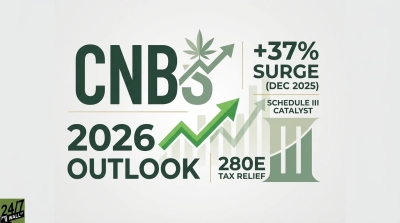
Investors have shied away from pot stocks, keeping valuations depressed despite booming state-level sales exceeding $30 billion annually. Now, however, President Trump has ignited fresh momentum. Reports indicate he plans to sign an executive order directing federal agencies to reclassify marijuana as a Schedule III substance.
Tilray Brands (NASDAQ:TLRY), Canopy Growth (NASDAQ:CGC), and Aurora Cannabis (NASDAQ:ACB) are all surging higher by double-digit percentages in morning trading today, with gains topping 30% for some.
What Trump’s Executive Order Entails
Trump is reportedly set to issue an executive order instructing the Justice Department and Health and Human Services to bypass ongoing administrative hearings and finalize marijuana’s shift from Schedule I to Schedule III. This classification recognizes moderate abuse potential but accepted medical value, akin to ketamine or codeine.
Trump discussed the plan in a Dec. 10 Oval Office call with House Speaker Mike Johnson, joined by industry executives, HHS Secretary Robert F. Kennedy Jr., and CMS head Mehmet Oz. Johnson raised concerns, citing studies on youth impacts, but executives countered with data on medical benefits and public support — polls show 70% of Americans favor reform.
How Reclassification Could Reshape Cannabis
Reclassification won’t fully legalize marijuana — that requires Congress — but it unlocks key changes.
- First, it ends the 280E tax penalty, letting companies deduct expenses like rent and salaries. This could boost after-tax profits by 40% to 70% for U.S. operators, freeing cash for expansion.
- Second, it eases research barriers, spurring clinical trials on cannabis for pain, epilepsy, and PTSD — potentially validating new products.
- Third, Schedule III status allows pharmacies to dispense medical cannabis federally, smoothing interstate transport and opening Medicare/Medicaid reimbursements.
For the $32 billion U.S. market, this bestows legitimacy, attracting institutional investors wary of Schedule I risks. Banking access improves, too, as fewer lenders will fear federal reprisals. Analysts estimate it could double industry growth rates to 20% annually, though rulemaking could delay its full effect for 12 to 18 months.
Tilray Brands (TLRY)
Tilray Brands is a diversified player in cannabis, but also serving beverages and wellness markets. It stands to gain from eased U.S. entry, as reclassification could allow it to import medical products interstate and deduct costs on American sales.
Fiscal 2025 revenue hit $821 million, up 4%, but 280E rules have squeezed margins, forcing it to focus on more profitable international markets. Adjusted gross margins widened to 40% from 36% year-over-year as a result.
After reform, Tilray’s U.S. craft beer acquisitions could pair with cannabis edibles, targeting a $10 billion crossover market. Analysts see 25% upside in stock value as research boosts its medical portfolio in Germany and Australia.
Canopy Growth (CGC)
Canopy Growth, a pioneer in medical cannabis, could see its turnaround accelerate. Already profitable in Canadian medical sales, Canopy exports to 20 countries but faces U.S. hurdles. Schedule III status would enable FDA-approved trials for its vaporizers and oils, validating claims for chronic pain relief.
With $300 million in trailing revenue, eased tax burdens could add $50 million to $70 million in annual savings, funding U.S. market entry through partnerships. Canopy’s Spectrum Therapeutics brand in Australia and Poland positions it for global medical dominance, potentially lifting EBITDA 30% by 2027.
Aurora Cannabis (ACB)
Aurora Cannabis is a lean operator after cutting cost, and would benefit from the thaw reclassification would bring to research. Its pharmaceutical-grade products, like CanniMed oils, align with Schedule III medical pathways, easing U.S. pharmacy distribution.
Aurora’s $284 million market cap reflects recent profitability — fiscal Q2 2026 net income hit $81 million Canadian — but taxes limit reinvestment. Reform could unlock banking for its Bevo Farms propagation arm, helping to scale tissue-culture technology for high-THC strains. With expansions in Poland and Australia, Aurora eyes 15% revenue growth, making it a value pick at 1x sales and trading at a fraction of its expected long-term earnings annual growth rate of 56%
Key Takeaways
Reclassification offers cannabis stocks a lifeline, but Congressional pushback, state and federal clashes, and illicit competition could slow progress. Canada’s experience with legalization also shows the potential pitfalls — cannabis companies are still mired in red tape and black-market competition, leaving pot stocks volatile despite $5 billion sales.
Rescheduling doesn’t guarantee smooth sailing, so be careful in getting what you wish for, but the upside potential outweighs the status quo. More importantly, investors gain improved visibility on profitability. It’s no panacea, but promises to launch a new era for cannabis investment.










 Top Gaining Stocks
 Top Losing Stocks