


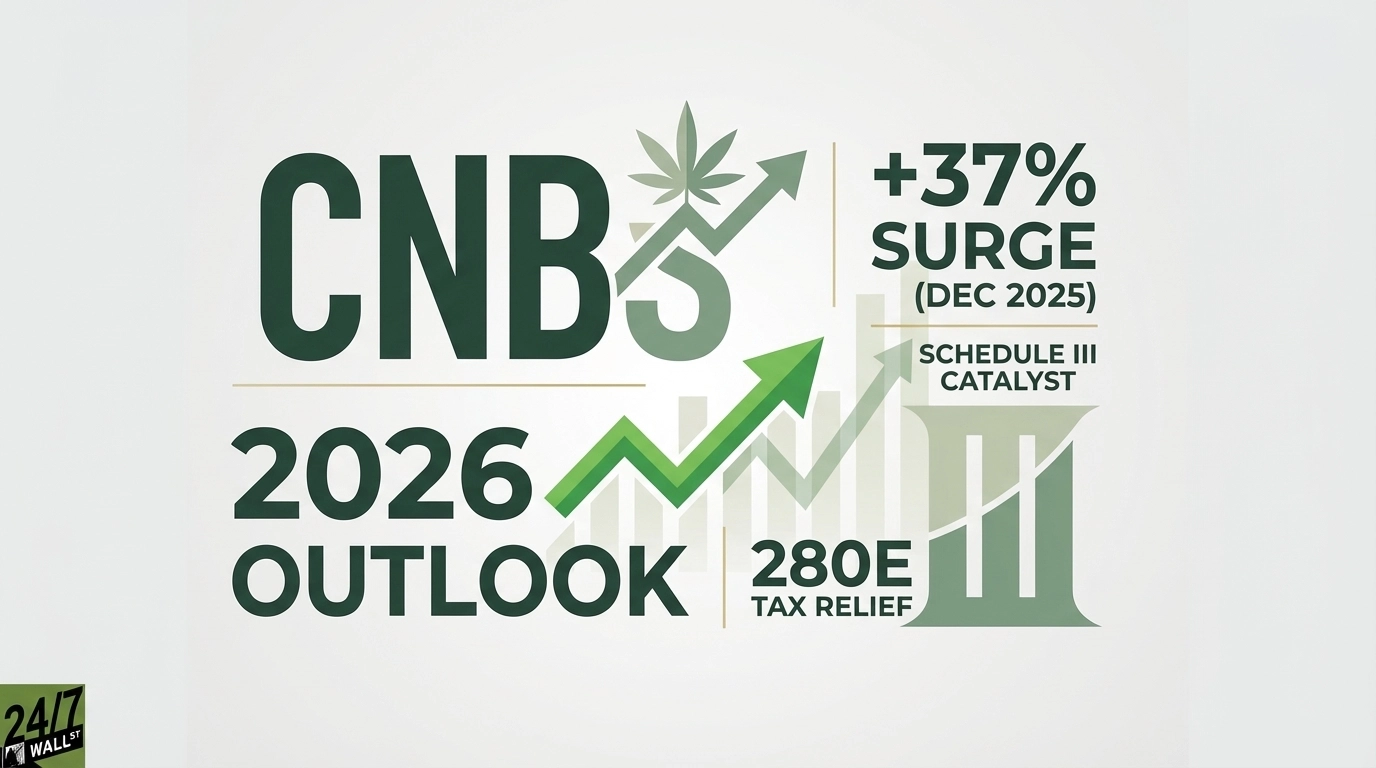
Amplify Seymour Cannabis ETF (NYSEARCA:CNBS) posted a 17% gain in 2025, but that masks the real story. The fund surged 37% in December alone after President Trump signed an executive order directing Attorney General Pam Bondi to complete rulemaking for reclassifying marijuana from Schedule I to Schedule III under the Controlled Substances Act. Reddit investors have been overwhelmingly bullish, with sentiment scores averaging 82 over the past quarter. The question for 2026 isn’t whether cannabis gets a regulatory boost, but whether that translates into sustainable returns for this concentrated ETF.
The Schedule III Catalyst That Changes Everything
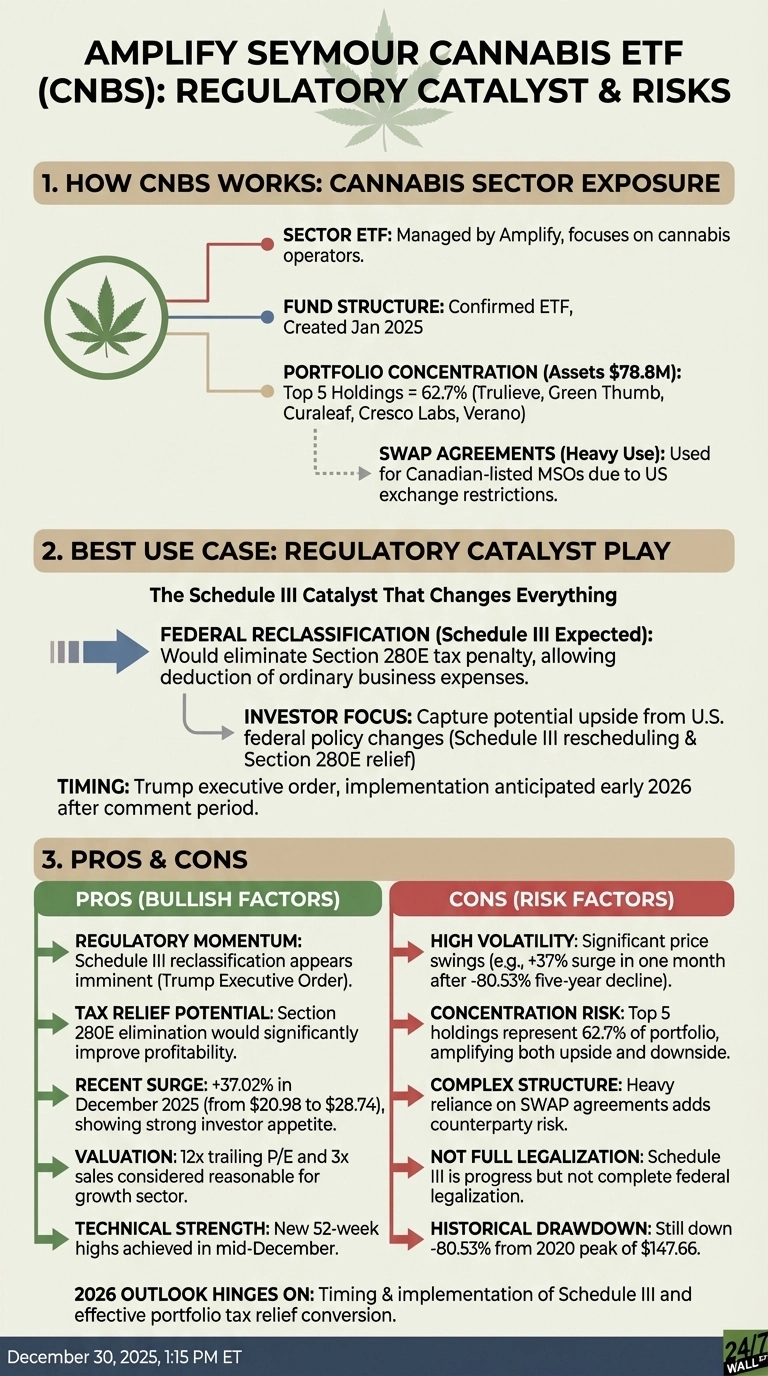
The biggest factor affecting CNBS in 2026 is eliminating Section 280E of the Internal Revenue Code, which prohibits cannabis companies from deducting ordinary business expenses. This tax provision forces operators to pay taxes on gross income rather than net income. The impact is brutal: a cannabis company with $1 million in revenue and $250,000 in operating expenses might owe ~$150,000 in taxes while an identical non-cannabis business with normal operations would owe roughly half as much (using some basic assumptions about operating expenses).
Once marijuana moves to Schedule III, that penalty disappears. Cannabis companies will suddenly deduct payroll, rent, marketing, and other normal expenses just like any other business. For many operators, this fundamentally reshapes cash flows and profitability. As Casa Verde Capital noted after Trump’s announcement, the change allows the industry to finally operate like a real consumer or healthcare category. This opens the door to institutional capital.
The timeline matters. Trump’s executive order requires a 30-day comment period before a final rule is issued, meaning implementation could land in early 2026. Watch for the Department of Justice’s formal rulemaking announcements and IRS guidance on when 280E relief takes effect. Monthly updates from cannabis industry trade groups and quarterly earnings calls from major operators will provide the clearest signals on how quickly tax savings flow through to bottom lines.
Concentration Risk in a Volatile Recovery
CNBS holds $78.8 million in assets across a remarkably concentrated portfolio. The top five holdings represent 63% of the fund, with Trulieve Cannabis (OTC:TCNNF) leading at 17%. This concentration amplifies both upside and downside. When Curaleaf Holdings (OTC:CURLF), the fund’s third-largest holding at 13%, surged 65% in 2025, it significantly outpaced CNBS’s 17% return. That gap suggests other holdings dragged on performance, or ancillary positions like Innovative Industrial Properties, which declined 18% in 2025, offset operator gains.
The fund also relies heavily on swap agreements to access Canadian-listed U.S. multi-state operators that can’t list on American exchanges due to federal prohibition. These derivative structures add complexity and counterparty risk that investors should monitor through the fund’s monthly holdings reports and fact sheets available on Amplify’s website.
Consider MSOS for Pure U.S. Operator Exposure
AdvisorShares Pure US Cannabis ETF (NYSEARCA:MSOS) outperformed CNBS in 2025, gaining 25% versus CNBS’s 17%. With $2 billion in assets compared to CNBS’s $79 million, MSOS offers dramatically better liquidity and tighter bid-ask spreads. The fund focuses exclusively on U.S. operators rather than mixing in ancillary plays, which may better capture the 280E tax relief upside in 2026.
The Bottom Line
CNBS’s 2026 performance hinges on the timing and implementation of Schedule III rescheduling and how effectively its concentrated portfolio converts 280E tax relief into profitability gains.















 Top Gaining Stocks
 Top Losing Stocks