


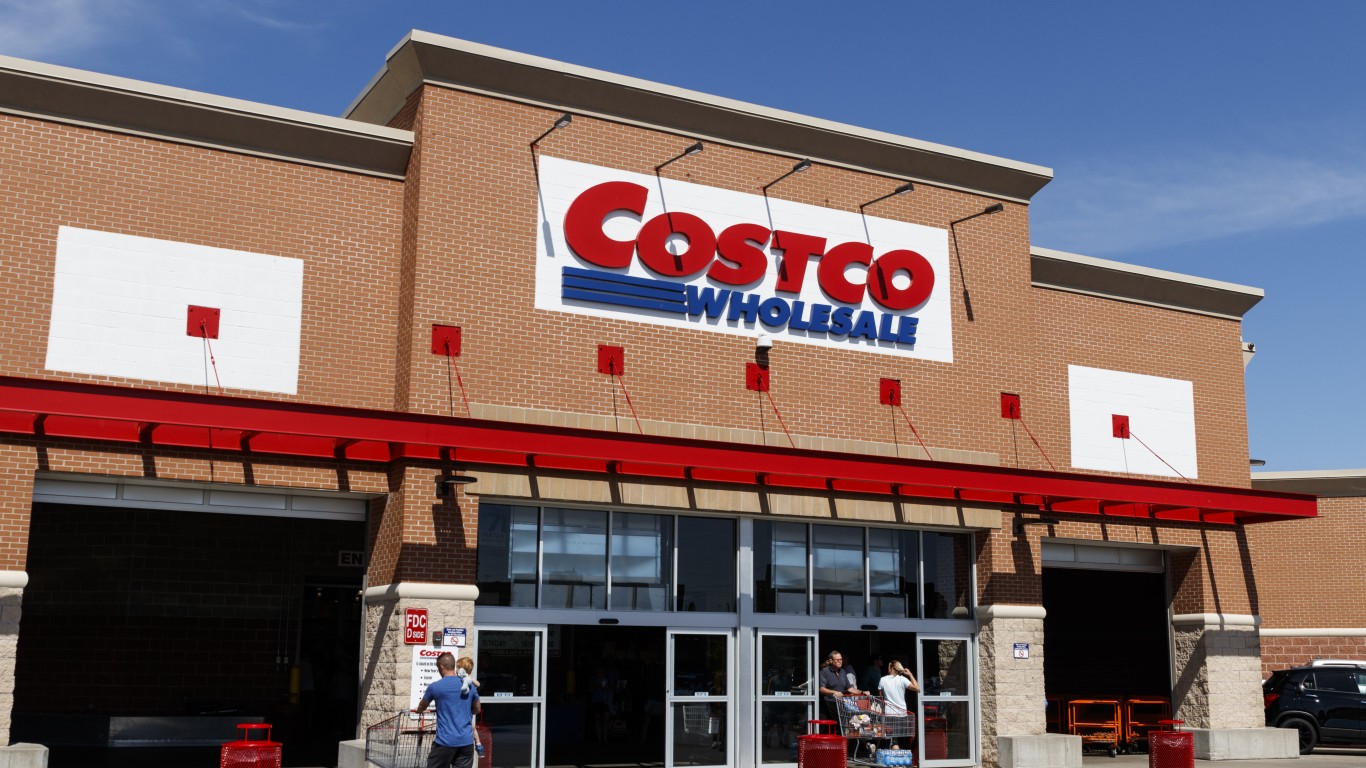
Costco (NASDAQ:COST | COST Price Prediction) has faced a challenging 2025, marking one of its worst relative performances in over two decades. Today, the stock is down approximately 3.5% year-to-date, while the S&P 500 has gained about 16.1%, creating a gap of 19.6 percentage points between the two.
This divergence in performance was caused by several factors, including investor enthusiasm and expectations following a strong 2024, which led to sky-high valuations. Costco traded at 50 times earnings at the start of the year, well ahead of rivals, but that was quickly deflated on slower comparable sales growth as consumers turned cautious.
However, investors looking ahead to 2026 are wondering if the doldrums will continue. Let’s look to Costco’s history to see if a rebound for this retail giant is in its future.
Earnings Offer Some Hope
Last week, Costco reported its fiscal first quarter 2026 results and showed renewed strength. Net sales increased 8.2% to $65.98 billion from $60.99 billion last year. Earnings of $4.50 per share beat analyst expectations of $4.28 per share as comparable sales grew 6.4%, while e-commerce sales surged 20.5%.
Membership fees also rose 14%, reflecting strength in U.S. and Canada renewals, which came in at 92.2%, only a tiny slip from 92.3% in Q4. Globally, renewals also ticked down 10 basis points to 89.7%. The decline was the result of fewer digitally-signed members renewing and Costco is expecting to see similar declines in renewal rates for the next few quarters.
Historical Performance: Costco vs. S&P 500 Since 2000
So what does 2026 have in store? As noted above, this year has been horrible in terms of performance compared to the S&P 500. Over the past 25 years, Costco has been an outstanding investment, topping the broad index’s annual performance 16 times, for a 64% win rate. On average, it beat the S&P by 15.5 percentage points.
In contrast, when Costco has lost to the index, it was by just 6.3 percentage points. So it’s clear that 2025 is an anomaly for the warehouse club. Yet there have been a few years — 2002, 2009, and 2016 — where the S&P 500 has surpassed it by more than 10 percentage points. Those are the years to look at to see what 2026 might hold in store.
The table below lists returns from 2000 to 2025, with relative divergence (Costco return minus S&P 500 return).
| Year | Costco Return (%) | S&P 500 Return (%) | Divergence (pp) |
| 2000 | (12.47) | (10.14) | (2.33) |
| 2001 | 11.12 | (13.04) | 24.16 |
| 2002 | (36.77) | (23.37) | (13.40) |
| 2003 | 32.50 | 26.38 | 6.12 |
| 2004 | 30.20 | 8.99 | 21.21 |
| 2005 | 2.19 | 3.00 | (0.81) |
| 2006 | 6.87 | 13.62 | (6.75) |
| 2007 | 31.95 | 3.53 | 28.42 |
| 2008 | (24.74) | (38.49) | 13.75 |
| 2009 | 12.70 | 23.45 | (10.75) |
| 2010 | 22.04 | 12.78 | 9.26 |
| 2011 | 15.39 | 0.00 | 15.39 |
| 2012 | 18.49 | 13.41 | 5.08 |
| 2013 | 20.55 | 29.60 | (9.05) |
| 2014 | 19.10 | 11.39 | 7.71 |
| 2015 | 13.93 | (0.73) | 14.66 |
| 2016 | (0.86) | 9.54 | (10.40) |
| 2017 | 16.25 | 19.42 | (3.17) |
| 2018 | 9.45 | (6.24) | 15.69 |
| 2019 | 44.28 | 28.88 | 15.40 |
| 2020 | 28.19 | 16.26 | 11.93 |
| 2021 | 50.67 | 26.89 | 23.78 |
| 2022 | (19.59) | (19.44) | (0.15) |
| 2023 | 44.60 | 24.23 | 20.37 |
| 2024 | 38.81% | 23.31 | 15.50 |
| 2025 (ytd) | (3.47%) | 16.08% | (19.56) |
pp =percentage points. Data source: 1stock1.com, MacroTrends. Table by author.
What History Says About Recovery in 2026
Years of notable Costco underperformance relative to the S&P resulted in returns in the years that followed:
- After 2002: 2003 delivered 6.12 pp outperformance.
- After 2009: 2010 showed 9.26 pp.
- After 2016: 2017 had (3.17) pp (continued mild lag).
Out of these three instances, Costco outperformed the S&P 500 in two of the subsequent years. This suggests a historical probability of around 67% for relative recovery to the index following significant underperformance, though it is a limited number of data points. And, of course, past patterns do not guarantee future outcomes.
Yet, the retailer has had absolute returns that were much worse than what it is experiencing now. When its stock has been down for a full year, it is often by double-digit percentages (a loss of almost 19% on average). Only one year — 2016 — did it turn in a meager performance like this year, and it surged 17% the next time out.
Key Takeaway
Regardless of how Costco actually performs next year, its business remains solid fundamentally, with consistent membership renewals above 90%, ongoing warehouse expansions, and steady revenue growth. Despite 2025 headwinds from valuation compression and softer comps, Costco remains a good, long-term stock to own for patient investors.








 Top Gaining Stocks
 Top Losing Stocks