



Retail giants Costco Wholesale (NASDAQ: COST | COST Price Prediction) and Walmart (NASDAQ: WMT) have taken very different paths over the past decade. Costco doubled down on its membership-driven warehouse model, turning Kirkland Signature into a private-label powerhouse and expanding internationally. Walmart reinvented itself, pivoting from a big-box stalwart into an omnichannel platform with a growing advertising business, AI-driven logistics, and Walmart+.
A Decade of Diverging Dominance
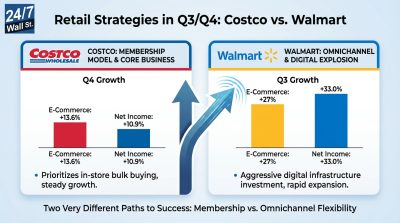
Costco’s edge has been consistency. Its membership renewal rate has held near 89.7%, and fee income has compounded quietly, growing 13.6% year-over-year in the most recent quarter. That recurring revenue acts like a subscription business layered on top of a retailer, giving investors predictable cash flow regardless of economic conditions.
Walmart’s transformation has been more dramatic. The company acquired VIZIO, built a nearly $6.40 billion global advertising business, and pushed e-commerce to 23% of Walmart U.S. total net sales. Global e-commerce grew 24% in Q4 FY2026, and the company raised its dividend to $0.99 per share for FY2027. This is no longer the same company it was in 2016.
Your $1,000 Then, Your Money Now
Costco
- 1-Year Return: Initial $1,000 | Total Return: $976.30 (−2.37%) | S&P 500 same period: $1,187.87 (+18.79%)
- 5-Year Return: Initial $1,000 | Total Return: $3,333.02 (+233.30)% | S&P 500 same period: $1,912.20 (+91.22%)
- 10-Year Return: Initial $1,000 | Total Return: $8,473.30 (+747.33%) | S&P 500 same period: $3,408.33 (+240.83%)
Walmart
- 1-Year Return: Initial $1,000 | Total Return: $1,297.10 (+29.71%) | S&P 500 same period: $1,187.87 (+18.79%)
- 5-Year Return: Initial $1,000 | Total Return: $3,066.50 (+206.65%) | S&P 500 same period: $1,912.20 (+91.22%)
- 10-Year Return: Initial $1,000 | Total Return: $6,537.50 (+553.75%) | S&P 500 same period: $3,408.33 (+240.83%)
Both stocks have delivered strong long-term performance, but Costco’s edge over a decade is notable. It also paid three special dividends, including $15.00 in 2024, $10.00 in 2020, and $7.00 in 2017, boosting total returns further for reinvesting shareholders. The past year flipped the script, with Walmart delivering strong gains while Costco pulled back from its highs.
The Long-Term Winner Is Costco, but Walmart Bears Watching
Costco’s bull case is straightforward: sticky members, rising fee income, and international expansion still have room to run. The 54x trailing P/E reflects a durable premium, but the bear case is valuation. A PEG ratio of 5.57 leaves almost no margin for error, and a single disappointing quarter could compress the multiple sharply.
For Walmart, the transformation story has more chapters left, with real advertising and e-commerce momentum. Its 47x trailing P/E is no longer cheap either, and the risk is execution: Walmart is juggling more moving parts than ever.
For a buy-and-hold investor, Costco’s 10-year track record makes the stronger case. But if Walmart continues closing the gap, the next decade may be a much tighter race.









 Top Gaining Stocks
 Top Losing Stocks