



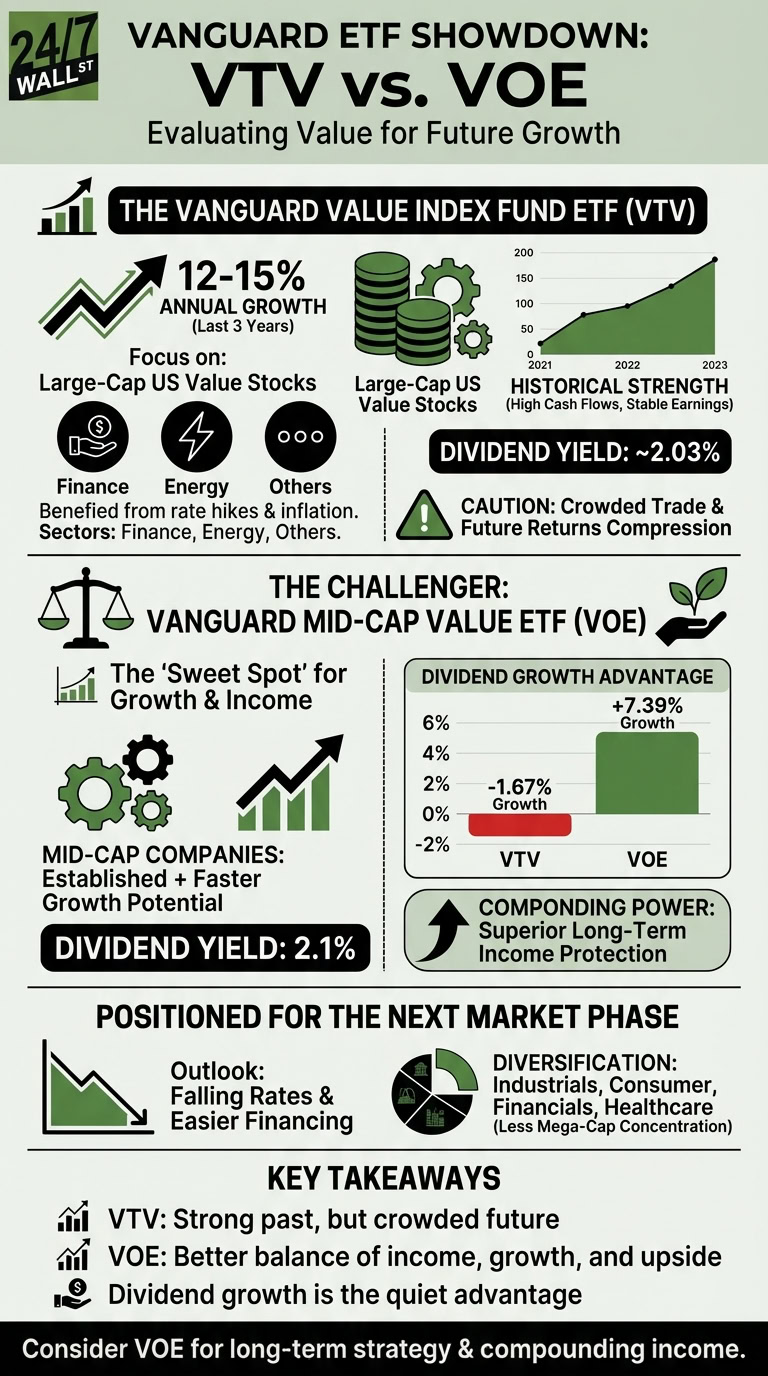
Over the last few years, the Vanguard Value Index Fund ETF Shares (NYSE:VTV | VTV Price Prediction) has performed exactly as investors hoped. Growing between 12% and 15% annually over the last three years, as rates have risen, this ETF has benefited from having exposure to multiple cash-generating names in its portfolio across finance, energy, and other sectors.
As anyone in the market knows, historically strong performance doesn’t necessarily guarantee a strong future. What this means is that just because the Vanguard Value Index Fund ETF has performed well in the last few years, it doesn’t make it the absolute best choice moving forward. With the potential for multiple market shifts in 2026, including more rate cuts, you might want to consider looking at a different corner of the Vanguard world for a better balance of income, growth, and long-term upside.
Why the Vanguard Value Index Fund ETF Performed So Well
For the most part, the Vanguard Value Index Fund ETF has long focused on large-cap US value stocks, and these companies have historically reported stable earnings thanks to their established business models and solid shareholder payouts.
During periods of inflation and higher rates, these profiles mattered quite a bit to investors who wanted stability, and these same investors were rewarded with solid balance sheets that generated income. In addition, this ETF also benefited from sector concentration as areas like banking, insurance, and energy all enjoyed strong pricing power, which in turn led to high cash flows, resulting in growing dividends and even stock buybacks.
The approximate 2.03% yield of the ETF highlights that it can generate steady income while investors wait out market volatility. This said, large-cap value is a crowded area, and when everyone starts to pile into the same defensive ETFs and stocks, it compresses future returns, which might have you wanting to move your money into another ETF.
What Makes the Vanguard Mid-Cap Value ETF Different
If you look closely, you’ll see that the Vanguard Mid-Cap Value ETF (NYSE:VOE) takes the same value discipline as its Vanguard sibling but applies it to a more flexible part of the overall market. Mid-cap companies sit in what many investors like to call a sweet spot. This means that they are established enough to make real profits, but also still small enough to grow faster than mega-caps without raising any red flags.
In the case of Vanguard’s Mid-Cap Value ETF, it holds companies that are often earlier in their dividend growth cycle, as many are reinvesting to grow the business while also looking to return some of their capital to shareholders. What this means is that you have a combination that is ideal for both income growth and capital appreciation.
The dividend yield of 2.1% for the Vanguard Mid-Cap Value ETF is similar to that of its sibling, but its dividend growth is meaningfully higher at 7.39% versus -1.67% growth for the Vanguard Value ETF.
Dividend Growth Is the Quiet Advantage
For income investors, there is too often a focus on current yield, and while yield no doubt matters, growth is what protects your purchasing power over time. It’s here that the Vanguard Mid-Cap Value ETF has the advantage in that its growth is in the high single digits.
Over time, the difference here between the two ETFs is compounding, and a portfolio that grows income steadily reduces the need to sell shares later on. There is also the hope that it will adapt better to inflation without having to chase risky assets. The hope is that mid-cap companies will look to raise dividends early on, which gives this ETF more of a structured advantage.
Investors who are looking to build a long-term growth and income strategy often find that this growth proves to be more valuable than a slightly higher payout right now.
Better Exposure During the Next Market Phase
With the likelihood that rates will continue to fall into the next year and beyond, there is a solid belief that an ETF full of mid-cap companies will perform better, and history validates this hypothesis. This Vanguard ETF is going to benefit from an environment where financing conditions are easier while still being able to maintain pricing discipline.
The Vanguard Mid-Cap Value ETF also works to avoid some of the concentration risk that comes with a large-cap ETF. In other words, its holdings are more spread out across industrials, consumer sectors, financials, and healthcare, all without being dominated by a small number of mega-caps in areas like tech.













 Top Gaining Stocks
 Top Losing Stocks