


Blockchain investing has always presented a dilemma: buy individual mining stocks and risk catastrophic losses, or spread exposure across an ETF and sacrifice some upside. The Global X Blockchain ETF (NASDAQ:BKCH) made that choice easier in 2025, gaining 31.6% year-to-date while individual miners experienced significant declines. Bitcoin currently trades just above $87,000, down 16.5% from its November peak of $105,316, but still positive for the year. The question for 2026 is whether institutional adoption can push both Bitcoin and blockchain equities higher, or whether mining economics will continue squeezing profitability.
The Institutional Adoption Question
The macro factor that will matter most for BKCH in 2026 is corporate Bitcoin adoption. Prediction markets assign a 59% probability that another S&P 500 company will add Bitcoin to its balance sheet by year-end 2026. That matters because BKCH holds a 12% position in Coinbase (NASDAQ:COIN | COIN Price Prediction), which benefits directly from institutional trading volume and custody fees. Broader corporate adoption validates the entire blockchain infrastructure thesis underpinning the ETF’s mining-heavy portfolio.
Watch quarterly earnings calls from S&P 500 companies, particularly in technology and financial sectors, for any mention of Bitcoin treasury strategies. These announcements tend to cluster, creating momentum that lifts both Bitcoin prices and blockchain infrastructure equities. The last wave of corporate adoption in 2024 demonstrated how quickly sentiment can shift when household names enter the space.
Mining Economics Are Brutal
Bitcoin mining difficulty ended 2025 at a record 148.2 trillion and continues climbing. Higher difficulty means BKCH’s mining-heavy holdings like Bitmine Immersion Technologies (13% of assets), Iren Ltd (NASDAQ:IREN) (10.9%), and Applied Digital (NASDAQ:APLD) (8.7%) need more computing power and electricity to earn the same Bitcoin rewards. Mining payback periods now exceed 1,000 days for many operations, squeezing margins and making profitability entirely dependent on Bitcoin price appreciation.
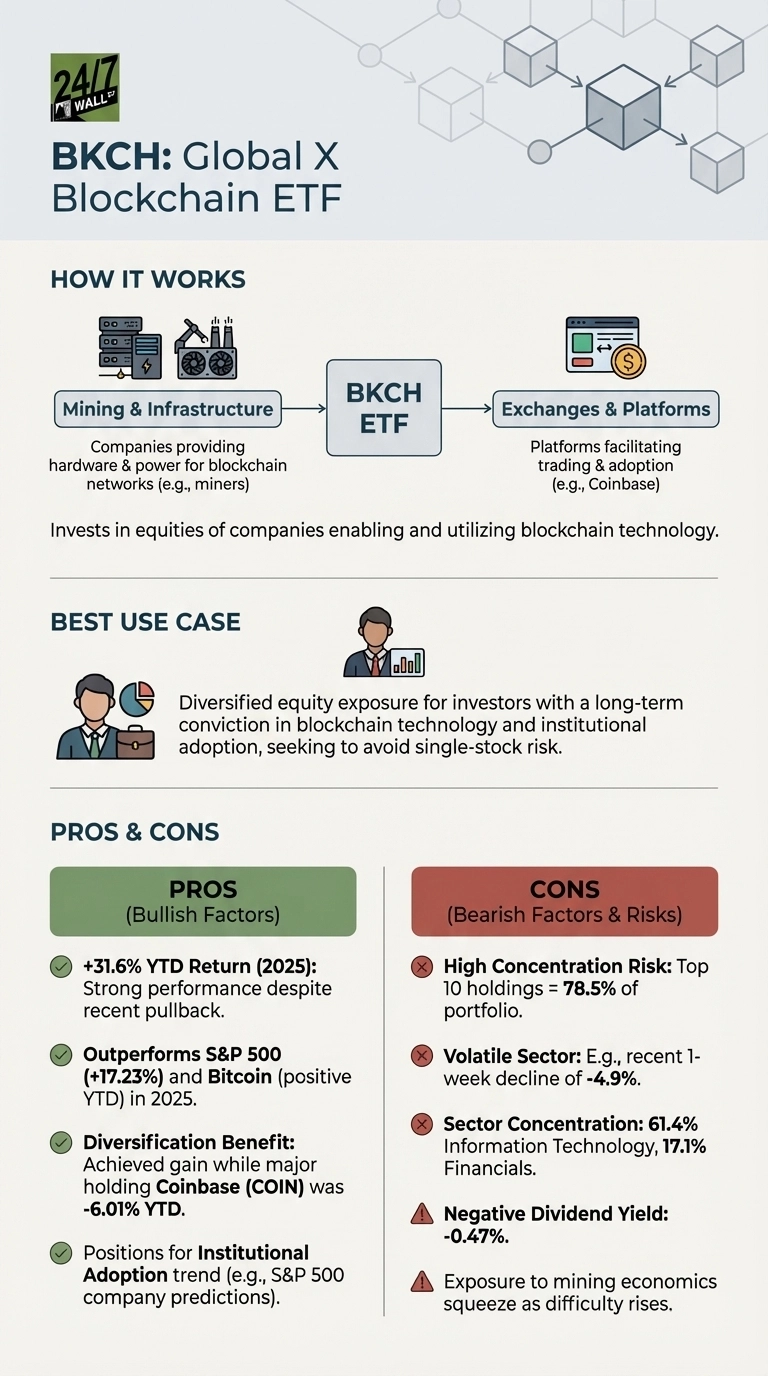
Check BKCH’s monthly holdings file on Global X’s website to track concentration in mining stocks versus exchanges and infrastructure plays. The 78.5% concentration in the top 10 holdings means a few names drive most returns. If mining profitability deteriorates further in 2026, those weights could shift meaningfully during quarterly rebalances.
Consider LEGR for Broader Exposure
The First Trust Indxx Innovative Transaction & Process ETF (NASDAQ:LEGR) offers a different approach. With $121 million in assets and a 0.65% expense ratio, LEGR tracks companies using blockchain technology rather than pure-play miners and exchanges. Its top holdings include Micron Technology (NASDAQ:MU), Intel (NASDAQ:INTC), and Samsung, providing exposure to the semiconductor infrastructure enabling blockchain rather than volatile mining operations. The trade-off is lower beta to Bitcoin price movements, but also less single-stock concentration risk than BKCH’s miner-heavy approach.
Watch Adoption and Mining Costs
Corporate Bitcoin adoption momentum and mining difficulty trends will determine whether BKCH extends its 2025 outperformance or faces headwinds as operational costs squeeze the miners that dominate its portfolio.











 Top Gaining Stocks
 Top Losing Stocks