



Retirees seeking geographic diversification face a fundamental tension: emerging markets promise growth but deliver volatility. The iShares MSCI Emerging Markets Asia ETF (NYSEARCA:EEMA) exemplifies this challenge, offering concentrated exposure to Asia’s developing economies amid political uncertainty and currency swings.
What EEMA Delivers: Growth Potential With Geographic Concentration
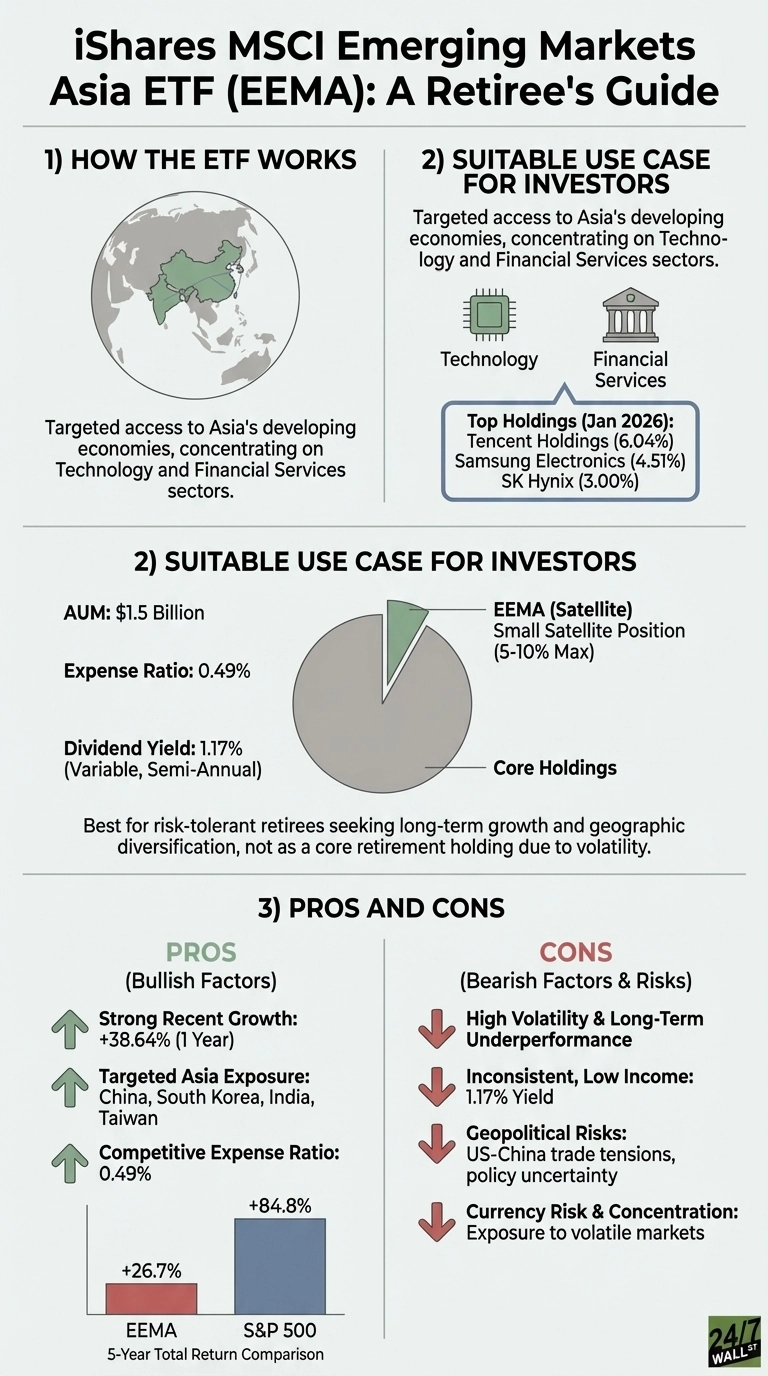
EEMA provides targeted access to emerging Asian markets through a portfolio dominated by technology and financial services. With $1.5 billion in assets and a 0.49% expense ratio, the fund concentrates holdings in China, South Korea, India, and Taiwan. Top positions include Tencent Holdings (OTC:TCEHY) (6.04%), Samsung Electronics (OTC:SSNLF) (4.51%), and SK Hynix (OTC:HXSCL) (3%).
The fund’s return engine depends on capital appreciation from companies in rapidly developing economies and modest dividend income. The current 1.17% yield comes from semi-annual distributions ranging from $1.13 to $1.80 per share over five years, highlighting income instability.
Recent Performance Masks Long-Term Underperformance
EEMA surged 38.6% in 2025, dramatically outperforming U.S. equities. However, this strength obscures a concerning pattern: the fund delivered just 26.7% total returns over five years, translating to roughly 5% annualized gains. Over the same period, the S&P 500 returned 84.8%.
This performance gap illustrates the core tradeoff retirees must accept. Emerging markets experience extended underperformance punctuated by sharp rallies. Investors needing predictable returns to fund retirement expenses may wait years for recovery, as occurred between 2021 and 2024.
The Tradeoffs: Volatility, Geopolitics, and Income Uncertainty
Three significant risks accompany EEMA’s Asia-focused strategy. First, geopolitical tensions remain elevated. U.S.-China trade conflicts persist into 2026, with tariffs and technology restrictions creating unpredictable headwinds for Chinese holdings.
Second, dividend variability undermines income planning. Annual distributions have fluctuated by more than 50% across recent years, making it difficult for retirees to budget. The current 1.17% yield also falls short of investment-grade bonds or dividend-focused U.S. equity funds.
Third, currency risk amplifies volatility. When the U.S. dollar strengthens against Asian currencies, returns suffer even when local stock prices rise. Retirees converting positions back to dollars face this additional uncertainty.
Who Should Avoid EEMA
Two investor profiles should look elsewhere. Retirees depending on portfolio income for essential expenses will find EEMA’s modest, inconsistent yield inadequate. Those with less than 10 years until they need to access funds also face sequence-of-returns risk, where a poorly timed downturn could permanently impair retirement plans.
Consider VWO for Broader Emerging Markets Exposure
The Vanguard FTSE Emerging Markets ETF (NYSEARCA:VWO | VWO Price Prediction) offers a compelling alternative. VWO charges just 0.07%, making it 86% cheaper than EEMA’s 0.49% expense ratio. This cost difference compounds significantly over retirement timeframes.
VWO also provides broader geographic diversification beyond Asia, including exposure to Latin America, Eastern Europe, and Africa. This reduces concentration risk tied to any single region’s challenges. With $141 billion in assets compared to EEMA’s $1.5 billion, VWO offers superior liquidity for retirees who may need to adjust positions.
EEMA works best as a small satellite position for risk-tolerant retirees seeking Asia-specific exposure, but the combination of high volatility, geopolitical uncertainty, and inconsistent income makes it unsuitable as a core retirement holding.












 Top Gaining Stocks
 Top Losing Stocks