What Retirees Need To Know About HDV’s Dividend Before Buying

Photo of Michael Williams
By Michael Williams Published

Quick Read

  • HDV’s 2025 distributions fell 4.9% from 2024 to $3.91 per share with quarterly payments fluctuating up to 58%.

  • AbbVie represents 6.2% of the fund but pays nearly five times its earnings in dividends as its payout ratio exceeds 497%.

  • HDV returned 11.3% over the past year versus 17% for the S&P 500 and underperformed by 100 percentage points over 10 years.

This post may contain links from our sponsors and affiliates, and Flywheel Publishing may receive compensation for actions taken through them.
What Retirees Need To Know About HDV’s Dividend Before Buying

© 24/7 Wall St.

The iShares Core High Dividend ETF (NYSEARCA:HDV | HDV Price Prediction) offers retirees a 3.3% yield with 0.08% fees, tracking high-quality U.S. dividend payers. The fund generates income from dividends of blue-chip stocks concentrated in Consumer Staples (28%), Energy (24%), and Healthcare (17%). With $11.8 billion in assets and a 14-year track record, HDV appeals to income-focused investors. However, distributions fluctuate significantly and have declined recently, raising sustainability questions.

Evaluating Dividend Safety Through Top Holdings

HDV’s income depends entirely on portfolio company dividends. The top five holdings represent 28.5% of the fund with mixed dividend safety.


Exxon Mobil (NYSE:XOM), HDV’s largest holding at 9.4%, shows solid dividend safety with a 58% earnings payout ratio and 3.2% yield. The company raised its quarterly dividend 4% in November 2025 to $1.03 per share and maintained payments through the 2020 oil collapse. With an 18 P/E ratio and 9.2% profit margin, Exxon’s dividend appears sustainable.

Chevron (NYSE:CVX) at 6.8% weighting offers a 4.1% yield but shows higher risk with a 95% earnings payout ratio. The company raised its dividend 4.9% in early 2025, continuing a 38-year growth streak, yet quarterly earnings declined 27% year-over-year. Combined with Exxon, these positions create 16.2% energy sector concentration risk.

Johnson & Johnson (NYSE:JNJ), representing 6.7% of HDV, exemplifies dividend aristocrat quality with over 60 consecutive years of increases and a 49% payout ratio. The healthcare giant raised its quarterly dividend 4.8% in 2025 to $1.30 per share, maintaining its 2.5% yield with a 27% profit margin.

The concerning outlier is AbbVie (NYSE:ABBV) at 6.2% weighting. Despite a 3% yield, the company’s earnings payout ratio exceeds 497%, meaning it pays nearly five times its earnings in dividends. Quarterly earnings plunged 89% year-over-year as Humira faces patent cliff challenges, though 9% revenue growth and strong cash flow currently support the $6.56 annual dividend.

Procter & Gamble (NYSE:PG) rounds out the top five at 5.4%, offering a 2.9% yield with a 60% payout ratio and 20% profit margins.

Distribution Volatility Concerns

HDV’s quarterly payments fluctuate dramatically, with Q4 2025 distributing $1.253 versus $0.795 in Q1 2025, a 58% variance. Total 2025 distributions of $3.91 declined 4.9% from 2024’s $4.11. Over 10 years, HDV’s dividend growth averaged just 3.1% annually, barely outpacing inflation.


Total return also lags: HDV gained 11.3% over the past year versus the S&P 500’s 17%, and over 10 years has underperformed by nearly 100 percentage points in price appreciation.
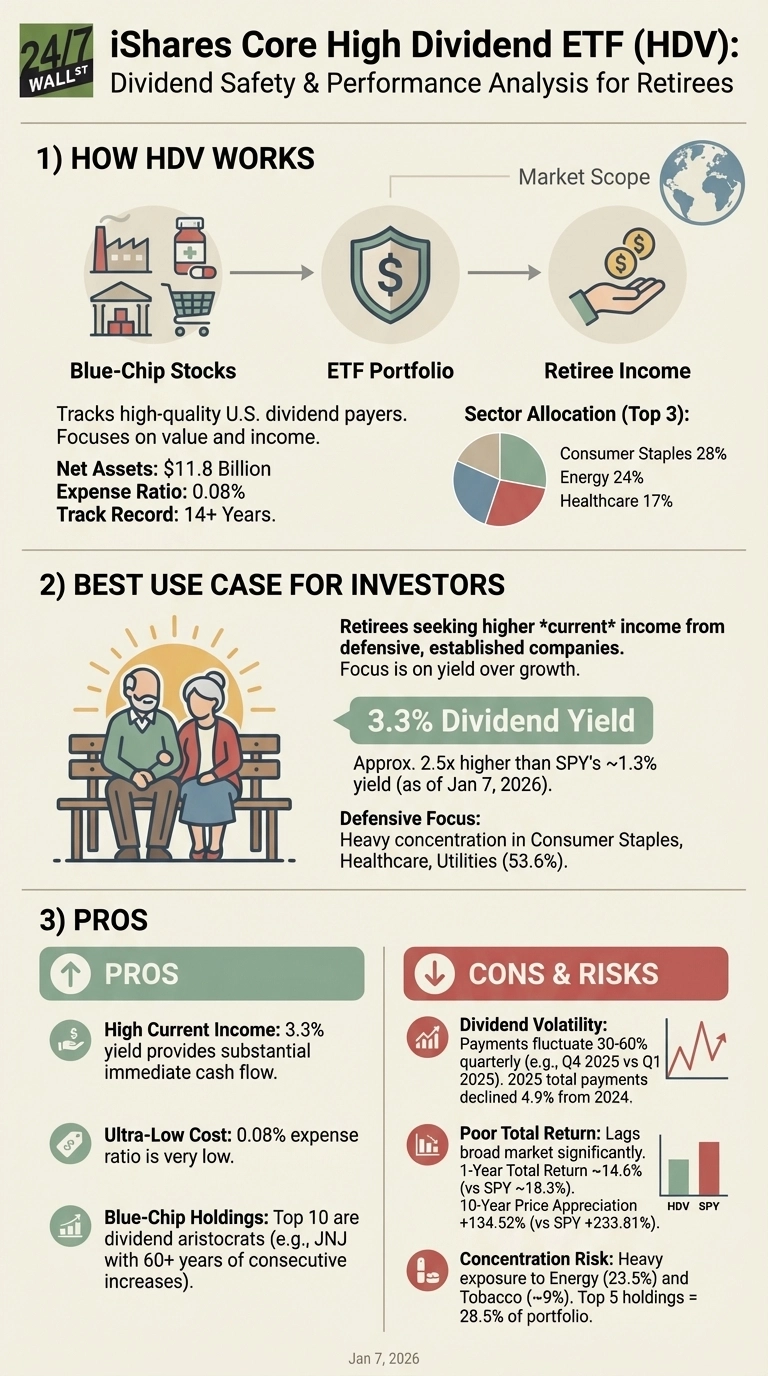
An infographic titled 'iShares Core High Dividend ETF (HDV): Dividend Safety & Performance Analysis for Retirees.' Section 1, 'How HDV Works,' illustrates a flow: Blue-Chip Stocks (represented by industry, residential, and consumer icons) feed into an ETF Portfolio (a shield with a dollar sign), which then generates Retiree Income (a hand holding dollar coins). This section details HDV's Net Assets ($11.8 Billion), Expense Ratio (0.08%), Track Record (14+ Years), and top 3 Sector Allocations: Consumer Staples 28%, Energy 24%, Healthcare 17%. Section 2, 'Best Use Case for Investors,' features an image of an elderly couple and specifies the fund is for retirees seeking high current income from defensive companies, with a focus on yield. It highlights a 3.3% Dividend Yield (2.5x higher than SPY's ~1.3% as of Jan 7, 2026) and a defensive focus in Consumer Staples, Healthcare, and Utilities (53.6%). Section 3, 'Pros,' lists: High Current Income (3.3% yield), Ultra-Low Cost (0.08% expense ratio), and Blue-Chip Holdings (Top 10 are dividend aristocrats). Section 3, 'Cons & Risks,' lists: Dividend Volatility (payments fluctuate 30-60% quarterly, 2025 payments declined 4.9% from 2024), Poor Total Return (lags broad market, 1-Year Return ~14.6% vs SPY ~18.3%, 10-Year Price Appreciation +134.52% vs SPY +233.81%, illustrated by a bar chart comparing HDV and SPY), and Concentration Risk (heavy exposure to Energy 23.5% and Tobacco ~9%, top 5 holdings = 28.5%). The infographic is dated January 7, 2026.
24/7 Wall St.
This infographic provides a detailed analysis of the iShares Core High Dividend ETF (HDV), outlining its mechanics, benefits like its 3.3% dividend yield, and risks such as dividend volatility and concentration.

Consider VYM as an Alternative

The Vanguard High Dividend Yield ETF (NYSEARCA:VYM) offers a compelling alternative. With $84.5 billion in assets and a 0.06% expense ratio, VYM provides a 2.4% yield through 571 holdings versus HDV’s 75. This broader diversification reduces concentration risk, with top holding Broadcom (NASDAQ:AVGO) at 8.7% versus HDV’s 9.4% Exxon position. VYM’s sector allocation favors Financials (21%) and Technology (16%) over HDV’s heavy Energy exposure, potentially offering more stable distributions. While VYM’s yield is lower, its superior diversification may better serve retirees prioritizing income reliability over maximum current yield.


Photo of Michael Williams
About the Author Michael Williams →

I am a long time investor and student of business, and believe finding good companies that can become great investments is the best game on earth. After 20 years of writing and researching the public markets it is clear that individuals have never had more tools and information to take control of their financial lives. From ETFs and $0 commissions to cryptos and prediction markets there has never been a greater democratization of access to investing. 

I write to help people understand the investments available to them so they can make the best choice for their portfolio, whether they're starting out or looking for income in retirement. 

Featured Reads

Our top personal finance-related articles today. Your wallet will thank you later.

Continue Reading

Top Gaining Stocks

CBOE Vol: 1,568,143
PSKY Vol: 12,285,993
STX Vol: 7,378,346
ORCL Vol: 26,317,675
DDOG Vol: 6,247,779

Top Losing Stocks

LKQ
LKQ Vol: 4,367,433
CLX Vol: 13,260,523
SYK Vol: 4,519,455
MHK Vol: 1,859,865
AMGN Vol: 3,818,618