


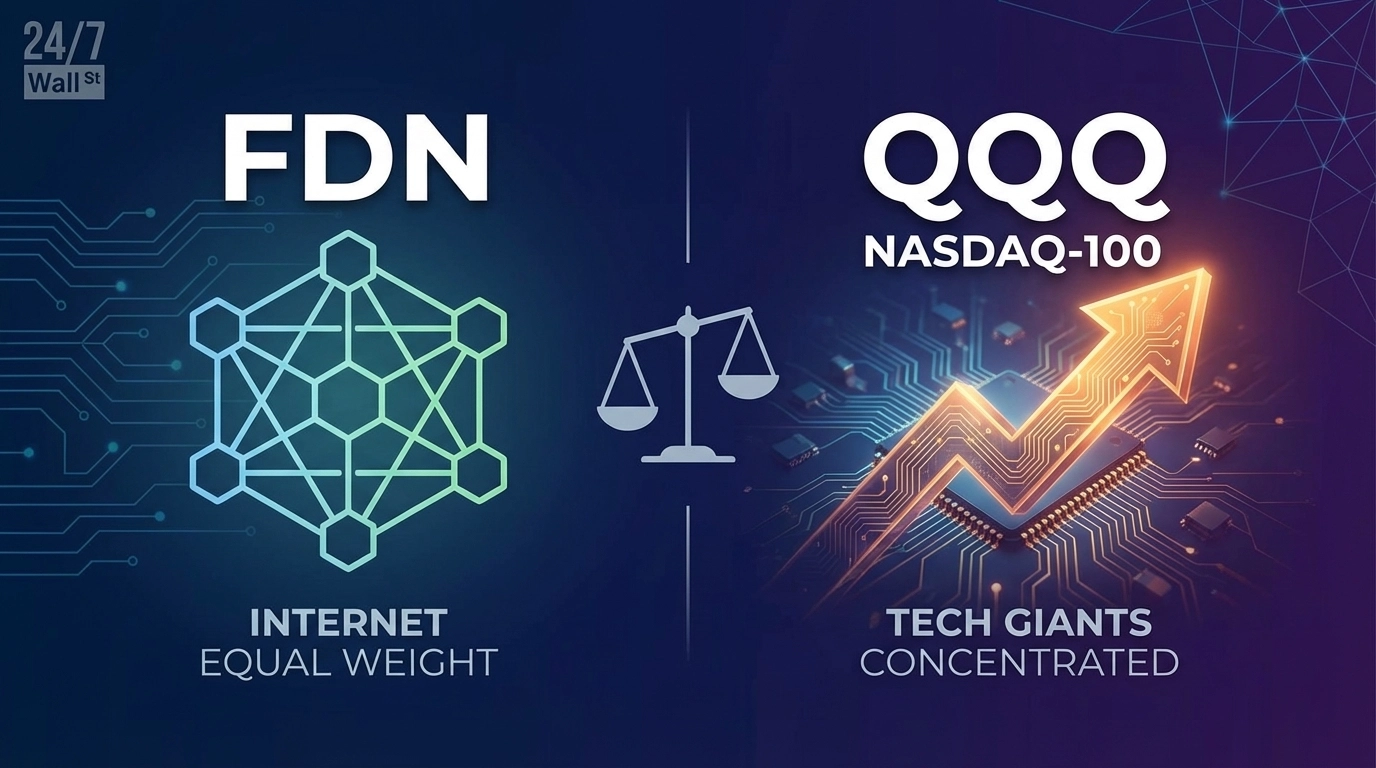
When mega-cap technology stocks dominate market returns, concentration risk becomes a concern. The First Trust Dow Jones Internet Index Fund (NYSEARCA:FDN | FDN Price Prediction) offers an alternative through equal-weight internet stocks, but investors need to understand the tradeoffs.
An Equal-Weight Bet on Pure Internet Companies
FDN tracks the Dow Jones Internet Composite Index and holds 42 internet-focused companies with roughly equal weighting. The fund’s largest holding, Meta Platforms (NASDAQ:META), represents just over 10% of assets, compared to Nvidia (NASDAQ:NVDA)’s 9% weight in Invesco QQQ Trust (NASDAQ:QQQ). This provides exposure to companies like DoorDash (NYSE:DASH), Snowflake (NYSE:SNOW), Cloudflare (NYSE:NET), and Carvana (NYSE:CVNA) that play smaller roles or don’t appear in QQQ.
FDN bets that a basket of internet businesses will collectively benefit from digital economy growth without allowing any single company to dominate outcomes. The fund rebalances to maintain equal weights, automatically trimming winners and adding to laggards. This reduces the risk of overexposure to one company’s missteps while capturing upside across the internet sector.
The Performance Gap Is Real
Over the past year, FDN returned roughly 8%, which sounds modest until you compare it to QQQ’s 18% return. The gap widens over longer periods, with QQQ’s 97% return over five years versus FDN’s 27%.
The culprit: FDN lacks exposure to Nvidia, Apple (NASDAQ:AAPL), and Microsoft (NASDAQ:MSFT), which together represent 24% of QQQ. These three stocks drove much of the Nasdaq’s recent outperformance, particularly Nvidia’s AI-fueled surge. FDN’s equal-weight approach also means it underweighted Amazon (NASDAQ:AMZN) and Meta during their strongest periods while maintaining exposure to weaker internet names.
What You Accept to Own This ETF
First, you’re paying 0.49% annually, nearly three times QQQ’s 0.18% expense ratio. Over decades, that difference compounds significantly.
Second, equal-weighting creates higher turnover as the fund rebalances. This generates tax inefficiency in taxable accounts and means you’re systematically selling winners to buy more losers.
Third, you’re making a concentrated bet that internet companies will outperform despite missing the semiconductor and hardware companies driving much of tech’s growth. If AI infrastructure continues to dominate returns, FDN’s pure internet focus becomes a liability.
Who Should Avoid This Fund
Long-term buy-and-hold investors seeking maximum tech exposure should stick with QQQ or a total market fund. The performance gap over five years represents real wealth left on the table.
Investors who want exposure to the Magnificent Seven stocks should also look elsewhere. FDN lacks Nvidia, Apple, Microsoft, and Tesla (NASDAQ:TSLA) entirely, meaning you’re missing four of the market’s most important growth drivers.
Consider QQQE Instead
If equal-weight tech exposure appeals to you, the Direxion NASDAQ-100 Equal Weighted Index Shares (NASDAQ:QQQE) offers a more comprehensive approach. QQQE applies equal-weighting to the full Nasdaq-100, giving you exposure to all the same companies as QQQ but with reduced concentration risk. The expense ratio is lower at 0.35%, and you maintain exposure to semiconductors, hardware, and software companies that FDN excludes.
FDN serves a narrow purpose for investors who specifically want pure internet exposure and are willing to accept significant underperformance for reduced concentration, but most investors will find QQQ or QQQE better suited to their goals.












 Top Gaining Stocks
 Top Losing Stocks