



An $85,000 annual retirement income is well above median U.S. household income and could cover most middle-class expenses. But whether this provides genuine security or hidden risk depends on where the money comes from and how long it needs to last.
On Reddit’s r/FinancialPlanning forum, one user asked how much they’d need saved to live on $80,000 annually, with responses emphasizing “you need $2,000,000 today for $80,000 a year to last at least 30 years, including increases for inflation.” The core tension is similar for anyone targeting $85,000: can your portfolio sustain withdrawals while keeping pace with inflation over 25-30 years?
Key Scenario Details
- Annual Income Target: $85,000
- Primary Challenge: Balancing sustainable withdrawals with inflation protection
- Time Horizon: 25-30+ years in retirement
- Critical Factor: Asset allocation between growth and income investments
The Real Financial Tension: Growth vs. Safety
The biggest risk isn’t whether $85,000 feels comfortable today – it’s whether that purchasing power survives decades of inflation. At 2.5% inflation, $85,000 in today’s dollars needs to become $139,000 in 20 years to maintain the same purchasing power.
Using the 4% withdrawal rule, you’d need roughly $2.1 million invested to generate $85,000 annually. But portfolio composition matters enormously. A conservative 30/70 stocks-to-bonds allocation might feel safer short-term, but severely limits long-term growth. Based on the S&P 500’s 10.8% annualized return over 20 years, a $1 million portfolio split 30/70 between stocks and bonds would grow to approximately $3.9 million over 30 years. The same portfolio at 70/30 would reach $9.2 million.
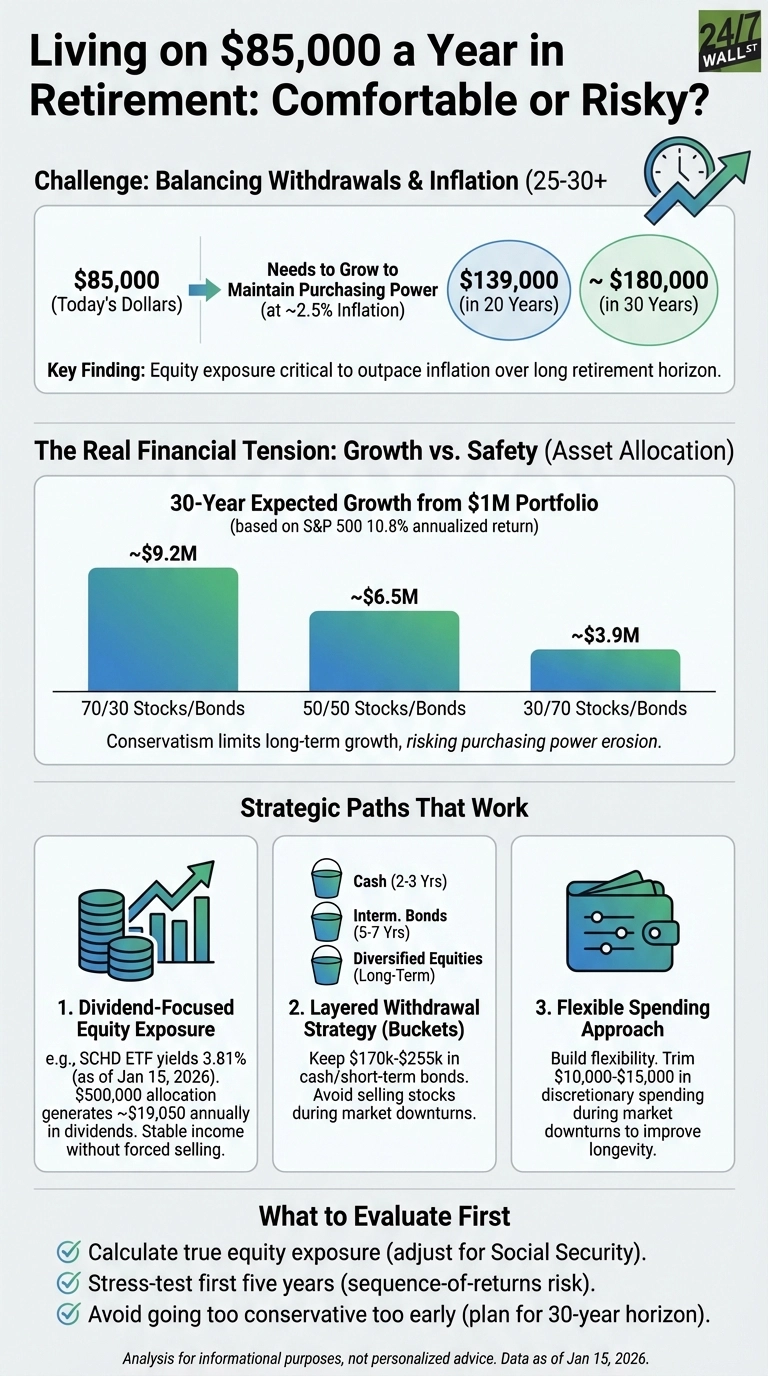
That difference determines whether your income increases with inflation or gets slowly eroded. Retirees who lean too heavily on fixed-income investments often cut spending in their 70s and 80s when healthcare costs surge.
Strategic Paths That Work
Dividend-Focused Equity Exposure: Consider dividend-paying equities like those in SCHD (Schwab U.S. Dividend Equity ETF), which currently yields 3.81%. A $500,000 allocation would generate roughly $19,000 annually in dividends while maintaining growth potential, providing income without forced selling during market downturns.
Layered Withdrawal Strategy: Split your portfolio into buckets. Keep 2-3 years of expenses in cash or short-term bonds ($170,000-$255,000). Hold another 5-7 years in intermediate bonds. Invest the remainder in diversified equities. This lets you avoid selling stocks during bear markets while maintaining long-term growth.
Flexible Spending Approach: Build flexibility into your $85,000 target. Identify $10,000-$15,000 in discretionary spending you could trim during market downturns. This variable withdrawal approach significantly improves portfolio longevity.
What to Evaluate First
Calculate your true equity exposure. If Social Security provides $30,000-$40,000 annually, you only need to generate $45,000-$55,000 from investments. That changes the math significantly and might allow more conservative positioning.
Stress-test the first five years. Sequence-of-returns risk is highest early in retirement. If you retire into a bear market and withdraw $85,000 while your portfolio drops 20%, recovery becomes much harder. Having that cash cushion is essential.
Avoid going too conservative too early. A 65-year-old retiree might live to 95—a 30-year investment horizon, not a short-term goal. Treating retirement like a 5-year bond portfolio almost guarantees purchasing power erosion.
This analysis is meant to be helpful but not personalized advice. Your specific situation requires individual evaluation.













 Top Gaining Stocks
 Top Losing Stocks