


When growth stocks dominate headlines and valuations stretch, finding established companies trading at reasonable prices becomes harder. Vanguard Mega Cap Value Index Fund ETF Shares (NYSEARCA:MGV | MGV Price Prediction) offers exposure to the largest U.S. companies trading at value multiples, combining stability and upside without growth-stock premiums.
Characteristics: Large-Cap Value at Lower Multiples
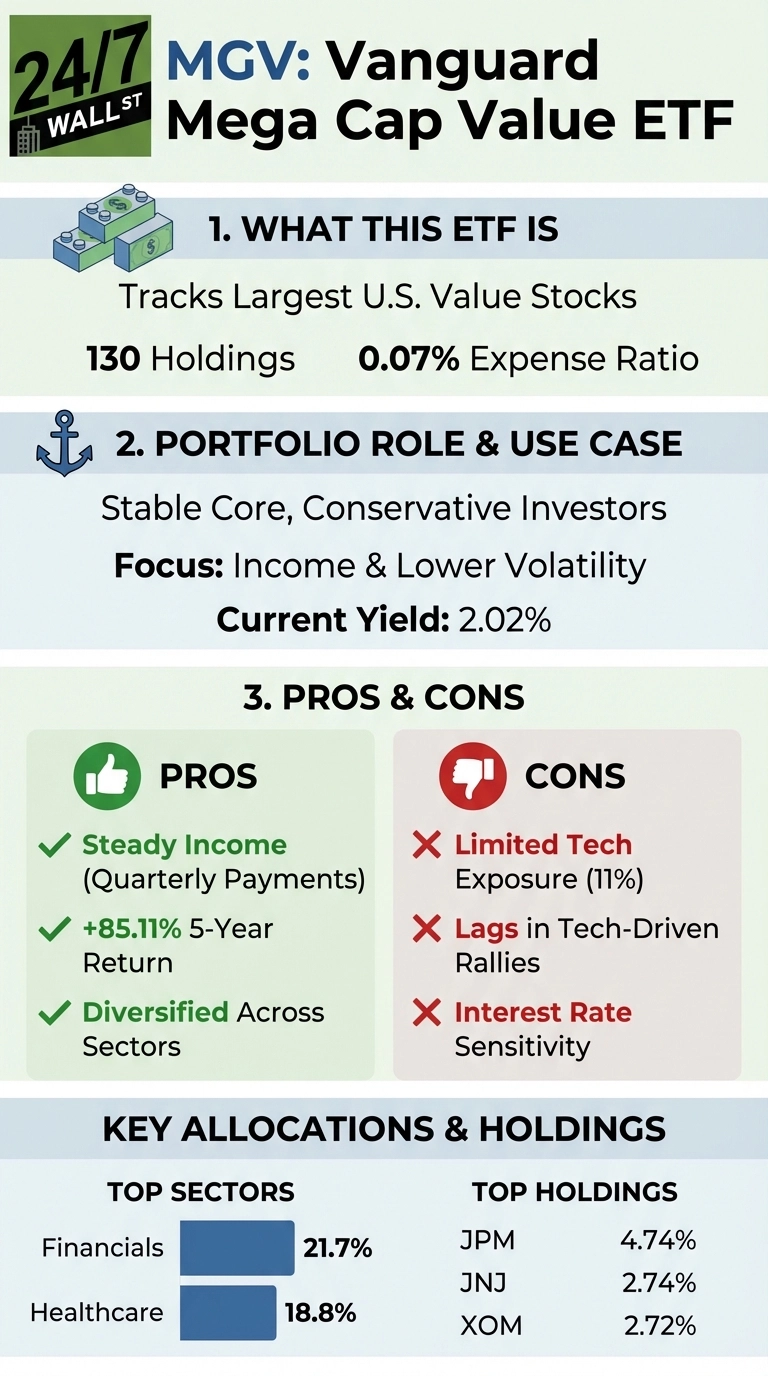
MGV tracks 130 mega-cap stocks with strategic concentration in defensive sectors that provide stability during market uncertainty. The fund’s largest bet is on financials at 21.7% of assets, positioning investors to benefit from banking sector strength as interest rates stabilize and loan demand recovers. Healthcare represents the second-largest allocation at 18.8%, adding pharmaceutical exposure through established players that generate consistent cash flows regardless of economic conditions.
The top holdings reveal the fund’s quality focus. JPMorgan Chase & Co. (NYSE:JPM) leads at 4.74% of assets, combining financial sector exposure with a track record of dividend growth. Johnson & Johnson (NYSE:JNJ)’s 2.74% weighting adds defensive healthcare characteristics, while Exxon Mobil Corp (NYSE:XOM)’s 2.72% stake provides energy diversification for portfolios seeking commodity exposure.
The fund generates returns through steady dividend income and capital appreciation from undervalued companies. Its 2.02% yield provides current income while the minimal 7 basis point fee ensures investors keep most of what they earn. The portfolio’s quality shows in dividend growth—JPMorgan raised its payout 23.4% last year, demonstrating how these mature businesses reward shareholders.
Performance Shows Value Can Compete
MGV delivered 18% returns over the past year, nearly matching growth-focused alternatives while providing higher income and lower volatility—a combination that appeals to investors seeking equity exposure without growth-stock risk. The longer-term picture shows the tradeoff value investors accept: MGV’s 85% five-year gain trails pure growth funds like Vanguard Growth ETF (NYSEARCA:VUG), which returned 97% by concentrating in technology during the AI boom. That performance gap came with a benefit—steady dividends and smaller drawdowns that made the journey smoother for investors who stayed the course.
The Tradeoffs You Accept
MGV caps upside in growth-driven markets. When tech stocks surge on AI hype or rate cuts favor high-multiple companies, this fund lags. Its 11% technology weighting means limited exposure to semiconductor and software rallies. Sector concentration in financials creates interest-rate sensitivity. Rising rates help bank margins, but regulatory headwinds like proposed credit card APR caps create uncertainty for holdings like JPMorgan.
The fund doesn’t shield against cyclical downturns. Energy exposure through Exxon and materials positions mean commodity price swings affect returns. This isn’t a bond substitute—it’s an equity fund that owns less expensive stocks.
Limitations and Tradeoffs
Aggressive growth portfolios seeking triple-digit returns will find limited exposure here. Portfolios with decades until retirement face a tradeoff: VUG’s higher growth exposure and technology concentration offers different characteristics for long-term compounding. Income-focused portfolios needing yields above 3% will find MGV’s 2.02% payout lower than dividend-focused alternatives.
VUG Offers Contrasting Growth Profile
VUG offers a contrasting approach with 50% technology weighting concentrated in the Magnificent Seven tech stocks. Its 0.04% expense ratio slightly undercuts MGV, though both remain exceptionally low-cost. The key tradeoff: VUG sacrifices dividend income at just 0.39% yield for greater capital appreciation potential, delivering 12 percentage points more return over five years for portfolios that can accept tech concentration.
MGV provides large-cap equity exposure at value multiples with 2.02% yield, though it has underperformed pure growth alternatives during tech-driven rallies and offers lower income than dividend-focused funds.












 Top Gaining Stocks
 Top Losing Stocks