



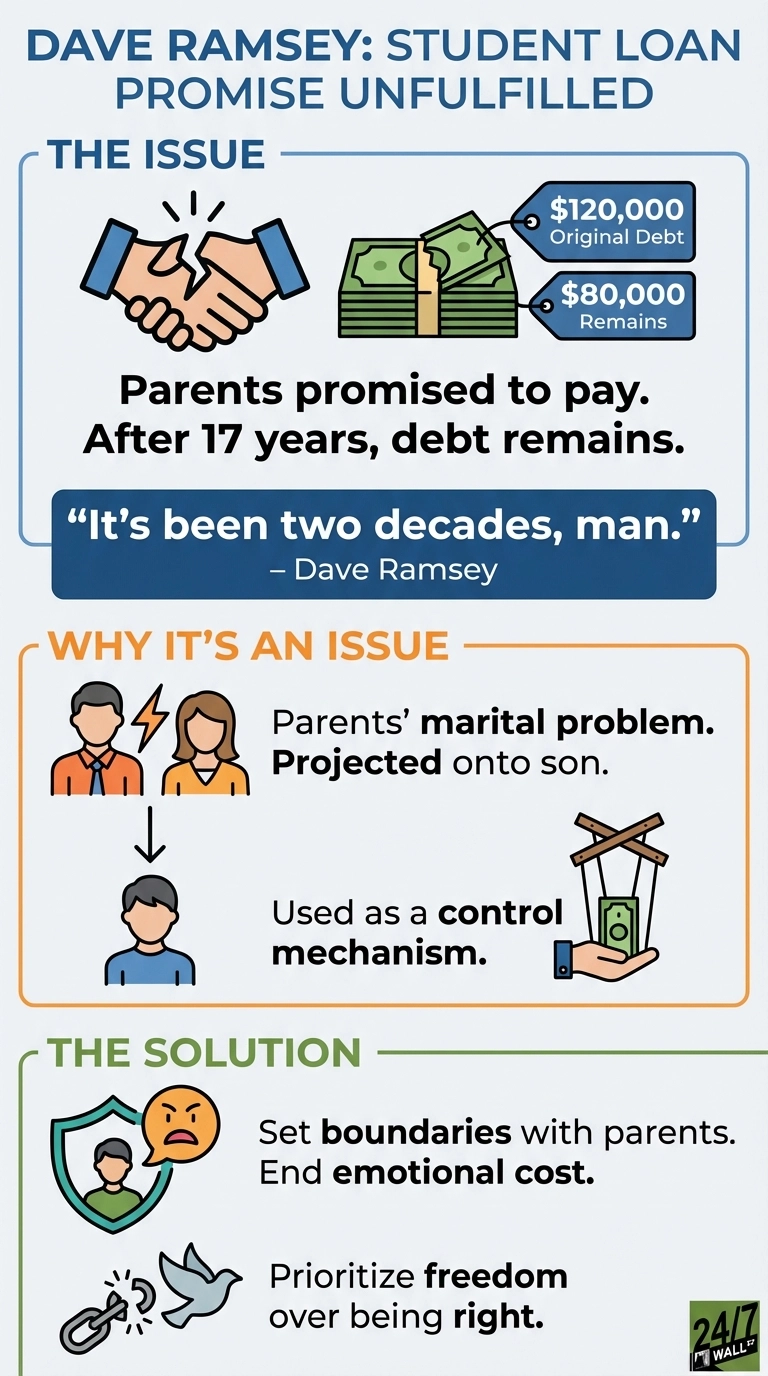
On a January 2026 episode of The Dave Ramsey Show, caller Shane described a situation that has dragged on for 17 years: his parents promised to pay his student loans when he was 18, but $80,000 remains on the original $120,000 debt. His financially comfortable parents continue making minimum payments while his mother criticizes his purchases. “A lot of the times it’s like, oh, you just bought a truck, like that could have gone to the student loans,” Shane explained.
Ramsey’s response cut through the noise: “It’s been two decades, man.” He and co-host Jade Warshaw identified the real problem as a marital disagreement Shane’s parents were projecting onto him. “This is now a marital problem they have of mom disagrees with how dad is handling a debt they agreed to pay,” Ramsey said.
Why This Advice Resonates
Ramsey’s assessment speaks to anyone trapped between broken promises and family guilt. After 17 years, this isn’t Shane’s problem to solve emotionally. His parents made a commitment when he was barely an adult, and their failure to honor it while criticizing his financial choices creates an impossible dynamic. The clarity feels liberating because it identifies the actual dysfunction: not the debt itself but the passive-aggressive communication pattern that has poisoned family interactions for nearly two decades.
Where the Advice Holds Up
Ramsey is right that Shane needs boundaries with his mother. When parents make a financial commitment and then use it as leverage for criticism, they’re violating the implicit contract. If Shane’s parents are financially comfortable enough to make payments but choose to stretch this out while commenting on his truck purchase, they’re using the debt as a control mechanism rather than treating it as their obligation.
The observation about the marital conflict is particularly astute. One parent likely wants to pay off the debt; the other is resistant. Rather than resolving this between themselves, they’ve made Shane the repository for their disagreement. This is fundamentally unfair and erodes the relationship with every passive comment.
The Missing Context
Ramsey didn’t fully explore whether Shane’s parents’ financial circumstances changed dramatically since making the promise. If they agreed to pay $120,000 when they were more secure and then faced job loss, medical expenses, or other financial shocks, the conversation becomes more nuanced. An honest discussion about changed circumstances is reasonable; 17 years of minimum payments with guilt trips is not.
The advice also doesn’t address tax implications if Shane’s parents have been claiming the student loan interest deduction while making payments. If they suddenly pay off the remaining balance, there may be gift tax considerations depending on how the payment is structured.
How to Think About Broken Financial Promises
If you’re in Shane’s position, consider whether ending the emotional cost is worth paying the debt yourself, even if you’re technically right. Sometimes being right costs more than being free. If your parents are in a similar situation and circumstances have changed, have the honest conversation immediately rather than letting resentment compound with interest for two decades.














 Top Gaining Stocks
 Top Losing Stocks