



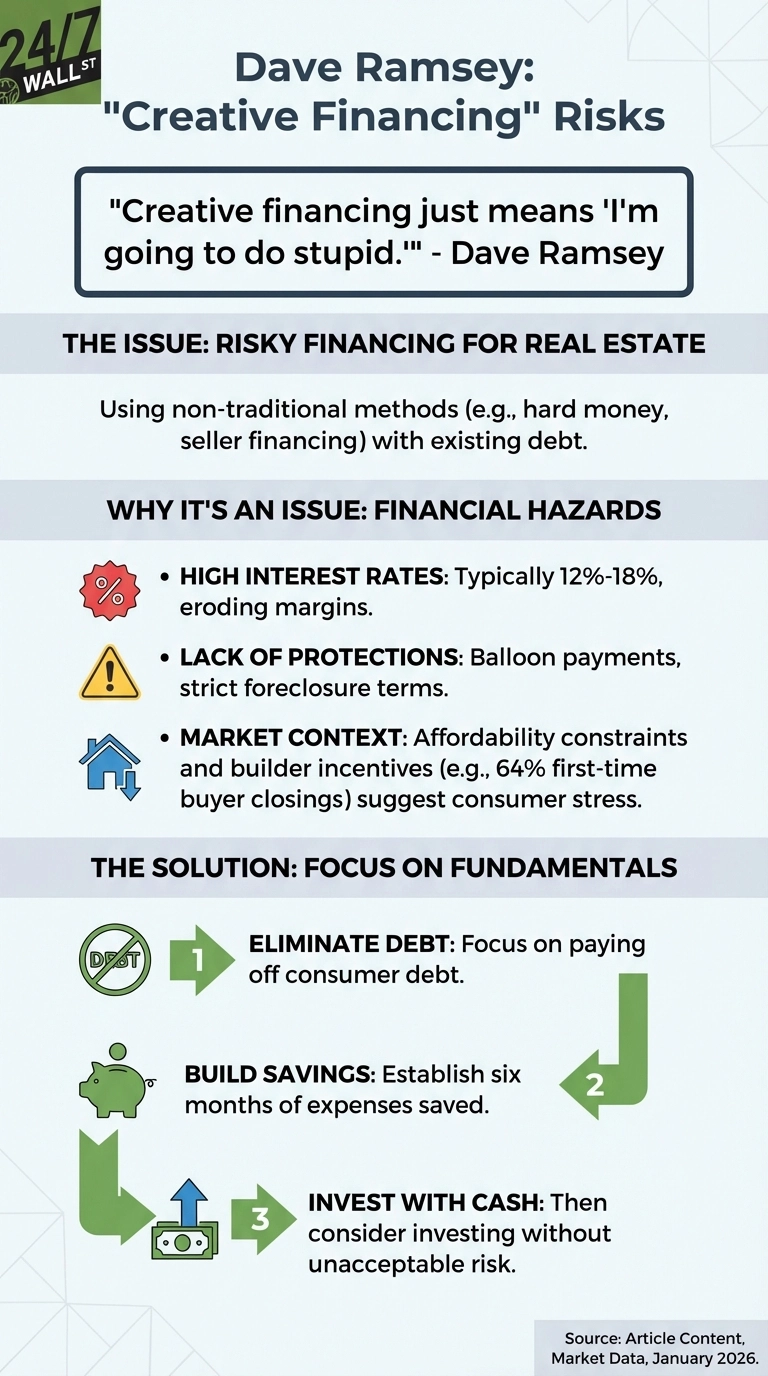
On a January 2026 episode of The Dave Ramsey Show, a caller named Trina presented a plan financial advisors hear too often: using creative financing to flip land while carrying $44,000 in debt on a $60,000 income. Ramsey’s response was characteristically blunt: “Creative financing just means, ‘Hey, I’m going to do stupid.'”
Trina, a 38-year-old Florida resident, was drowning in $44,000 of debt on a $60,000 annual income. Her financial obligations spanned car loans, credit cards, and her son’s private school tuition—a complex web of commitments that became more concerning when she revealed filing Chapter 7 bankruptcy just two years earlier. This recent bankruptcy suggested her struggles weren’t isolated incidents but part of a recurring pattern of financial instability.
What Ramsey Gets Right About Creative Financing
“Creative financing” in real estate refers to non-traditional purchase methods: seller financing, land contracts, hard money loans, or “subject-to” arrangements where a buyer takes over existing mortgage payments. These techniques allow investors to acquire property with little or no money down.
Ramsey’s skepticism is mathematically sound for people already in debt. When you’re paying 20% interest on credit cards, no legitimate real estate flip can reliably generate returns that justify additional risk. Creative financing compounds this problem by typically carrying interest rates between 12% and 18%—substantially higher than conventional mortgages. These elevated rates, combined with origination fees and points, quickly erode profit margins on property flips.
For someone like Trina, who demonstrated difficulty managing conventional debt and recently filed bankruptcy, avoiding creative financing is particularly appropriate. Bankruptcy should function as a financial reset, not a brief pause before accumulating new obligations through complex investment schemes.
The Context Ramsey Doesn’t Always Emphasize
Creative financing isn’t inherently reckless for every investor. Experienced real estate professionals with strong cash reserves and proven track records use seller financing and other alternative structures as legitimate tools. The key difference: they’re not using these methods because they can’t access traditional financing due to poor credit or excessive debt.
Early 2026 real estate market data shows why caution is warranted. Homebuilders like D.R. Horton are using aggressive incentives to maintain sales volumes amid affordability pressures, with 64% of their mortgage closings going to first-time buyers. This suggests underlying consumer stress that makes real estate speculation particularly risky for overleveraged individuals.
Additionally, creative financing deals often lack consumer protections built into traditional mortgages. Seller-financed contracts may include balloon payments, prepayment penalties, or foreclosure terms that heavily favor the seller.
How to Think About This Advice
Ramsey’s guidance to Trina—abandon early retirement dreams and focus on debt payoff—represents the unglamorous reality most overleveraged people need to hear. The math is simple: eliminating $44,000 in debt on a $60,000 income requires discipline, not additional financial complexity.
Before considering any real estate investment, particularly one involving creative financing, ask yourself: Do I have six months of expenses saved? Is my consumer debt paid off? Can I afford to lose my entire investment without jeopardizing my family’s security? If the answer to any of these is no, creative financing is indeed doing stupid.
Ramsey’s warning against creative financing won’t apply to every investor in every situation, but it’s precisely correct for people already demonstrating poor debt management. Building wealth requires boring fundamentals first—eliminate debt, build savings, then invest with cash. There are no shortcuts that don’t involve unacceptable risk for those starting from a position of financial weakness.







 Top Gaining Stocks
 Top Losing Stocks