


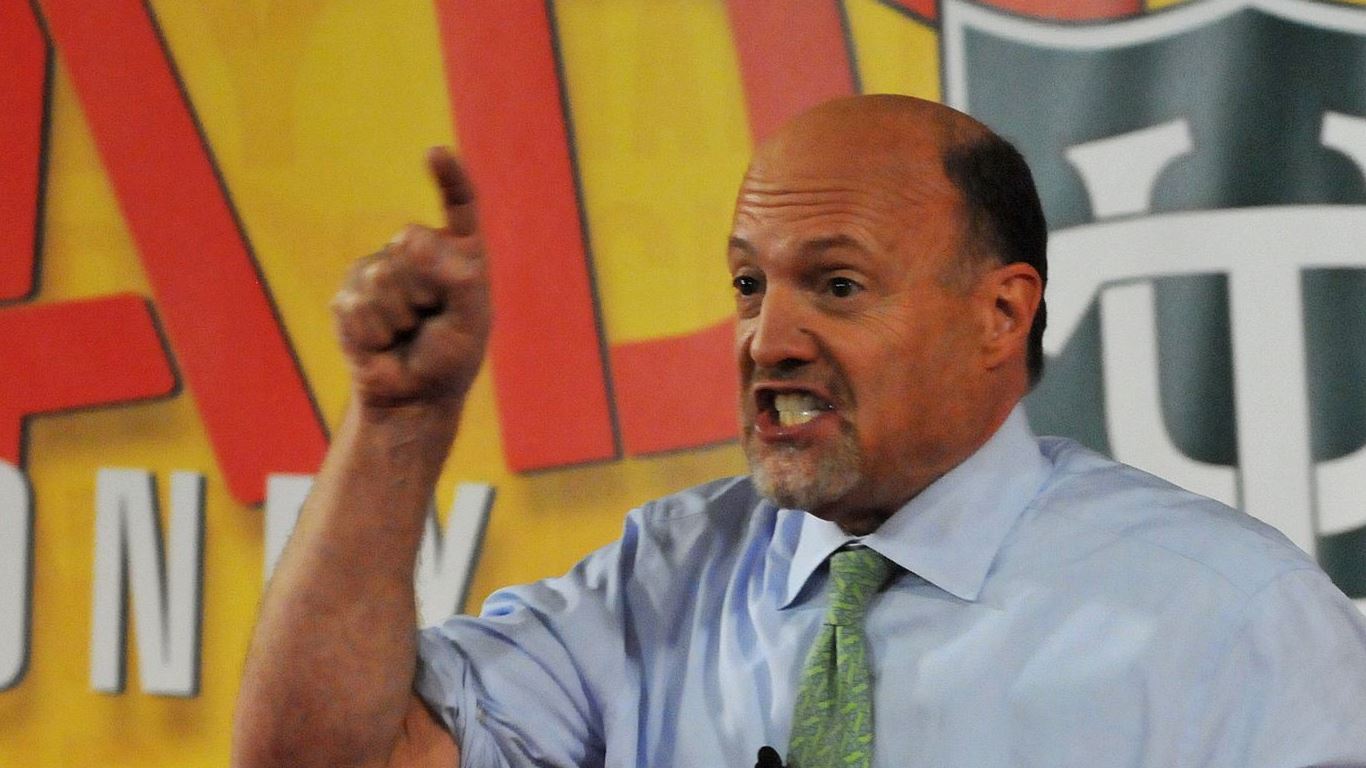
As the host of the popular television program Mad Money, Jim Cramer has a lot of influence in the financial community. He’s been around for decades and has seen the stock market rise and fall — and in the first month of 2026, Cramer offers a warning for optimistic investors.
On January 20, stocks wavered as traders weighed President Trump’s threats to impose tariffs on nations impeding a proposed takeover of Greenland. That same day, Cramer issued incisive commentary about the pitfalls of excessive speculation in the financial markets.
Should large-cap stock investors be worried? Is a 2022-style drawdown coming in 2026? It’s worth your time to heed the Mad Money host’s admonitions, but at the end of the day, it may be too soon to call a top in the current bull market.
Paper Gains Don’t Count
The S&P 500, which is often traded via exchange traded funds (ETFs) like the SPDR S&P 500 ETF (NYSEARCA:SPY | SPY Price Prediction) or the Vanguard S&P 500 ETF (NYSEARCA:VOO), fell rapidly on January 20. However, prior to that event, the S&P 500 had rallied strongly for eight months.
Moreover, large-cap stocks easily recovered their losses in the days following January 20. Still, Cramer used the one-day S&P 500 drawdown to remind investors that it’s sensible to lock in your profits on high-flying stocks.
“You haven’t made a profit unless you ring the register on some of your gains,” Cramer explained. Those unrealized profits are just “paper gains. That doesn’t count,” he added.
Cramer’s advice applies to all stocks and not only the S&P 500. “Let’s say you have a big gain in a stock that’s soared this year; tomorrow [you should] take something off the table,” he suggested.
Always Check the Fundamentals
It’s sensible to book profits on some stocks after a sharp rally. Yet, for many stock traders, ignoring Cramer’s advice and holding high flyers has been a winning strategy.
Take quantum computer developer IonQ (NYSE:IONQ) as an example. IONQ stock is up 300% over the past five years, so it may be flippant to declare that the shareholders’ “paper gains” don’t “count.”
But then, you might notice that IonQ stock is in danger of losing those gains. As I’ve discussed elsewhere, IonQ’s fundamentals are less than perfect as the company’s expenditures greatly outweigh its revenue.
Mind you, this isn’t just about IonQ. Evidently, Cramer is wary of certain stocks with a market capitalization exceeding $1 billion that have rallied 50% or more year-to-date.
“For the most part,” Cramer is leery of a group of “companies with no earnings and little in the way of sales.” The takeaway, then, is that it’s hazardous to hold on to moonshot stocks representing businesses with less-than-ideal fundamentals.
No Need to Sell Everything
While Cramer’s warnings might sound alarmist, he’s not telling people to keep all of their wealth in cash. Instead, he’s “advocating that you try to take a big percentage of your stock and put it in cash.”
This advice particularly applies to anyone who got lucky and has unrealized profits on high-flying stocks representing earnings-poor companies. If you take partial or full profits now, according to Cramer, “you’re playing with what I call the house’s money.”
With that, we’re now circling back to the idea of taking “something off the table” if you “have a big gain in a stock that’s soared this year.” This strategy can apply to any stock, whether it’s in the S&P 500 or not.
Unlike Cramer, I wouldn’t focus my cautionary tone on unprofitable businesses. Take a look at the chart of Trade Desk (NASDAQ:TTD) stock and you’ll see what I mean.
Trade Desk is a profitable company, and until December of 2025, TTD stock was up substantially. Then, the market turned against Trade Desk and the stock collapsed.
Taking Cramer’s advice and booking profits after the Trade Desk stock rally would have been a smart move. This is true even though Trade Desk isn’t a business with “no earnings and little in the way of sales.”
Not New Advice, but Still Relevant
In this case, Cramer’s ideas aren’t new but they can still apply in 2026. As the stock market hovers near all-time highs, it could make sense for investors to trim their positions in stock that have gained, say, 50% or more.
Plus, I concur with Cramer’s concepts as it’s wise to always check the fundamentals of companies you’re invested in. At the same time, Cramer is right to advise that you don’t need to sell all of your stock holdings. That way, you can “play with the house’s money” and steer clear of overly risky, potentially destructive speculation.











 Top Gaining Stocks
 Top Losing Stocks