



Advanced Micro Devices (NASDAQ: AMD) | AMD Price Prediction reports FY2025 full-year and Q4 earnings on Feb. 3, 2026, after market close. Wall Street is expecting EPS of $1.32 on revenue of approximately $9.6 billion, representing 21% year-over-year (YOY) growth and 25% YOY growth, respectively. Shares have gained 115% over the past year, significantly outpacing the broader technology sector.
The Numbers That Matter
What Wall Street Expects:
- EPS consensus: $1.32
- Revenue consensus: ~$9.6 billion
- Data center revenue: Expected above $4 billion
- Gross margin: Guidance of 54.5%
The Beat Threshold:
A meaningful beat requires EPS of at least $1.40 paired with revenue exceeding $9.8 billion. The company has beaten or met estimates in six of the past seven quarters, with an average surprise of approximately 8%.
Historical Context:
AMD delivered a 10.3% earnings surprise in Q3 2025, reporting $0.75 versus the $0.68 estimate. Q2 2025 saw an exceptional 1,180% beat as analysts expected a loss but AMD delivered $0.54 in earnings.
What Happened Last Quarter
Three Key Takeaways from Q3:
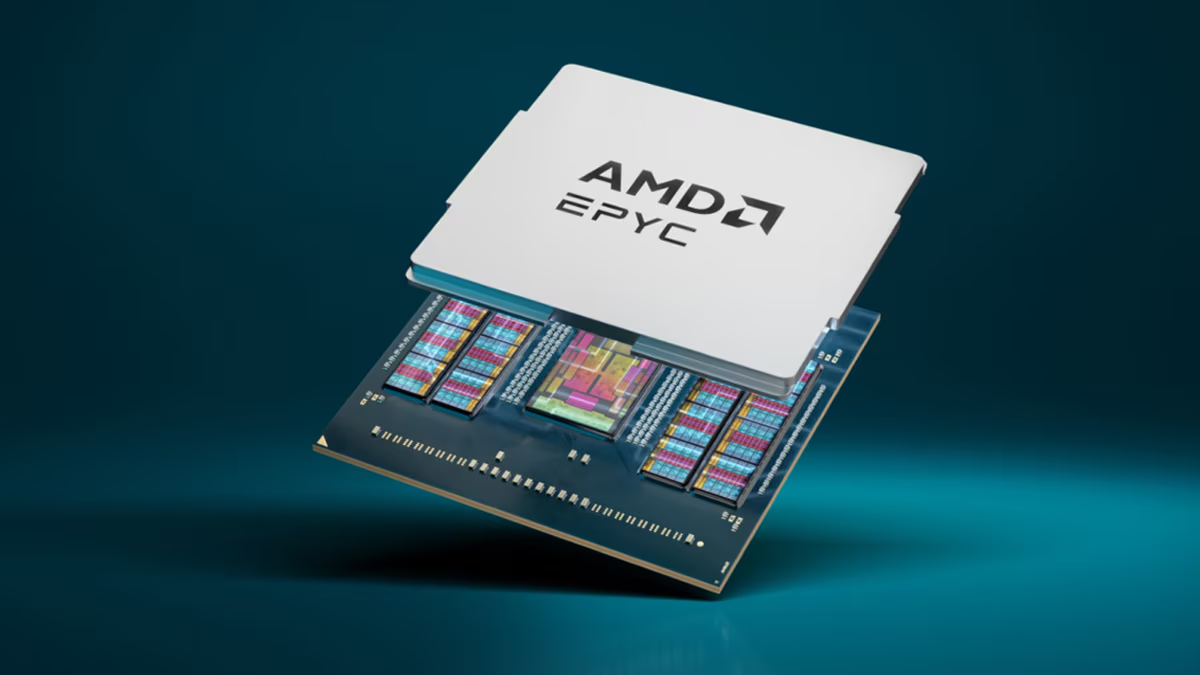
- Data center revenue hit $4.3 billion, up 22% year-over-year, driven by EPYC processor and Instinct AI accelerator demand from OpenAI, Oracle, and IBM
- Client and gaming segments delivered $4 billion in combined revenue, up 73% year-over-year with record Ryzen processor sales
- Management guided Q4 revenue to approximately $9.6 billion with a 54.5% gross margin
Management’s Promise:
Last quarter, management projected 25% year-over-year revenue growth for Q4 with continued margin expansion. This report will show whether data center momentum sustained through year-end.
Analyst Optimism Heading Into Results
HSBC Securities raised its price target to $335 from $300 on February 3, citing structural acceleration in server CPU demand driven by agentic AI workloads. The firm highlighted AMD’s superior manufacturing partnerships and product cadence as competitive advantages.
Zacks Investment Research noted AMD’s 107.1% one-year stock performance versus NVIDIA’s 63.8%, suggesting the company is rapidly closing the gap in AI accelerators while maintaining a more diversified business model.
The average analyst price target sits at $289.23, implying 17% upside from current levels. Of 53 analysts covering the stock, 41 rate it Buy or Strong Buy with zero Sell ratings.
What Could Move the Stock
Bull Case Triggers:
- EPS above $1.40 with full-year 2026 guidance exceeding $6 per share
- Data Center revenue surpassing $4.5 billion would signal accelerating AI infrastructure adoption
- Management commentary on MI500 series GPU ramp and OpenAI partnership expansion
Bear Case Triggers:
- Revenue miss below $9.4 billion, particularly weakness in Data Center segment
- Gross margin compression below 54% due to competitive pricing or product mix
- Cautious 2026 guidance reflecting concerns about AI spending slowdown or China export restrictions
The Wild Cards:
- Recent OpenAI partnership announcement and cloud expansions with Oracle and IBM could drive upside guidance surprises
- Broader concerns about AI infrastructure spending persist after mixed reactions to Microsoft and Meta earnings
- China export restrictions remain a revenue headwind that management must address
Market Expectations Signal Confidence
The options market is pricing in significant movement. Prediction markets show a 91.5% probability that AMD will beat consensus estimates, based on $15,362 in total trading volume. This represents strong crowd confidence, though it raises the bar for what constitutes a positive surprise.
The Metric That Really Matters:
Analysts are laser-focused on data center revenue growth. Sustaining momentum above $4.3 billion while expanding into new AI workloads will determine whether AMD can justify its premium valuation. A print below $4.2 billion would raise concerns about competitive pressure from NVIDIA, while exceeding $4.5 billion would validate the thesis that AMD is gaining meaningful AI accelerator market share.
Valuation Context
AMD trades at 37.31x forward earnings, a premium to the semiconductor sector average but justified by 60.3% YOY earnings growth. The company’s PEG ratio of 0.51 suggests the growth rate supports current multiples, though any guidance disappointment could trigger multiple compression.
AMD has delivered consistent execution in recent quarters, and this report will test whether management can sustain data center momentum while navigating competitive and regulatory headwinds. With shares near 52-week highs, investors are pricing in continued AI infrastructure strength. The key question: Can AMD prove its diversified approach to AI computing is winning share from both NVIDIA and Intel?






 Top Gaining Stocks
 Top Losing Stocks