



Once upon a time, horse-drawn carriages were the primary means of transportation for those who did not ride horses themselves. The use of horse-drawn carriages lasted for approximately 3,500 years until the invention of the automobile. Since then the horse-drawn carriage has been reduced to a quaint reminder of an earlier time, but an otherwise impractical mode of transportation in the modern age.
The advent and rapid development of Artificial Intelligence (AI) is now threatening the Software as a Service (SaaS) industry. Although perhaps not to the same degree, AI is nevertheless spooking investors away from a number of SaaS companies with functions apparently easily replicated and replaced by more comprehensive computing power. Especially vulnerable are Business Development Companies (BDCs), many of whom have significant direct investments in and/or financing deals in place with SaaS companies. The SaaS sector has been hit so hard of late that Jeffries has coined the mass selloff as the “SaaSpocalypse”.
The following SaaS stocks have been especially hard hit as a result of AI and investor selloffs:
- Asana Inc. (NYSE: ASAN | ASAN Price Prediction): down -59.28% for 1 year, -92% from all-time high
- Docusign Inc. (NASDAQ: DOCU): down -51.58% for 1 year, -85% from all-time high
- ServiceNow Inc. (NYSE: NOW): down -46.04% for 1-year, -54% from all-time high
Asana Inc.

Asana stock is down nearly 60% in 12 months but hopes that its AI adoption can reverse their downturn.
Based in San Francisco, CA, Asana Inc provides a work management platform designed to help teams organize, track, and manage their work. Asana services businesses across various industries including technology, healthcare, and education to streamline workflows. Its SaaS platform supports a wide range of functions such as product launches, marketing campaigns, and goal setting. The company announced recently that it was pivoting to accelerate its own adoption of AI with its AI Teammates and AI Studio platforms in an effort to draw investors and clients back.
Docusign Inc.

Docusign’s popularity in government, real estate, and Salesforce sectors has built its reputation, but AI threatens much of its business model with potential obsolescence.
As the most popular digital means to execute documents, Docusign has developed a large subscriber base in the real estate and US government sectors, as well as in other businesses requiring contracts and document authorizations. The ability to execute documents remotely and securely, eschewing the need to physically deliver paperwork, has been its main appeal. Beyond e-signatures, it offers a suite of services including automated workflow for contract management, agreement generation within Salesforce, and secure signer identification. DocuSign’s Agreement Cloud combines contract lifecycle management, document generation, and workflow automation to streamline agreement processes from initiation through execution and storage.
Although Docusign is also in the process of developing its own AI platform, analysts and investors alike are not convinced. Wedbush, UBS, JP Morgan, and RBC have all cut their ratings and forecasts for Docusign, and the company’s CEO, Allan Thygesen, personally sold $1.87 million worth of shares in the past 90 days.
ServiceNow Inc.
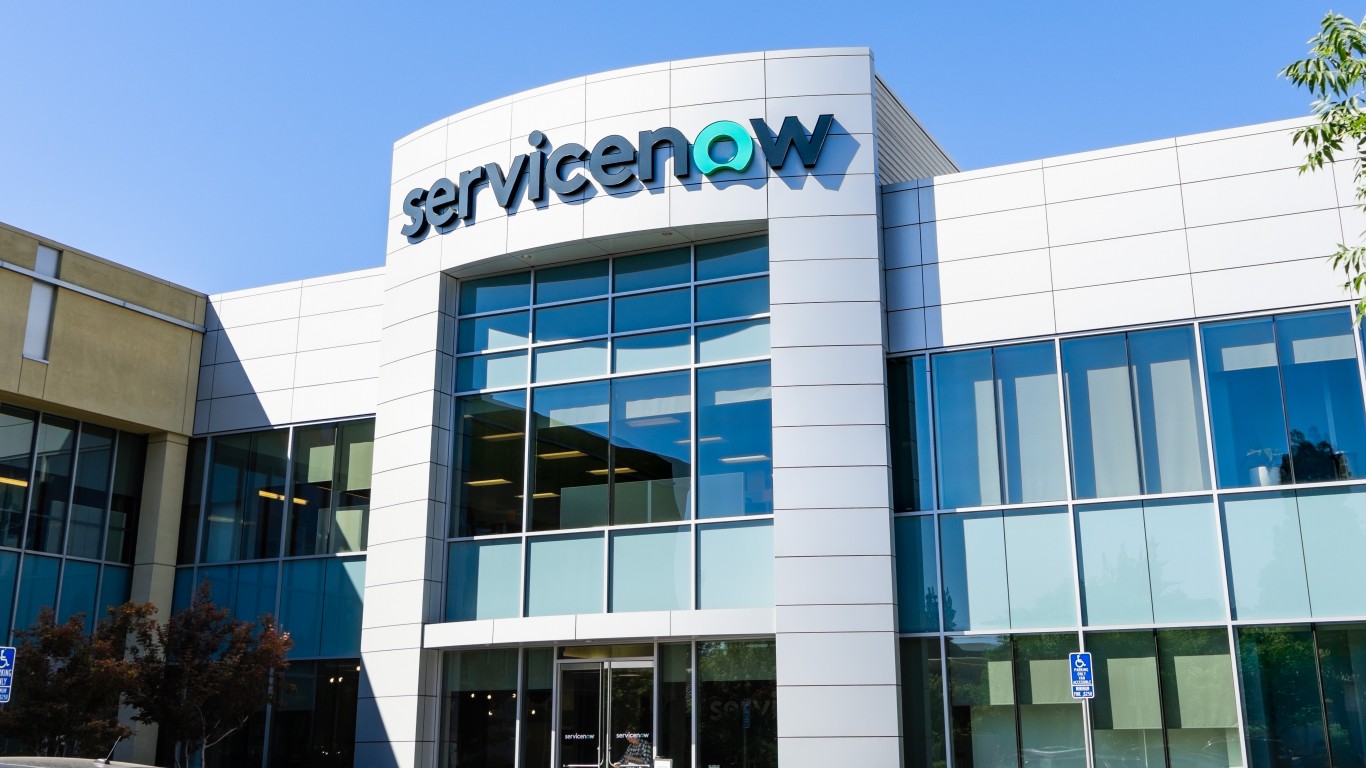
ServiceNow has already incorporated AI and machine learning basics into its Now platform, which may help it weather the SaaSpocalypse.
Santa Clara, CA headquartered ServiceNow has already incorporated AI elements and machine learning into its Now platform process automation. ServiceNow streamlines operations across various domains including IT, risk management, customer service, and human resources, making it a go-to for industries like government, healthcare, and finance.
The company recently announced new collaborations with OpenAI and Anthropic. Another bright note was the company’s most recent elevated guidance for 2026 subscriptions and a $5 billion share buyback program.
The BDC Time Bomb

While the BDC industry and private credit has been an impressively lucrative business, the sector’s 20% exposure to the SaaS industry may put it at as high as a 13% default risk.
The BDC industry has a sizable exposure to SaaS companies. Between direct equity investment, private debt financing contracts and in some cases, as venture capital, the BDC industry is estimated to have a roughly 20% exposure to SaaS, according to Barclays. UBS believes that should AI create an “aggressive disruption”, the private credit sector could see as high as a 13% default rate, most of it coming from software companies.
Ares Capital, Horizon Technology Finance, Blackstone, and Blue Owl are among those BDCs at a particular high exposure risk.
The fact that much of AI is also being developed with Magnificent 7 companies is placing huge financial resources behind its proliferation. With some exceptions to be covered in an upcoming article, a lot of SaaS firms may be in danger of becoming 21st century horse-drawn carriages unless their respective AI adoptions allow them to remain in the game.











 Top Gaining Stocks
 Top Losing Stocks